The Big Picture
Today the Technology sector showed both momentum and friction. On the upside, major players pushed forward on AI: Meta introduced Muse Spark as part of a larger model overhaul, and Anthropic launched Claude Managed Agents in public beta to help developers deploy AI agents at scale.
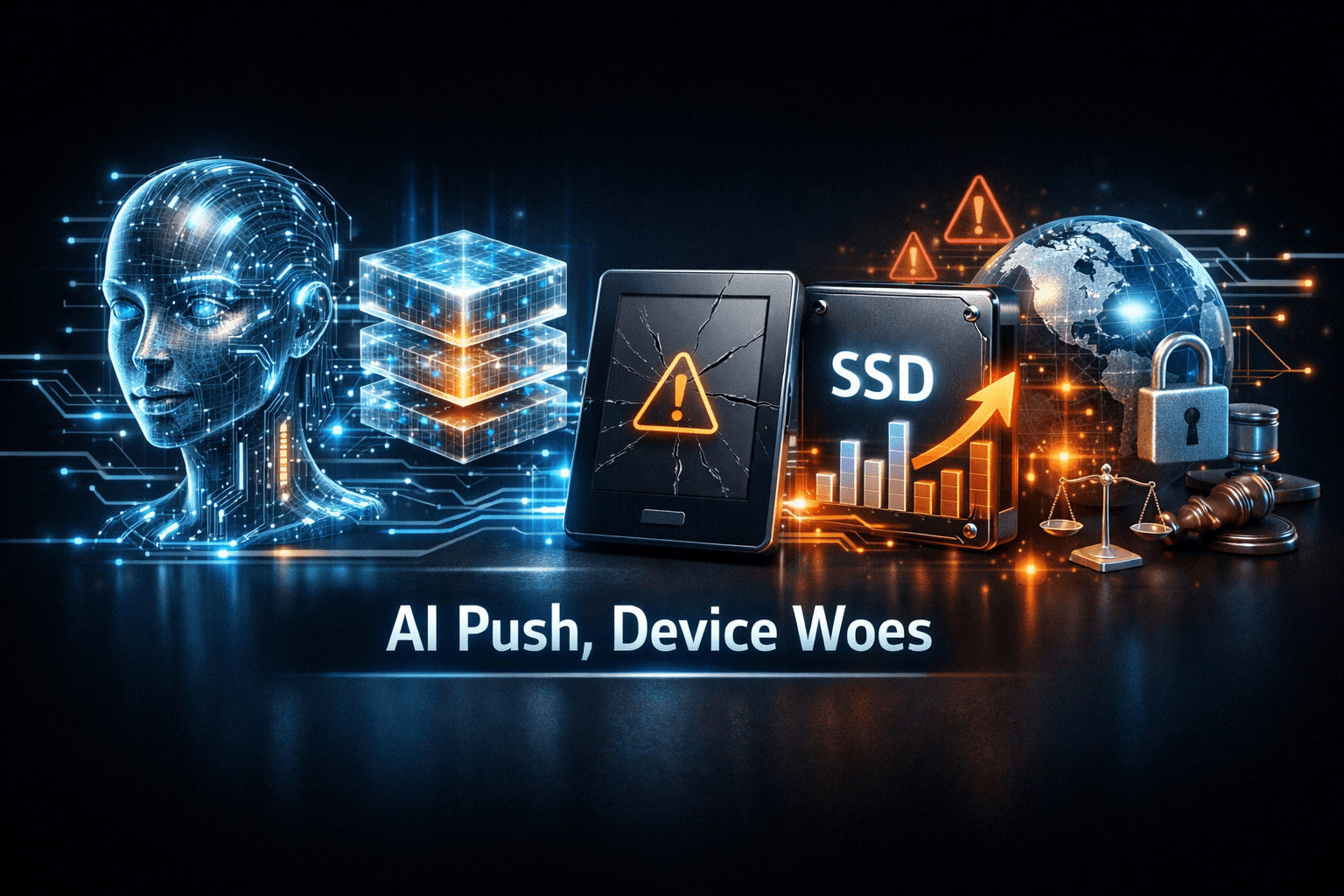
At the same time, consumer and infrastructure stories highlighted growing pains. Amazon is ending support for older Kindles, SSD prices have spiked amid an AI-driven memory race, and security and regulatory risks surfaced with a hack-for-hire campaign and Greece proposing a social media ban for children under 15.
Market Highlights
Here are the quick facts you need from today's headlines and how they touch major names.
- $META, Meta Platforms: unveiled the Muse Spark model, part of a ground-up AI overhaul under Superintelligence Labs.
- Anthropic: announced Claude Managed Agents, now in public beta, aimed at lowering barriers for businesses building AI agents.
- $AMZN, Amazon: told Kindle owners that e-readers from 2012 and earlier will lose official support, affecting access to new content.
- $AAPL, Apple: indirectly referenced through reporting of iCloud-targeted spyware and broader device security concerns tied to Android and iCloud backups.
- $WDC, Western Digital and storage market: SSD prices have surged, with the WD Black SN850X 2TB cited as rising from about $173 in 2024 to roughly $649 today, a near quadruple move since November 2025.
- Pebblebee Halo: new personal-safety tracker with a 130dB siren and strobe light captured attention as an AirTag alternative.
Key Developments
AI Race Intensifies: Meta and Anthropic Move Faster
Meta released Muse Spark as part of an overhaul led by its Superintelligence Labs, signaling renewed product focus. Anthropic's Claude Managed Agents launched in public beta, offering an agent harness and developer tools to scale AI agents for enterprise use.
These moves suggest enterprise demand and tooling for AI remain a central growth story for the sector, and they make it easier for businesses to adopt agent-based AI. Will developers and enterprises follow quickly enough to offset other headwinds? That's the question industry watchers will be asking.
Device Friction: Kindle Support Ends and Workarounds Multiply
Amazon said devices released in 2012 or earlier will no longer be supported, which effectively blocks new content delivery on those Kindles. Readers and resale markets are reacting, and coverage surfaced rapid workarounds, including EPUB-to-Kindle conversion guides and jailbreak instructions that aim to keep older hardware usable.
For you that means more vendor control at one level, and a community-driven response at another. It's a reminder that product lifecycle decisions can have second-order effects on customer goodwill and resale demand.
Hardware and Security Strains: Storage Prices and Spyware
Storage prices climbed sharply, with the WD Black 2TB example illustrating how a shortage in AI RAM and related components can cascade into SSD price inflation. That raises costs for data centers, enterprises building AI infrastructure, and consumers upgrading PCs.
At the same time, researchers exposed a hack-for-hire campaign targeting Android devices and iCloud backups, showing attackers are combining spyware with credential-phishing to breach devices. Security incidents like this can prompt faster enterprise security spending, while also driving regulatory scrutiny.
What to Watch
Looking ahead, several catalysts and risks will shape sector moves tomorrow and in the weeks ahead.
- AI product rollouts: Watch for technical deep dives, benchmarks, and enterprise adoption signals from $META and Anthropic. Developer uptake and third-party integrations are the metrics to track.
- Storage and supply: Monitor SSD price trends and vendor inventories from $WDC and other suppliers. Rising component costs could pressure margins for hardware OEMs and cloud providers.
- Device support fallout: See how consumers respond to Amazon's Kindle decision. Will resale markets and community-driven fixes blunt the impact? Will $AMZN comment further on trade-in or upgrade programs?
- Security and regulation: Follow detailed disclosures about the hack-for-hire campaign and any policy responses. Also track EU reaction to Greece's social media ban proposal, which could influence platform moderation and compliance costs for $META and other social platforms.
- Upcoming earnings and events: Expect investor focus on AI-related guidance when large-cap tech reports next. You should watch for capex plans and software monetization updates tied to generative AI.
Bottom Line
- AI momentum remains a clear growth driver, shown by new models and developer tooling from Meta and Anthropic, but adoption and integration will determine near-term impact.
- Hardware bottlenecks and price inflation in SSDs reflect strong demand but add cost pressure for infrastructure and consumers.
- Consumer-facing moves, like Amazon ending support for older Kindles, can erode goodwill and spur community-led workarounds that you should track.
- Security incidents and potential regulation are active risk vectors that may increase compliance and security spending across the sector.
- Overall it's a mixed bag, so stay selective and watch adoption signals rather than headlines alone.
FAQ Section
Q: What does Meta's Muse Spark mean for AI competition? A: Muse Spark signals renewed competitive investment in proprietary models and infrastructure, which could accelerate feature rollouts and enterprise partnerships.
Q: If my Kindle is older than 2012, can I still read books? A: Official support ends for devices from 2012 or earlier, but guides on converting EPUB files and community jailbreaks exist that can restore functionality at your own risk.
Q: Are SSD price increases permanent? A: Price moves are tied to supply and demand for memory and AI-related components. Prices could ease if supply catches up, but near-term inflation in storage is likely to persist while AI capacity grows.