The Big Picture
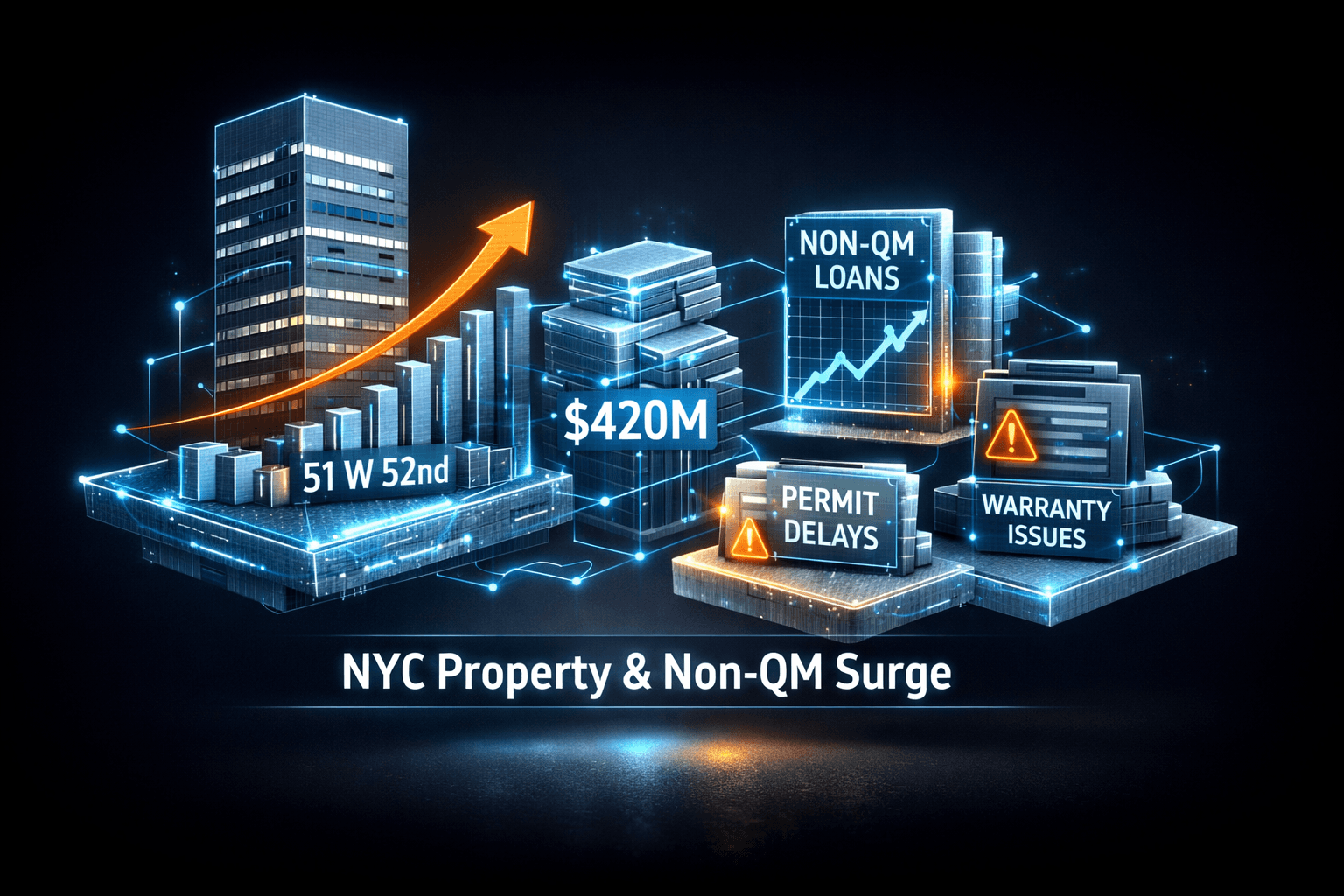
Commercial and residential real estate are sending mixed signals this morning, with targeted stabilization in Midtown Manhattan and renewed momentum in mortgage securitization offset by persistent policy and data challenges. A $420 million CMBS loan tied to 51 West 52nd Street has exited special servicing after a sponsor-led extension, and Bank of America projects a large ramp in non-QM securitization capacity, but researchers and industry groups are flagging permitting bottlenecks and measurement gaps that could keep project timelines and risk perceptions elevated.
Why does this matter to you? These stories affect liquidity and risk pricing across office assets, mortgage-backed paper, and new development pipelines. They also suggest you should be selective about which segments of real estate you follow closely this quarter.
Market Highlights
Quick facts and scale for today's top items. These are the tangible details to file away before the open.
- 51 West 52nd Street, a 38-story Midtown office tower with about 893,000 square feet, saw its $420 million CMBS loan exit special servicing after Harbor Group International closed an extension.
- Rolex Building at 665 Fifth Avenue will open this fall, a 30-story, 165,000-square-foot boutique office tower that replaces a 1924-era 12-story building on a high-profile Midtown site.
- Bank of America Securities, part of $BAC, projects up to $100 billion in potential non-QM securitization issuance after a record $20.9 billion of non-QM RMBS in Q3 2025.
- Researchers tracking 1.1 million permits from 2000 through 2025 say approval timelines, not construction, are the main source of delays, strengthening the case for permit shot clocks.
- Industry-wide discussion on warranty standardization warns that better measurement can initially make performance look worse, which may reduce incentives to normalize and share building-level benchmarks.
Key Developments
51 West 52nd Loan Exits Special Servicing
Harbor Group International closed an extension that allowed a $420 million CMBS loan secured by 51 West 52nd to exit special servicing. That transition is noteworthy because loans tied to large Midtown office properties have been a focal point for market stress over recent years.
The implication for investors is subtle, not sweeping. The loan move suggests selective stabilization in sponsor negotiations and creditor flexibility, which could ease pricing pressure for similar single-asset, single-borrower CMBS deals. But stress remains concentrated in older office stock and in properties with weak leasing momentum.
Non-QM Securitization: Bigger Pool Ahead
Bank of America Securities projects as much as $100 billion of non-qualified mortgage securitization issuance on the horizon, following record issuance of $20.9 billion in Q3 2025. That signals growing institutional appetite for alternative mortgage credit where traditional underwriting may not apply.
For you this means mortgage credit pools may diversify, creating new yield-bearing instruments for fixed-income allocators. It also raises questions about underwriting standards and servicing performance if originations scale rapidly.
Development Frictions: Permits and Benchmarks
Two policy and data stories add friction to the growth narrative. Researchers found permit approval delays, not construction, drive much of development timeline drag across 1.1 million permits studied from 2000 to 2025. Separately, calls for warranty standardization argue better benchmarking can initially reveal weaker outcomes, which may discourage voluntary disclosure.
These items matter because permitting speed directly affects pipeline timing and carrying costs, and uneven benchmarking hinders transparent pricing for buyers and lenders. Which reforms actually stick will shape development economics over the next several years.
What to Watch
Focus on near-term catalysts and risks that could change the tone in this sector. You'll want to track these items through the week and into earnings season.
- Office asset performance and leasing updates for Midtown towers, especially any rent rolls or lease renewals for 51 West 52nd and nearby properties.
- Follow Bank of America commentary and RMBS issuance calendars for non-QM deal flow. Watch $BAC research notes for underwriting assumptions and expected spread compression if markets absorb issuance.
- Regulatory and municipal actions on permit shot clocks, particularly in large jurisdictions. Will cities adopt hard approval timelines, and how will that change project economics?
- Industry moves toward warranty standardization. If standards gain traction, expect increased data disclosure and potential repricing for higher-risk assets.
- Credit markets' response to CMBS workouts and extensions, including special servicer activity updates. Pay attention to trading levels and repricing in single-asset deals.
How should you position information in a watchlist? Be selective. Ask whether a story affects cash flow, refinancing risk, or valuation multiples for the assets you follow.
Bottom Line
- Sector tone is mixed: stabilization in specific CMBS loans and growth in non-QM issuance contrast with structural permitting and transparency issues.
- Asset-level outcomes will matter more than broad narratives, so focus on cash flow metrics, lease activity, and servicing status for troubled loans.
- Non-QM securitization growth could expand fixed-income options, but underwriting and servicing performance deserve scrutiny.
- Permitting reforms and warranty benchmarking are policy-level levers that could materially affect development timelines and risk pricing if implemented.
- Stay selective, monitor upcoming issuance calendars and municipal policy moves, and consider how each item affects liquidity and refinancing windows for the assets you track.
FAQ Section
Q: What does a CMBS loan exiting special servicing mean? A: It means the loan is no longer handled by a special servicer because the sponsor reached an agreement, often easing immediate workout pressure but not eliminating underlying asset risk.
Q: Why is non-QM issuance important to mortgage markets? A: Non-QM expands the pool of securitized mortgage credit, offering more yield options, but it also raises the importance of underwriting quality and servicing oversight.
Q: How could permit shot clocks change development timelines? A: Shot clocks set firm review deadlines for authorities, which can cut approval times and carrying costs if enforced, but implementation detail and legal challenges will determine real-world impact.