The Big Picture
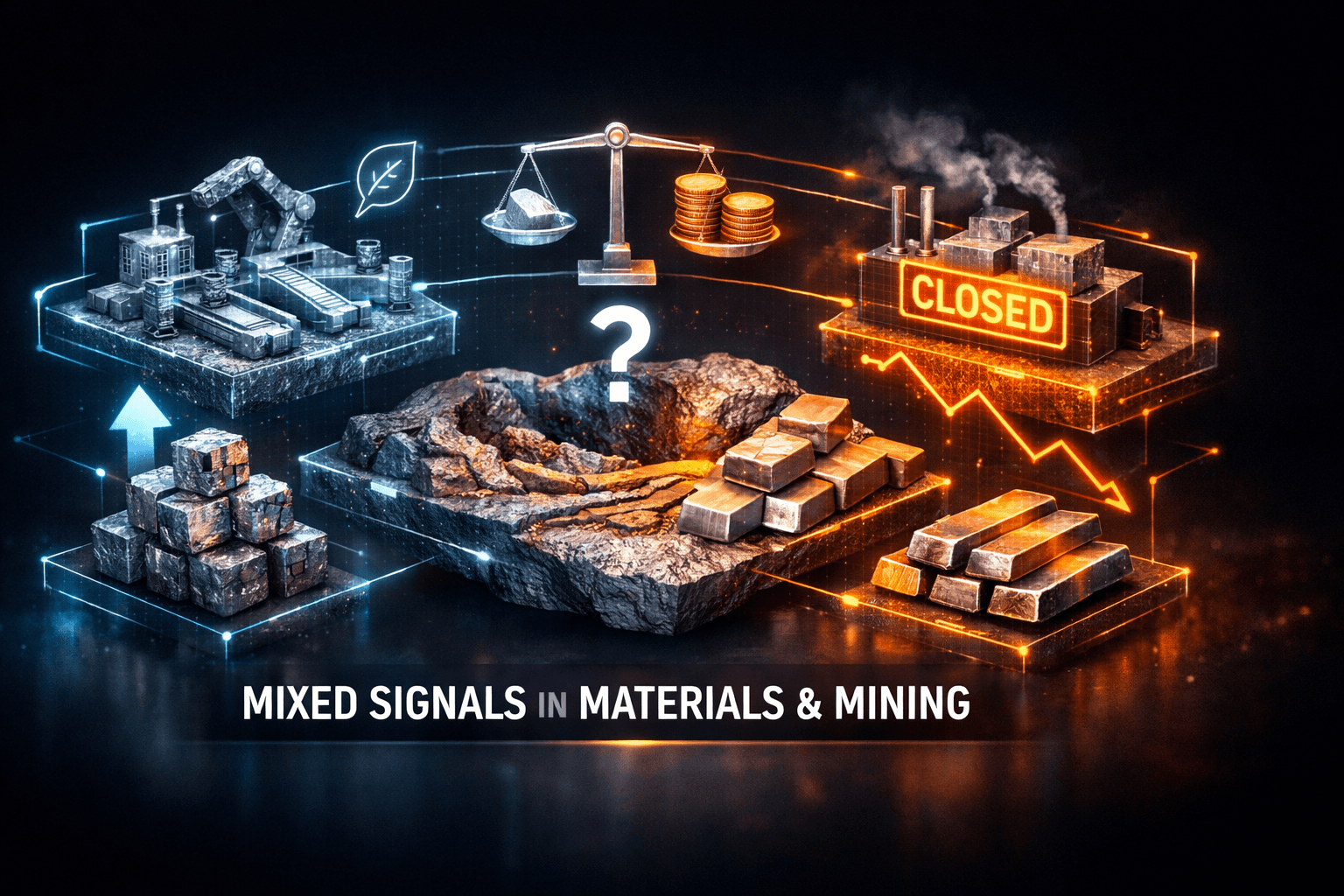
Today the Materials & Mining sector delivered mixed signals for investors, with practical operational moves on the recycling front balanced by tighter standards and an ongoing capital debate for critical minerals. You saw both an opening of a consolidated operations center and a local facility closure, while industry groups and conference speakers pushed a tougher regulatory and financing agenda.
That matters because operational efficiency and regulatory certainty both influence margins and project timelines. If you follow miners, recyclers, or suppliers, today’s developments underscore why selectivity and attention to near-term catalysts matter.
Market Highlights
Here are the quick facts and market takeaways from today’s headlines.
- Evergreen Goodwill opened a new Georgetown Operations Center, consolidating e-commerce, storage, transportation, recycling and salvage operations into one site, a move that should boost logistical efficiency.
- Clynk announced it will close its Biddeford, Maine, recycling facility, part of a broader program to realign operations, signaling consolidation in local collection networks.
- Standards and sustainability gained attention after ASTM strengthened biodegradation requirements for materials, expanding the constituents that must demonstrate biodegradability.
- A sponsored analysis on the next heavy-duty engine oil standard, termed PC-12, highlighted potential efficiency gains, though miners will be watching for evidence on durability and uptime.
- At the Canada Investment Summit, experts led by Mark Carney stressed that mobilizing private capital is essential to translate critical minerals resources into mines and processing capacity, keeping financing squarely on the industry radar.
Key Developments
Recycling consolidation and facility closures
Evergreen Goodwill’s Georgetown Operations Center centralizes multiple functions into a single location, which should reduce handling costs and speed throughput. At the same time, Clynk’s closure of its Biddeford facility is an example of local consolidation aimed at strengthening overall recycling operations.
For you that means the recycling chain is evolving, with some operators investing in scale while others trim underperforming sites. Which model wins will depend on logistics economics and local demand for reclaimed materials.
Standards tighten on biodegradation
ASTM revised D6400 to expand the range of constituents that must show independent biodegradability, raising the bar for materials that claim compostability. That change will affect manufacturers, recyclers and certification bodies who will need to validate more components under the standard.
Analysts note increased testing and compliance costs could follow, at least in the near term. If you’re tracking packaging suppliers or polymer producers, expect momentum toward reformulated products and new lab work budgets.
Efficiency standards under scrutiny in mining
The PC-12 conversation frames the next-generation heavy-duty engine oil standard as a potential source of efficiency gains. Mining operators will assess whether improved fuel efficiency translates into lower operating costs without sacrificing equipment durability or uptime.
Data suggests early promises focus on fuel and maintenance savings, but mines will judge performance by total cost of ownership. You should watch field trials and vendor validations closely.
Financing remains the central challenge for critical minerals
Voices at the Canada Investment Summit emphasized that resource endowments are insufficient without capital to build mines and processing facilities. The message was clear: public policy can de-risk projects, but banks, institutional investors and the private sector must provide the bulk of funding.
For investors, this renews focus on deal flow, permitting timelines and which projects can attract structured finance or partnerships. How capital is allocated will determine which projects move from promise to production.
What to Watch
Expect attention to fall into three areas over the coming weeks. First, operational updates and cost metrics from recyclers that are consolidating or investing in logistics will provide early signals on margin impacts. Second, follow implementation timelines and guidance from ASTM and certification bodies as companies adjust testing and product claims. Third, monitor financing announcements and project-level capital raises for critical minerals, including which banks and funds step up.
What are the near-term catalysts? Look for field trial results on PC-12 engine oil, corporate filings or company releases about site realignments, and any summit follow-up that outlines financing mechanisms or government guarantees. How fast these items move will shape sentiment tomorrow and beyond.
Bottom Line
- Recycling saw both expansion and contraction today, highlighting a sector in transition rather than a clear trend.
- ASTM’s tougher biodegradation rules raise compliance needs, which could increase near-term costs for some material producers.
- Efficiency standards like PC-12 could reduce operating costs if durability and uptime are proven in the field.
- Financing is the gating factor for critical minerals; successful projects will need a mix of public de-risking and private capital.
- Given the mixed news, take a selective approach and watch near-term operational updates and financing announcements closely.
FAQ Section
Q: How will ASTM’s changes affect recyclers and manufacturers? A: Companies will likely face more testing and validation work to prove biodegradability for additional constituents, which could raise short-term compliance costs while pushing product reformulation.
Q: Should you expect immediate cost savings from the PC-12 oil standard? A: Not immediately, mining operators will require real-world durability and uptime data before material savings are proven, so field trials are key.
Q: What would unlock more investment in critical minerals? A: Clearer risk sharing between governments and private lenders, bank and institutional commitments, and credible project-level economics are the main levers to attract capital.