The Big Picture
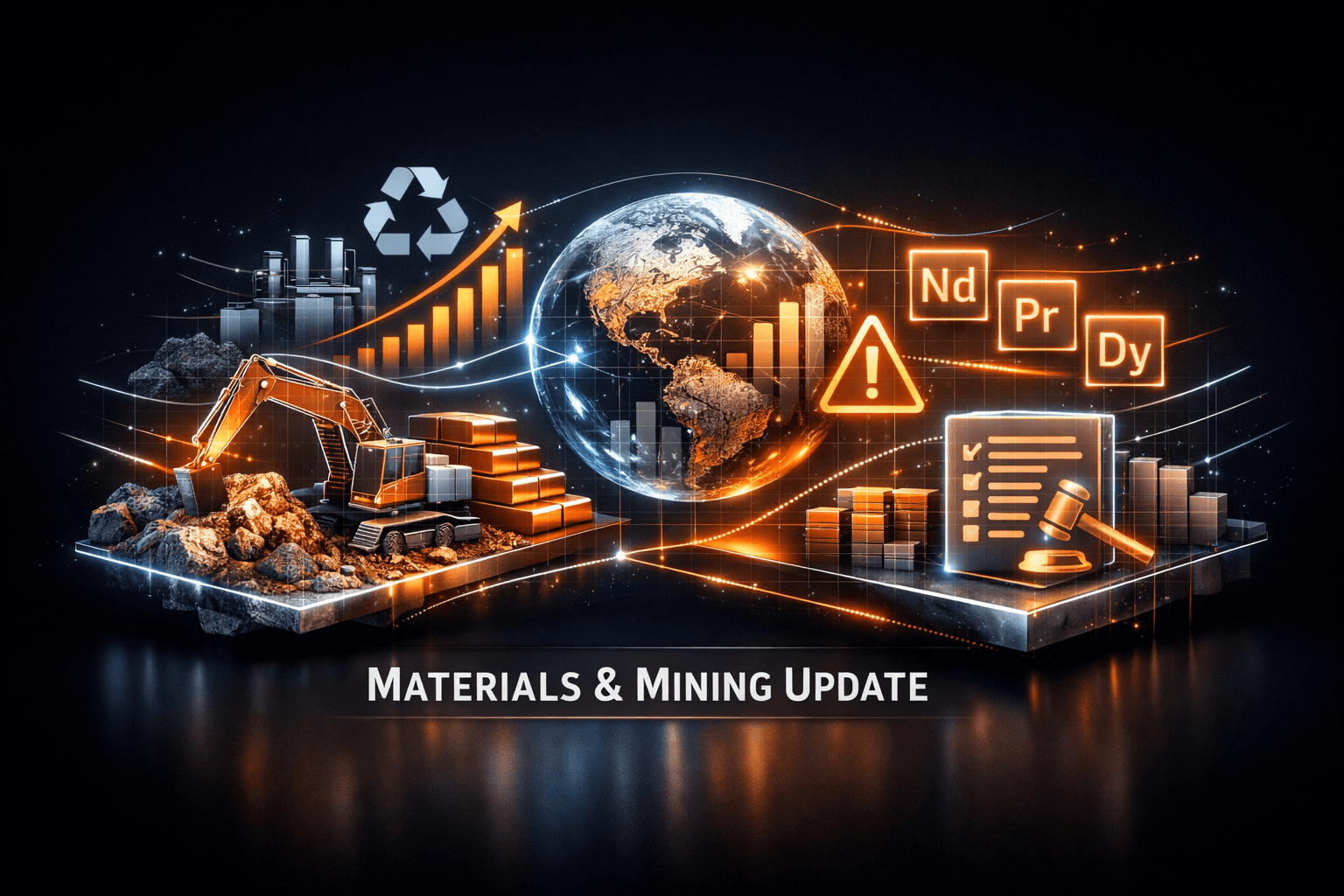
Today brought a steady stream of operational wins and industry-building moves across the Materials & Mining sector, but analysts and commentators reminded readers to separate durable advantages from hype. Equipment supply agreements, battery-collection rollouts and advisory hires point to real commercial momentum, yet rare earth coverage and a policy-focused report underscore ongoing geopolitical and execution risks that you shouldn’t ignore.
For investors, that mix means there are constructive signals on demand and supply-chain resiliency, while strategic and regulatory considerations are increasingly shaping long-term value. How you read today’s developments will depend on whether you focus on near-term contract visibility or on the tougher questions around competitive moats and national-security policy.
Market Highlights
Key facts and company-level developments from the day, presented short and sweet for quick scanning.
- Metso extended a long-term supply agreement for MX crusher wear parts used in Nordberg MP1250 crushers in South America, reinforcing aftermarket revenue visibility for the supplier.
- Sandvik secured an order from Mexican contractor Constructora Minera Villagómez, underlining demand for underground equipment in Latin America.
- Australian Rare Earths Limited, listed as $AR3, is pursuing ionic adsorption clay rare earths at its Koppamurra Project, a geological play that could matter for Western supply chains.
- Recycling and collection moves: Call2Recycle Canada launched a Québec battery collection program, and Casella announced executive leadership changes aimed at bolstering operations.
- Industry commentary and policy: InvestorNews pieces flagged rare earth investment caution and noted an acceleration of critical-minerals policy coordination among G7 nations following Chinese export controls.
Key Developments
Equipment orders and supply contracts
Metso extended a long-term parts supply deal in South America for MX crusher wear parts tied to Nordberg MP1250 crushers, while Sandvik won an underground equipment order from Mexican contractor CoMinVi. These stories reinforce two visible themes: mining contractors continue investing in replacement and expansion equipment, and aftermarket parts sales create recurring revenue streams for vendors.
For you that means suppliers to mining projects may see steadier cash flow than cyclical capex alone suggests, and small moves in equipment order flow can signal regional activity trends. Suppliers with proven service footprints should benefit first.
Rare earths: opportunity and caution
InvestorNews ran two pieces that together capture today’s rare earths debate. One profile highlighted $AR3’s pursuit of ionic adsorption clay deposits at Koppamurra, an uncommon geological setting outside Asia that could be strategically important for diversified Western supply. Another commentary urged investors to prioritize sustainable competitive advantage over catchy labels like “mine-to-magnet.”
Meanwhile a broader critical-minerals report flagged recent Chinese export controls and stepped-up enforcement, and noted the G7 response on coordination and diversification. That combination is a reminder that geology is only part of the story. You should ask whether projects have processing partners, supportive policy, and a defensible position in the value chain before treating them as long-term winners.
Recycling and leadership moves supporting circularity
Recycling-sector news showed practical progress. Call2Recycle Canada launched a Québec battery collection program addressing a rise in battery-embedded products. Casella made executive promotions and named Damian Ribar EVP and COO, while Valis Insights added former ReMA chair Colin Kelly as an advisor to help with strategic growth and business development.
These items point to two trends: first, battery collection and end-of-life management are becoming infrastructure priorities, and second, leadership and advisory hires show companies are positioning to scale. You’ll want to track how collection programs feed into downstream recyclers and whether policy or extended producer responsibility frameworks boost volumes.
What to Watch
Look for catalysts and risks that could move the sector in the near term.
- Policy and geopolitics: follow any G7 coordination announcements and China's export-control enforcement, both of which can reshape rare-earth trade dynamics and reroute supply chains.
- Project milestones: keep an eye on technical updates and permitting progress from ionic-clay rare earth projects like $AR3’s Koppamurra, and watch for processing partnerships that could validate commercial plans.
- Order flow and aftermarket demand: upcoming quarterly results from major equipment suppliers will show whether orders like Metso’s and Sandvik’s are isolated wins or part of a broader activity uptick.
- Recycling scale: monitor take-up rates for Call2Recycle Canada’s Québec program and any announced volumes or collection targets that indicate growing feedstock for domestic recyclers.
- Corporate execution: leadership changes at operations-focused companies like Casella deserve attention, because operational execution will determine whether strategic plans translate into margin gains.
What should you be asking as an investor? Which companies have real processing capability and long-term contracts, and which are still selling a concept? Those answers will matter more than headlines.
Bottom Line
- Today’s news mixes concrete commercial wins in equipment and recycling with cautionary analysis on rare earth speculation, creating balanced signals for the sector.
- Aftermarket parts and equipment orders offer visible revenue tails that can stabilize supplier cash flows; track quarterly order disclosures for confirmation.
- Ionic adsorption clay projects like $AR3’s Koppamurra could be strategically important, but investors should demand proof of processing plans and competitive moats before assigning value.
- Recycling and collection programs are scaling, which can feed domestic supply chains and reduce reliance on imports over time.
- Policy and export controls remain a wildcard; geopolitical developments could be a game changer for market access and pricing.
FAQ Section
Q: How do equipment orders affect mining supplier earnings? A: Orders signal near-term revenue and often lead to follow-on service and parts sales, improving visibility for suppliers beyond one-off capex cycles.
Q: Why is ionic adsorption clay rare earths news important? A: These deposits are rare outside Asia and could provide alternative feedstock for critical minerals if projects clear technical and permitting hurdles and secure processing partners.
Q: Will battery collection programs change supply chains quickly? A: Collection programs increase feedstock availability, but scaling recycling capacity and establishing reliable downstream processing will take time and policy support.
Investment disclaimer: This article is for informational purposes only. It does not constitute investment advice or a recommendation to buy, sell, or hold any security. Analysts note trends and data, but you should assess your own situation and consult a professional before making decisions.