The Big Picture
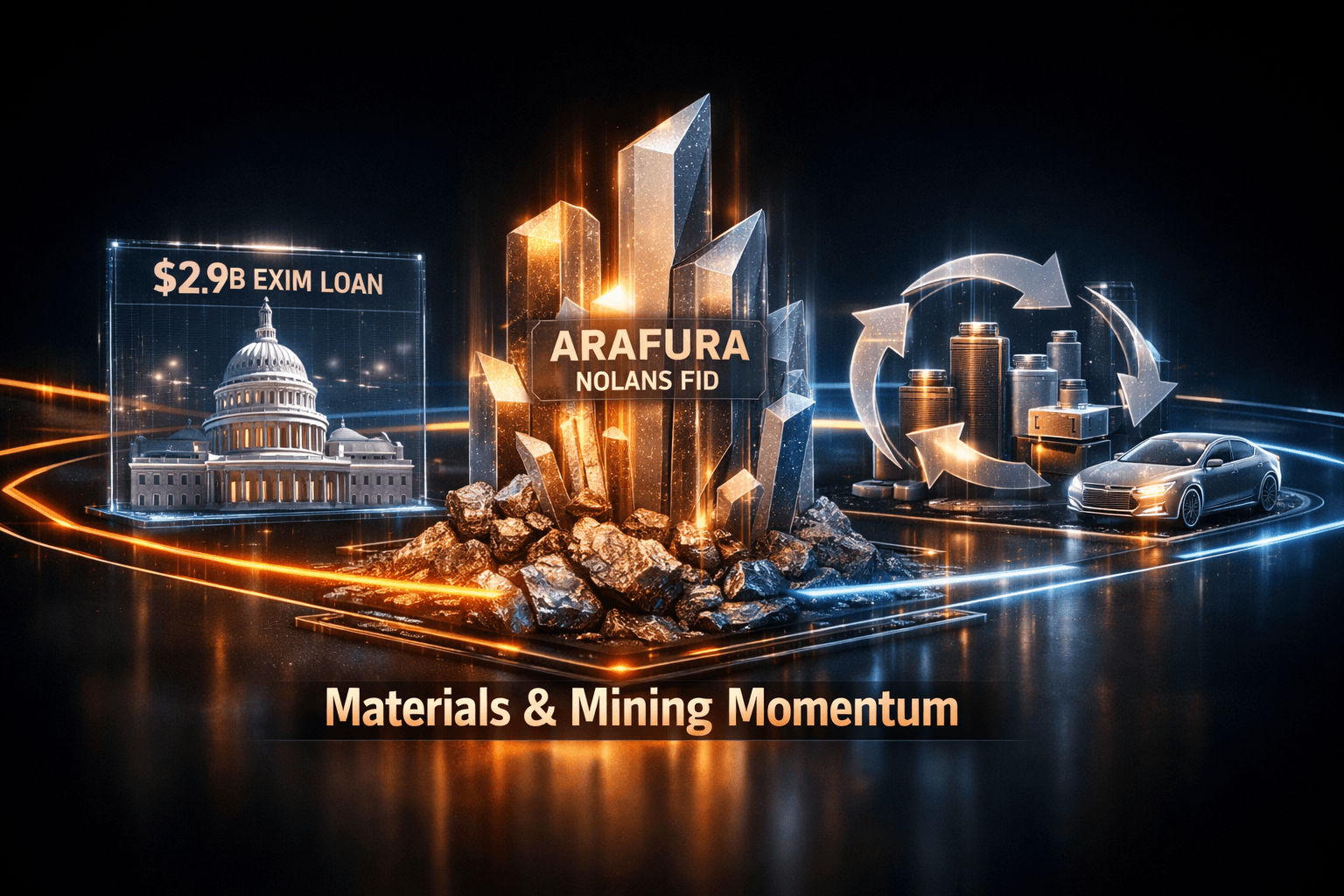
Capital flowed into major projects across the materials and mining space today, with a headline $2.9 billion EXIM loan announced for a U.S. gold project and a board final investment decision taken for an Australian rare earths mine. Those developments underline a surge in project-level support from both public and private backers, and they reinforce a shift toward securing supply chains for critical minerals.
For you, that means the sector's narrative is tilting toward execution and scale, not just exploration. Today's mix of finance, strategic stakes, and technology funding could move the needle for midstream and downstream supply chains over the next 6 to 24 months.
Market Highlights
Here are the quick facts and numbers investors watched today. These items set the tone across commodities, juniors, and project developers.
- Perpetua Resources received a $2.9 billion senior secured long-term loan from the Export-Import Bank of the United States to develop the Stibnite Gold Project in Idaho.
- Arafura Rare Earths' board approved the final investment decision to develop the Nolans Rare Earths Project in Australia's Northern Territory, aiming to create a fully integrated ore-to-oxide operation.
- Helix Resources acquired a 50% interest in the Weerianna Gold-Lithium Project in Western Australia's West Pilbara from Western Metals, expanding its exposure to lithium and gold.
- Worcester Polytechnic Institute won a $1 million U.S. Department of Energy award to develop a lithium-ion battery recycling process, signaling ongoing public investment in battery circularity.
- World Steel Association data showed global steel mill production fell year on year and month on month in April, while tight scrap supplies in Asia are prompting new primary aluminum export approaches from China.
Key Developments
Perpetua EXIM loan secures Stibnite project
The Export-Import Bank of the U.S. granted Perpetua Resources a $2.9 billion senior secured long-term loan to fund development of the Stibnite Gold Project in Idaho. This is one of the largest single-project financings reported for a U.S. gold project in recent years, and it shows lender appetite for projects that can demonstrate U.S. supply chain or strategic benefits.
Implications: Access to long-term capital reduces execution risk and improves project bankability. You should watch permitting milestones and offtake or processing partner announcements, because they will shape the timetable for cash flow generation and potential downstream contracting.
Arafura final investment decision on Nolans
Arafura Rare Earths announced its board has taken a final investment decision to develop the Nolans Rare Earths Project, an integrated ore-to-oxide operation in the Northern Territory. That kind of integrated approach aims to capture more value domestically rather than exporting concentrates for overseas processing.
Implications: The FID suggests supply chain security for magnet and EV-related rare earths is being prioritized. For you, that raises the profile of companies tied to permanent magnets, clean-energy manufacturing, and governments that want domestic processing capacity.
Battery, lithium and critical minerals activity
Activity clustered around batteries and critical minerals today. Helix Resources' 50% stake in the Weerianna Gold-Lithium Project gives it a foothold in a West Pilbara asset with both gold and lithium potential. Academic and public support continues too, with Worcester Polytechnic Institute receiving a $1 million DOE award to develop a lithium-ion battery recycling process. On the exploration front, Quantum Critical Metals highlighted a gallium-cesium discovery in Quebec, showing juniors are still advancing specialty critical mineral targets.
Implications: You're seeing a pipeline that covers the full lifecycle, from discovery through recycling. That mix helps reduce long-term supply risk for battery manufacturers, but it also means near-term value creation will depend on successful pilot projects, permitting, and scalable processing solutions.
What to Watch
Keep an eye on near-term milestones that will confirm today's momentum. Who gains permits, who lines up offtake, and who moves from FID to construction will matter most to markets over the next 6 to 12 months.
- Earnings and updates: Watch quarterly updates from listed developers tied to rare earths and lithium, they may provide construction timelines or revised capex figures.
- Permitting progress: For Stibnite and Nolans, environmental approvals and community agreements will be key gating items. Any delays could change project financing requirements.
- Recycling and feedstock trends: The DOE-funded WPI project and tight scrap availability in Asia make battery recycling and primary aluminum flows an area where policy and cost shifts can change margins quickly.
- Commodity prices: Moves in rare earth oxide prices, lithium carbonate, and aluminum spreads will influence development economics and investor sentiment. Where will capital flow next, to greenfield projects or to recycling and processing?
- Junior discoveries: Keep tabs on drill results from critical minerals juniors, because new specialty finds like gallium or cesium can attract strategic partners or M&A interest.
Bottom Line
- Major financing and FID news pushed the sector toward execution rather than concept today, and that supports a bullish outlook on project development momentum.
- Battery and critical minerals received meaningful attention from both public funding and corporate deals, suggesting supply chain resilience is becoming a priority.
- Demand signals were mixed, with global steel output down in April and aluminum scrap tightness creating regional shifts in primary exports.
- Near-term risks include permitting delays, commodity price swings, and execution on engineering and construction, so watch milestone updates closely.
- For your portfolio or watchlist, focus on project delivery timelines, financing structures, and companies that control downstream processing, because those factors will determine who captures value.
FAQ Section
Q: What does the EXIM loan mean for the Stibnite Gold Project? A: The $2.9 billion EXIM loan provides long-term financing that improves the project's bankability and supports moving from development to construction phases.
Q: How important is Arafura's Nolans FID for rare earth supply? A: The FID is notable because Nolans aims to be an integrated ore-to-oxide operation, which can reduce reliance on overseas processing and support magnet and EV supply chains.
Q: Will the WPI recycling project change lithium supply economics? A: The $1 million DOE award funds research that could improve recycling yields and reduce reliance on primary extraction, but commercial impact will depend on successful scale-up and cost competitiveness.