The Big Picture
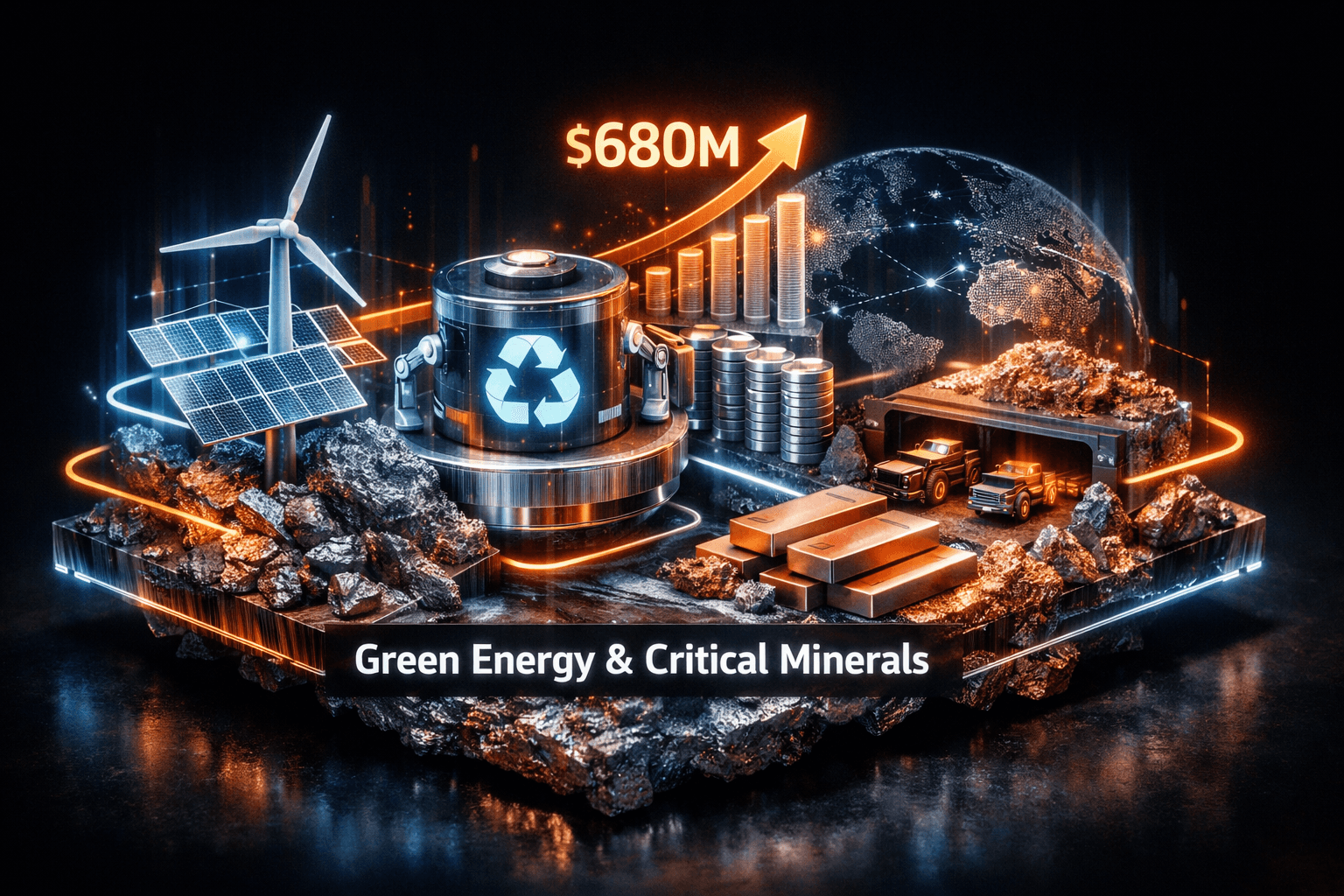
Large-scale capital commitments and strategic coordination led headlines in Materials & Mining today, signaling momentum across green energy, critical minerals intelligence, and recycling. Fortescue’s $680 million Pilbara green energy expansion and the Critical Minerals Institute’s new partnership and board reinforcement stood out as the most impactful developments for markets and supply chains.
These moves matter because they link capital, policy and operations. If you follow sector flows, you’ll want to pay attention to how project spending, market intelligence and funding for recycling alter access to critical inputs and the downstream industries that depend on them.
Market Highlights
Here are the quick facts and market-moving numbers you should note from today’s news stream.
- Fortescue, $FMG, committed $680 million to expand green energy infrastructure in the Pilbara region of Western Australia, a major resource hub.
- Ace Green Recycling secured $32 million in purchase agreements tied to its SPAC, backing battery recycling technology scaling and commercial traction.
- Global lead output rose marginally by 0.7% in 2025 to 4.575 million tonnes, with further increases expected in 2026 as ramps and expansions come online.
- Leviathan Metals completed a helicopter-borne EM survey at its Central Project in Botswana with 300 meter line spacing, advancing project de-risking work.
- The Critical Minerals Institute announced a strategic partnership with the Perth Critical Minerals Platform and appointed Alister MacDonald to its board, extending its reach into Western Australia and policy circles.
Key Developments
Fortescue’s $680m Pilbara green energy push
Fortescue’s sizable investment in Pilbara renewables aims to expand the region’s green power and decarbonization infrastructure. For companies and suppliers, that’s a potential multi-year demand signal for construction services, contractors and renewable equipment providers.
Analysts note the move reinforces Australia’s role as a resource and energy transition hub, and it could tighten competition for skilled labor and grid-connected capacity in the near term. What does that mean for your exposure to related suppliers and energy stocks?
Critical Minerals Institute expands reach and board depth
The CMI’s partnership with the Perth Critical Minerals Platform and the appointment of Alister MacDonald strengthen market intelligence and policy links in Western Australia. Tracy Hughes framed the tie-up as a way to give industry and capital better intelligence in a shifting geopolitical environment.
This is a shot in the arm for coordinated policy and capital allocation on critical minerals. Better intelligence can reduce execution risk for projects, and it may influence where you see capital flow as supply chains are reshaped.
Recycling, funding, and operational surveys move projects forward
Ace Green Recycling’s $32 million in purchase agreements tied to its SPAC suggests private capital is still lining up behind battery recycling technology. That’s important for long-term supply security of battery metals and for the economics of circular supply chains.
Meanwhile, Leviathan Metals’ completed EM survey in Botswana and the incremental rise in global lead output signal ongoing exploration and near-term production gains. You’ll want to track how survey results translate into drilling and resource updates.
What to Watch
Expect a busy news calendar next week as project-level updates, regulatory consultations and events fill in the picture. Key catalysts and risks to track are below.
- CMI Summit and presentations, including Defense Metals’ $DEFN talk at CMI Summit 5 on May 13 and 14, will showcase bankability criteria for rare earth projects and could shift capital allocation priorities.
- Fortescue execution milestones and permitting updates for the Pilbara green expansion will be critical to timing and cost outcomes, so watch for project schedules and contractor awards.
- EPA’s interim guidance on PFAS destruction and disposal is out for comment. Changes to disposal rules could affect remediation and recycling costs for firms handling PFAS-contaminated streams.
- Follow Ace Green Recycling’s commercialization schedule and any SPAC or financing disclosures, which will clarify the timeline for capacity buildout and revenue flow.
- Exploration follow-ups from Leviathan’s EM survey, including drill targeting and assays, will determine whether the survey converts into a resource that impacts the Kalahari Copper Belt outlook.
Which of these developments will most affect your holdings? You’ll want to watch near-term execution and regulatory signals closely, because they tend to move valuations quickly.
Bottom Line
- Capital and coordination are trending up across green energy, critical minerals policy, and recycling, which supports a constructive sector backdrop.
- Fortescue’s $680 million commitment in Pilbara is a tangible spending program that could create multi-year demand for contractors and green equipment suppliers.
- CMI’s partnership and board additions should improve market intelligence and reduce policy uncertainty for projects in Western Australia.
- Battery recycling funding and lead production ramps indicate supply-side responses to electrification and legacy metal markets are underway.
- Keep an eye on execution risk and regulatory changes, since project delays or tougher disposal rules can alter economics quickly.
FAQ Section
Q: How will Fortescue’s $680m investment affect the Pilbara and project contractors? A: The investment should boost demand for renewables construction and grid work in the Pilbara, with contractors and equipment suppliers likely to see higher activity during project execution.
Q: What does the CMI partnership with PCMP mean for critical minerals projects? A: The partnership expands market intelligence and policy connectivity in Western Australia, which may lower some development risk and sharpen capital allocation decisions across the sector.
Q: Should I expect immediate supply improvements from recycling and lead production news? A: Data suggests gradual supply improvements, with recycling financing and project ramps contributing over months to years rather than delivering immediate large volume shifts.