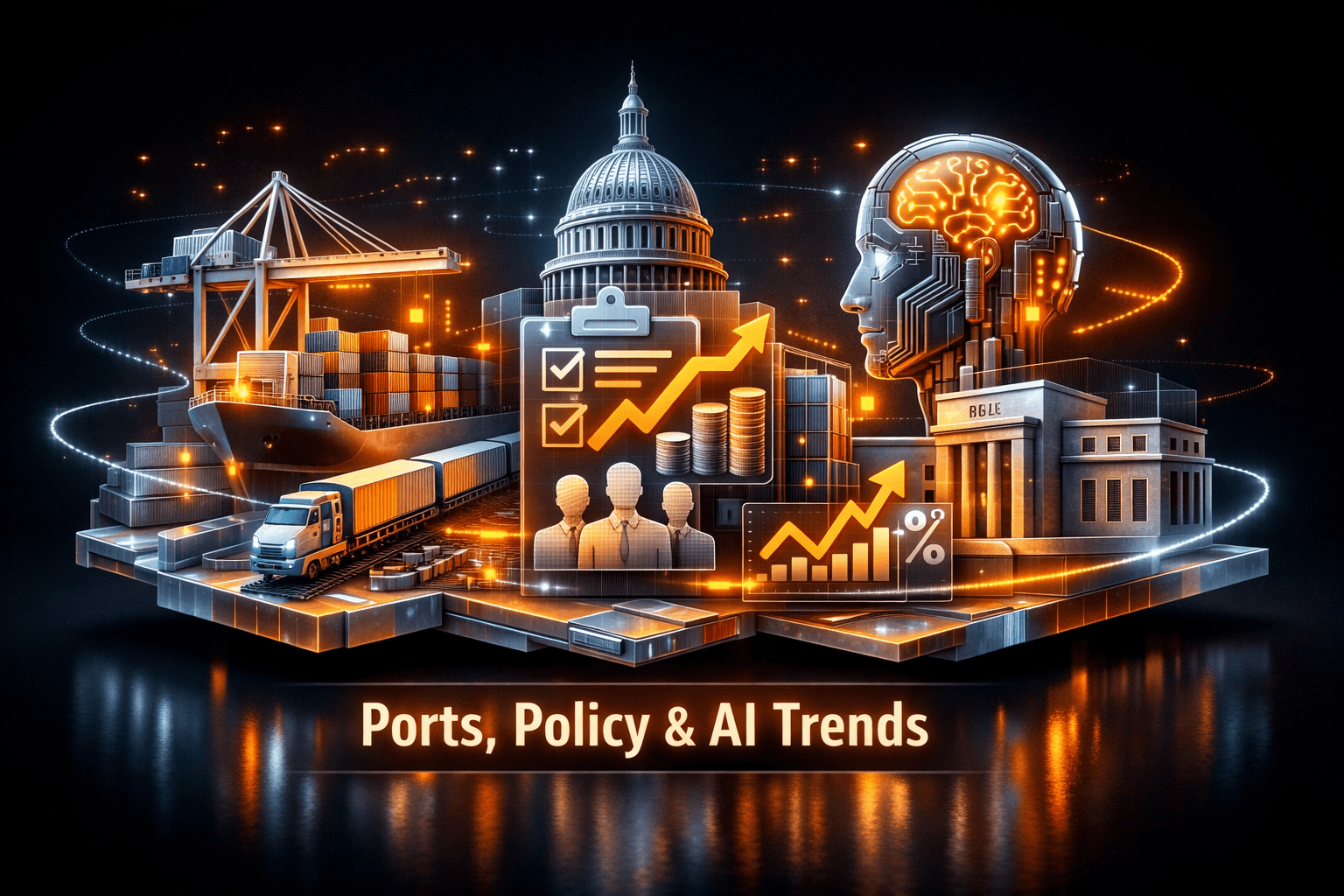
The Big Picture
Overnight developments reinforce an industry in active reshaping, with trade policy, logistics expansion and workforce investments leading the headlines. You should note that these moves address persistent supply chain bottlenecks and long-term capacity, even as macro policy tightens financial conditions.
Taken together, the announcements suggest momentum in operational improvements and decarbonization incentives, while the Federal Reserve's 25 basis point rate hike keeps financing costs and capital allocation squarely in investors' view.
Market Highlights
Quick facts and numbers from today's key stories, useful if you're scanning for what matters before the open.
- CBP tariff processing: U.S. Customs and Border Protection will expand processing of IEEPA tariff entries beginning Oct 6, making certain finally liquidated entries eligible for reimbursements.
- Ports and rail: South Carolina Ports and $NSC Norfolk Southern added daily intermodal service to Huntsville, Alabama, extending connectivity to Middle Tennessee and nearby markets.
- Zero-emission incentives: San Pedro port authorities proposed payments of up to $36,000 per year for qualifying zero-emission trucks operating in the port complex.
- Workforce investment: Four states, including New York and Illinois, launched manufacturing training facilities or expanded programs to boost the pipeline of skilled workers.
- Monetary policy: The Fed raised its main interest rate by a quarter point, 25 basis points, citing stubborn inflation, a near-term headwind for capital-intensive firms.
Key Developments
CBP expands IEEPA tariff reimbursements, effective Oct 6
The Commerce-linked move will let more finally liquidated entries be considered for reimbursements under IEEPA processes starting Oct 6. That change can improve cash flow for import-heavy manufacturers and distributors by opening a broader path to recover duties paid in prior periods.
For you, that means customs-related working capital may ease for affected firms, and balance sheet timing could improve for companies with heavy import exposure.
Ports and logistics widen network, with environmental incentives
South Carolina Ports and $NSC Norfolk Southern's new daily intermodal run to Huntsville increases inland reach for the Port of Charleston, helping shippers access Middle Tennessee and nearby manufacturing hubs more efficiently. Efficient intermodal links often lower landed costs and speed inventory turns.
At the same time, San Pedro port operators are proposing incentives up to $36,000 per year for qualifying zero-emission trucks. Will those payments accelerate truck electrification in port drayage fleets? If uptake rises, you could see emission-related cost tails shrink for shippers that move through the complex.
Workforce and technology: training and AI shape the future shop floor
State-level workforce initiatives in New York, Illinois, New Mexico and Ohio aim to expand training pipelines through new facilities and school partnerships. Labor availability has been a limiting factor for capacity growth, so these programs are a step in the right direction for long-term productivity.
Meanwhile, manufacturing leaders at the International Manufacturing Technology Show debated AI's next phase, with one executive saying, we're going to stop talking about AI. The tone suggests AI is moving from novelty to integration, which could mean steady adoption in predictive maintenance, production optimization and supply chain planning.
What to Watch
Here are the catalysts and risk factors that could move stocks and operations in the coming weeks. Ask yourself how each item affects the companies you follow and your exposure.
- Implementation timeline for CBP reimbursements. Watch for agency guidance and claim-processing cadence after Oct 6. Faster reimbursements would ease cash flow for importers.
- Port incentive rollout details. Track eligibility rules and timelines for the San Pedro truck program. Adoption rates will determine how quickly emissions and operating costs change for drayage fleets.
- Intermodal volumes and pricing. Monitor volume reports from South Carolina Ports and $NSC service performance data to see if new rail runs materially lower terminal congestion.
- Workforce metrics. Look for enrollment and placement statistics from the new state facilities. Gains here should bolster capacity over the medium term.
- Fed policy and borrowing costs. The 25 basis point hike raises the cost of capital. If the Fed signals additional tightening, capital spending or margin plans at manufacturers could be revised.
Bottom Line
- Operational catalysts dominate today's headlines, with port expansion, intermodal links and workforce programs likely to improve supply chain efficiency over time.
- Trade-policy adjustments from CBP on tariff reimbursements should help import-dependent manufacturers with working capital starting Oct 6.
- Decarbonization incentives at San Pedro could speed EV truck adoption, but watch the program's uptake and eligibility details.
- AI is moving from discussion to deployment, potentially lifting productivity, though benefits will appear unevenly across firms.
- Monetary tightening remains the key macro risk, as the Fed's 25 basis point hike keeps borrowing costs elevated and could temper near-term capex.
FAQ Section
Q: How soon will CBP's reimbursement change affect company cash flow? A: The change takes effect Oct 6, and companies that qualify could start seeing improved timing on duty recoveries after claims are processed.
Q: Will port incentives immediately cut transportation costs? A: Incentives aim to lower long-term operating costs by encouraging zero-emission trucks, but immediate cost reductions depend on fleet uptake and program design.
Q: How does the Fed rate hike affect industrial firms? A: Higher rates raise financing costs for capital projects and could delay discretionary spending, while firms with strong cash flow may be less affected.