The Big Picture
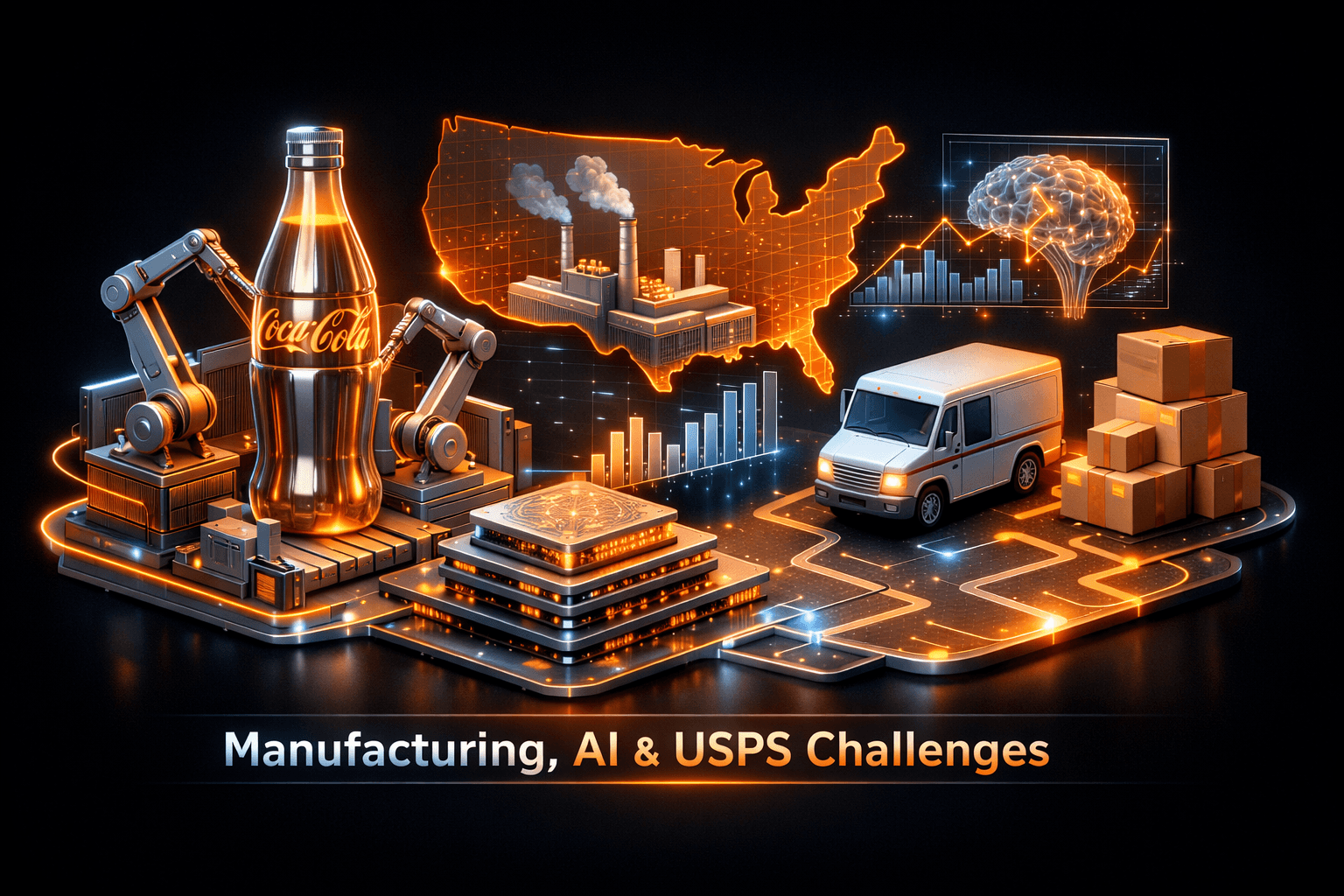
Coca-Cola's announced $10 billion U.S. manufacturing investment stole the spotlight overnight, signaling renewed corporate confidence in domestic production and distribution. That commitment, alongside federal backing for Manufacturing Extension Partnership centers and expanding AI pilots at major retailers, underscores a clear push toward automation and resilience in the sector.
At the same time you should note that operational and logistics frictions remain, with a watchdog report flagging rural delivery disruptions at USPS. The picture for investors is one of momentum in technology and capital spending, tempered by real world delivery and workforce challenges.
Market Highlights
Quick facts and numbers investors will want at a glance.
- Coca-Cola ($KO) plans to invest $10 billion in U.S. manufacturing through 2030, expanding production and distribution in its biggest market.
- NIST awarded more than $30 million to 12 Manufacturing Extension Partnership sites across 11 states and Puerto Rico to accelerate AI, automation, robotics, and additive manufacturing adoption.
- Macy's ($M) is moving an AI-driven inventory replenishment tool from pilot to broader rollout to improve in-stock rates and operational efficiency.
- A Supply Chain Dive watchdog report says U.S. Postal Service network changes have worsened on-time delivery for rural customers, drawing attention to last-mile logistics risk.
- Schneider Electric executive Andre Marino urged the sector to focus on software-defined frameworks rather than getting sidetracked by humanoid robot hype, emphasizing integration and ROI.
- Baby-products maker Munchkin hired Kunal Thakkar as its first chief supply chain officer, signaling increased leadership focus on sourcing and operations.
Key Developments
Coca-Cola's $10B manufacturing push
Coca-Cola's commitment to invest $10 billion in U.S. manufacturing through 2030 is the largest discrete capital plan among these headlines. The spending will touch production, packaging and distribution infrastructure and is likely to benefit equipment suppliers, packagers, and regional logistics providers.
For you that means demand for automation, maintenance services, and local supply chains could pick up. Analysts note the move supports reshoring trends and could move the needle for industrial-capex sensitive names.
Federal backing and corporate pilots accelerate automation
NIST's award of more than $30 million to 12 MEP sites should speed technology adoption at small and medium manufacturers by subsidizing AI, robotics, automation, and additive manufacturing projects. Those centers often amplify local investment and help firms deploy solutions that larger manufacturers have already proven.
At the same time Macy's is scaling an AI inventory replenishment tool beyond pilot status. That rollout underlines how retailers are squeezing inventory costs and improving availability through forecasting tech. Can broader adoption sustain margins while avoiding rollout hiccups? Expect implementation and outcomes to be closely watched.
Hype versus execution: humanoids and supply chain leadership changes
Schneider Electric's Andre Marino cautioned that humanoid robots and agentic AI are drawing attention away from core industrial needs, like software-defined controls and integration. His point is practical, and it matters because execution and interoperability tend to drive ROI more than headline-grabbing prototypes.
Meanwhile Munchkin's appointment of a veteran supply chain chief shows firms are continuing to invest in talent and governance, not just technology. That combination of capability building and targeted tech funding is a practical blueprint for scaling automation.
USPS network changes raise last-mile concerns
A government watchdog report found USPS network revamps have reduced trips to distant post offices and hit on-time deliveries in rural areas. Those delivery disruptions increase costs for manufacturers and retailers that rely on consistent last-mile performance, especially for small businesses and direct-to-consumer logistics.
If you sell or source from rural regions you'll want to factor in potential delays and rising fulfillment complexity as firms reroute shipments or pay for alternative carriers.
What to Watch
Here are the near-term catalysts and risks that could move sector sentiment and stock-level performance.
- Implementation timelines for Coca-Cola's capex program, and which suppliers or bottlers win contracts will be key. Watch vendor announcements and regional construction permits for clues.
- Outcomes from the NIST-backed MEP projects, including case studies showing productivity gains or cost reductions, will indicate how quickly smaller manufacturers can adopt advanced tech.
- Macy's inventory rollout performance metrics, such as improvements in in-stock percentages and inventory turns, will show whether AI forecasting delivers measurable margin benefits.
- USPS operational updates and any Congressional oversight following the watchdog report could pressure last-mile reliability. Monitor shipping times and carrier cost adjustments that affect margins for retailers and manufacturers.
- Watch for demonstrations of software-defined control systems and credible ROI cases for robotic deployments. Will vendors prioritize integration and uptime over flashy humanoid demos?
Which companies are prepared to execute at scale, and which are still in the pilot stage? Your answers will shape sector winners over the next 12 to 24 months.
Bottom Line
- Capital spending and public funding are leaning bullish for industrial technology adoption, with $10 billion in corporate investment and over $30 million in federal grants supporting automation and reshoring.
- Practical deployments and talent upgrades, like Macy's expansion of AI forecasting and Munchkin's new supply chief, suggest the sector is shifting from pilot projects to broader implementation.
- Operational risks remain, notably USPS rural delivery disruptions, which could increase last-mile costs and complicate e-commerce fulfillment for some firms.
- Execution, integration, and demonstrable ROI matter more than hype. Analysts note focus on software-defined systems and scalable automation will determine long-term winners.
- This article provides informational analysis only. It does not recommend buying, selling, or holding any security. Data and commentary are for your consideration, not personalized investment advice.
FAQ Section
Q: How will Coca-Cola's $10B plan affect manufacturers? A: The spending should boost demand for packaging equipment, maintenance services, and regional logistics, benefiting suppliers who can scale production.
Q: Will Macy's AI rollout cut inventory costs immediately? A: Macy's is expanding from pilot to broader use, but measurable cost and in-stock improvements typically show up over several quarters as models and processes are tuned.
Q: Should I be worried about the USPS delivery report? A: The report highlights real last-mile risks, especially for rural shipments. You should monitor shipping lead times and carrier choices if you depend on consistent deliveries.