The Big Picture
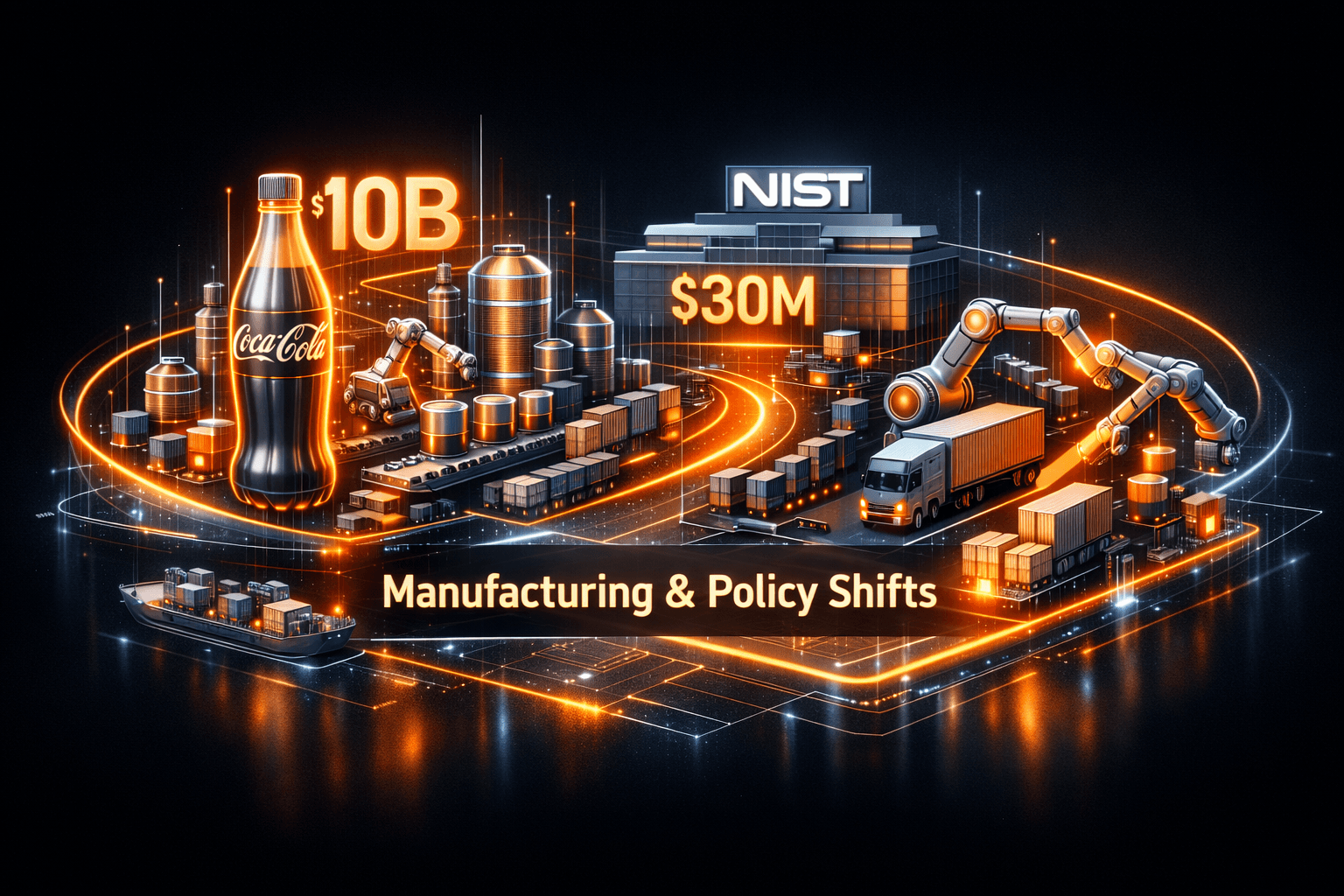
Coca-Cola’s announcement that it will invest $10 billion in U.S. manufacturing by 2030 set the tone for the industrial complex today, reinforcing a broad push to onshore capacity and modernize factories. That headline-sized commitment underscores demand for new equipment, automation, and distribution upgrades that can boost suppliers and service providers across the sector.
At the same time, federal support for small and mid-size manufacturers and large retail deployments of AI show momentum on both public and private fronts. You’ll see both long-term opportunity and near-term operational friction in the stories below, so weigh execution as you track names in this space.
Market Highlights
Key developments and company actions moved conversations across the sector. Here are the quick facts you need.
- Coca-Cola ($KO) unveiled plans to spend roughly $10 billion on U.S. manufacturing through 2030, targeting expanded production and distribution capacity.
- NIST awarded more than $30 million to 12 Manufacturing Extension Partnership sites, supporting advanced tech adoption in 11 states and Puerto Rico.
- Macy’s ($M) is scaling an AI-driven inventory replenishment tool beyond pilot, aiming to improve in-stock levels and operational efficiency.
- Schneider Electric ($SU) executives warned that hype around humanoid robots and agentic AI risks distracting from core, software-defined industrial priorities.
- USPS network changes drew an inspector general report noting disproportionate on-time delivery impacts for rural customers, a logistics headwind for distributors and last-mile partners.
- Munchkin appointed Kunal Thakkar as its first chief supply chain officer, signaling a stronger focus on sourcing and global operations.
Intraday price moves for individual industrial names varied with each announcement. Trading reflected company-specific drivers rather than a uniform sector swing.
Key Developments
Coca-Cola’s $10B U.S. manufacturing pledge
The $10 billion commitment from Coca-Cola is a multi-year investment in plants, packaging, and distribution. For you that means potential downstream demand for machinery makers, materials suppliers, and contract manufacturers that serve beverage production lines.
This kind of capex cadence tends to favor OEMs, automation vendors, and logistics firms that can deliver scale quickly. Analysts note the move strengthens domestic supply chains and may accelerate replacement cycles for aging equipment.
NIST grants boost regional modernization
NIST’s allocation of over $30 million to 12 MEP centers will fund AI, robotics, automation, and additive manufacturing adoption among small and medium manufacturers. The funds target 11 states and Puerto Rico and aim to raise competitiveness at the plant-floor level.
Smaller suppliers often lack capital to trial advanced systems. These grants reduce that barrier and could expand the addressable market for automation integrators and software providers. Will local shops convert pilot projects into production-scale upgrades? That’s the next test.
AI and talent shifts, from Macy’s to Munchkin and Schneider
Macy’s moving its AI replenishment tool out of pilot signals retailers are comfortable scaling machine-led forecasting to improve in-stock performance. You should watch for efficiency gains and potential margin improvements tied to lower inventory carrying costs.
At the same time, Schneider Electric’s senior automation executive cautioned that flashy humanoid robots risk diverting attention from pragmatic software-defined strategies. The comment is a reminder that not all automation trends translate to immediate factory ROI. Separately, Munchkin’s hire of a seasoned supply chain leader shows consumer brands are beefing up operations to manage sourcing complexity and resilience.
What to Watch
Execution and timing will separate winners from the rest. Here are the catalysts and risks to monitor heading into tomorrow and the coming weeks.
- Capex spending flows from large commitments like Coca-Cola’s, and the vendor revenue paths they create. Track vendor order books and supplier disclosures for early signs of contract awards.
- MEP grant program rollouts and local adoption rates, which will affect demand for integration services and training providers. Watch state-level announcements and center-level roadmaps.
- AI deployment outcomes at retailers such as Macy’s, including in-stock improvements and margin impacts. Quarterly commentary will help you evaluate scalability.
- Logistics and last-mile pressure from USPS network changes. If rural delays persist, costs and service-level disputes could rise for distributors and ecommerce-dependent manufacturers. How will companies adjust routing and contracts?
- Worker skills and labor availability as companies automate. You should watch hiring trends, training programs, and union negotiations where relevant.
Bottom Line
- Coca-Cola’s $10B U.S. investment and NIST’s $30M in MEP awards point to durable demand for automation, robotics, and plant upgrades.
- AI is moving from pilots to scale in retail and manufacturing, but practical software integration matters more than hype around humanoid robots.
- Logistics risks from USPS changes could pressure last-mile service and add complexity for supply chains serving rural markets.
- Talent moves and grant funding improve execution potential, but you’ll want to follow order flow and implementation milestones closely.
- Data suggests momentum building across capital goods and services, though near-term execution and logistics headwinds require selective attention.
FAQ
Q: What does Coca-Cola’s $10B plan mean for industrial suppliers? A: It suggests multi-year demand for equipment, packaging lines, and distribution upgrades, which can translate into larger order books for machinery and integrators.
Q: How will NIST’s MEP grants affect small manufacturers? A: The funding lowers the barrier to adopt AI, robotics, and automation, helping smaller firms pilot and scale technology that could boost productivity and competitiveness.
Q: Should I worry about USPS delivery changes? A: You should monitor service-level trends for rural routes, because persistent delays can raise costs and complicate fulfillment for manufacturers and distributors that serve those areas.