The Big Picture
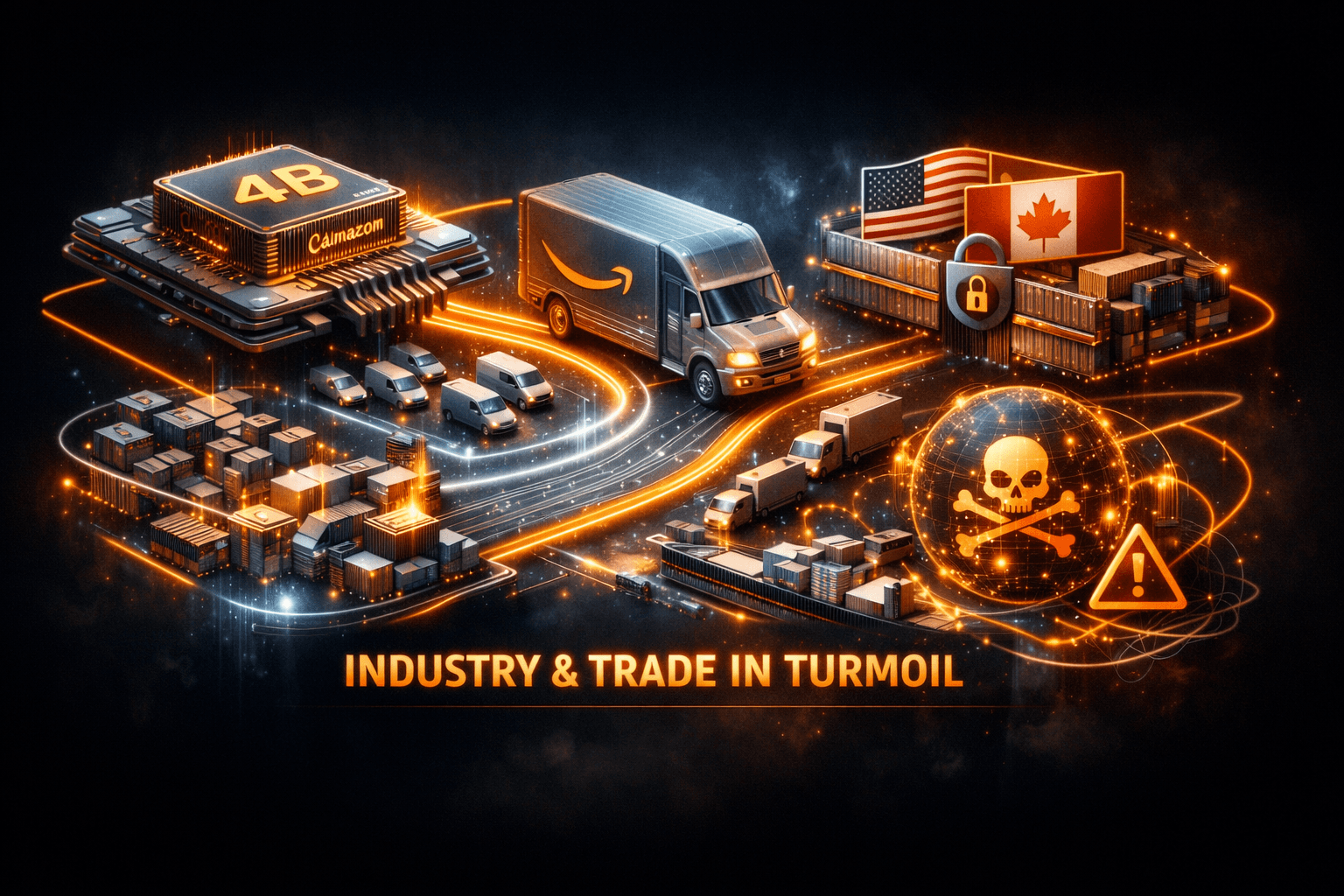
Today’s standout was a landmark manufacturing tie-up: Qualcomm will build custom chips for Amazon under an initial $4 billion agreement, with filings saying Amazon could buy as much as $60 billion in processors over the next decade. That deal signals continued demand for custom silicon and deeper integration between cloud operators and chipmakers, which matters to you if you follow semiconductors, data center suppliers, and industrial electronics makers.
At the same time, geopolitical and operational headwinds showed up. The U.S. announced new tariffs and import restrictions on Canada, and Boston Scientific began restoring shipments after a disruptive cyberattack. It was a mixed bag for the sector, with growth catalysts on one side and supply chain risk on the other.
Market Highlights
Key market moves and data points from the day, condensed for quick reading.
- Qualcomm and Amazon, reported deal value: $4 billion initial agreement, filings suggest Amazon could purchase up to $60 billion in processors over 10 years. Companies: $QCOM, $AMZN.
- Amazon delivery plans: internal estimates say the company could handle more than 86% of its own package deliveries next year, changing demand patterns for carriers and logistics vendors.
- U.S.-Canada trade actions: the U.S. announced new tariffs and import bans, prompting Canadian retaliatory levies that could affect cross-border supply chains and component sourcing.
- Operational disruptions: Boston Scientific, $BSX, is restoring shipping after a cyberattack that slowed manufacturing and order processing; Miami International Airport saw limited air cargo disruption after a crash, but runway limits may have longer-term effects on cargo flows.
- Technology trends: manufacturing leaders spoke about AI and digitization, highlighting automation, cloud services, and generative AI as continuing drivers of capital spending.
Key Developments
Qualcomm-Amazon custom chip partnership
The $4 billion initiative for custom chips is the day’s most consequential manufacturing headline. Filings say Amazon may scale purchases to as much as $60 billion over ten years, which could reshape demand for data-center processors and related assembly, test, and packaging services.
Why it matters: custom silicon reduces reliance on third-party vendors and can push more workload-specific hardware into production lines, giving foundries and subcontractors a clearer multi-year demand signal. Analysts note this may accelerate capital spending among semiconductor suppliers and cloud hardware integrators.
Tariff escalation with Canada
The administration’s fresh tariffs and import bans on Canadian goods arrived the same day Ottawa matched levies in retaliation. The measures target a range of items and come at a time when North American supply chains are still being rationalized.
Why it matters: companies that source components, raw materials, or finished parts across the U.S.-Canada border may see higher costs or disrupted sourcing. How will manufacturers adjust their sourcing and inventory strategies in response? That’s the key question for supply-sensitive firms.
Logistics and operational risks: Amazon delivery push and cyber incidents
Amazon’s move to deliver over 86% of its own packages next year, if realized, will shift volume away from big carriers and toward Amazon’s tech and fulfillment networks. That alters demand for last-mile vehicles, warehouse robots, and packaging manufacturers.
Meanwhile, Boston Scientific’s recovery from a cyberattack underscores ongoing operational vulnerability across medical device and broader manufacturing networks. Shipping is being restored, but backlogs remain. Data suggests you should monitor order flow and late shipments for exposure to revenue timing risks.
What to Watch
Several near-term catalysts will determine whether today’s positives outweigh the risks. First, watch any follow-up SEC filings or statements from $QCOM and $AMZN on volume, timelines, and manufacturing partners. Those details will clarify which plants and suppliers gain the most.
Trade policy is the big macro wildcard. Look for announcements on tariff scope, duration, and exemptions, plus any industry petitions or negotiated settlements. How aggressive will re-shoring or near-shoring plans become if tariffs persist?
Operational signals matter too. Track Boston Scientific shipment cadence and backlog disclosure, cargo throughput at Miami and other key hubs, and any new cyber or safety incidents. You should also keep an eye on capital expenditure plans tied to AI, automation, and custom hardware, since those will drive orders for industrial equipment and contract manufacturers.
Bottom Line
- Qualcomm’s custom-chip pact with Amazon is a major positive for semiconductor demand, but most gains will play out over years as designs and production scale.
- Amazon’s push to self-deliver will reshape logistics demand, creating winners among internal-capability suppliers and headwinds for traditional carriers.
- New U.S.-Canada tariffs introduce material supply-chain risk for cross-border manufacturers and could raise costs or force sourcing shifts.
- Operational disruptions, from cyberattacks to airport capacity limits, remain a real drag on order fulfillment and near-term revenue timing.
- Take a selective approach: monitor company disclosures, tariff clarifications, and shipping metrics to gauge which names are most exposed or positioned to benefit.
FAQ Section
Q: How significant is the Qualcomm-Amazon chip deal for chipmakers? A: The deal signals rising demand for custom silicon from cloud operators, which could increase long-term orders for foundries, test and packaging services, and hardware integrators, though most volume will materialize over several years.
Q: Will the U.S.-Canada tariff fight hit all manufacturers the same way? A: No, impact will vary by supply-chain footprint and product mix; firms with heavy cross-border sourcing or just-in-time operations face higher near-term disruption and cost risk.
Q: What short-term signs should you watch for supply-chain recovery after disruptions? A: Monitor shipping cadence updates, inventory and backlog disclosures from suppliers and OEMs, cargo throughput at major hubs, and any company-level incident reports that affect production or distribution.