The Big Picture
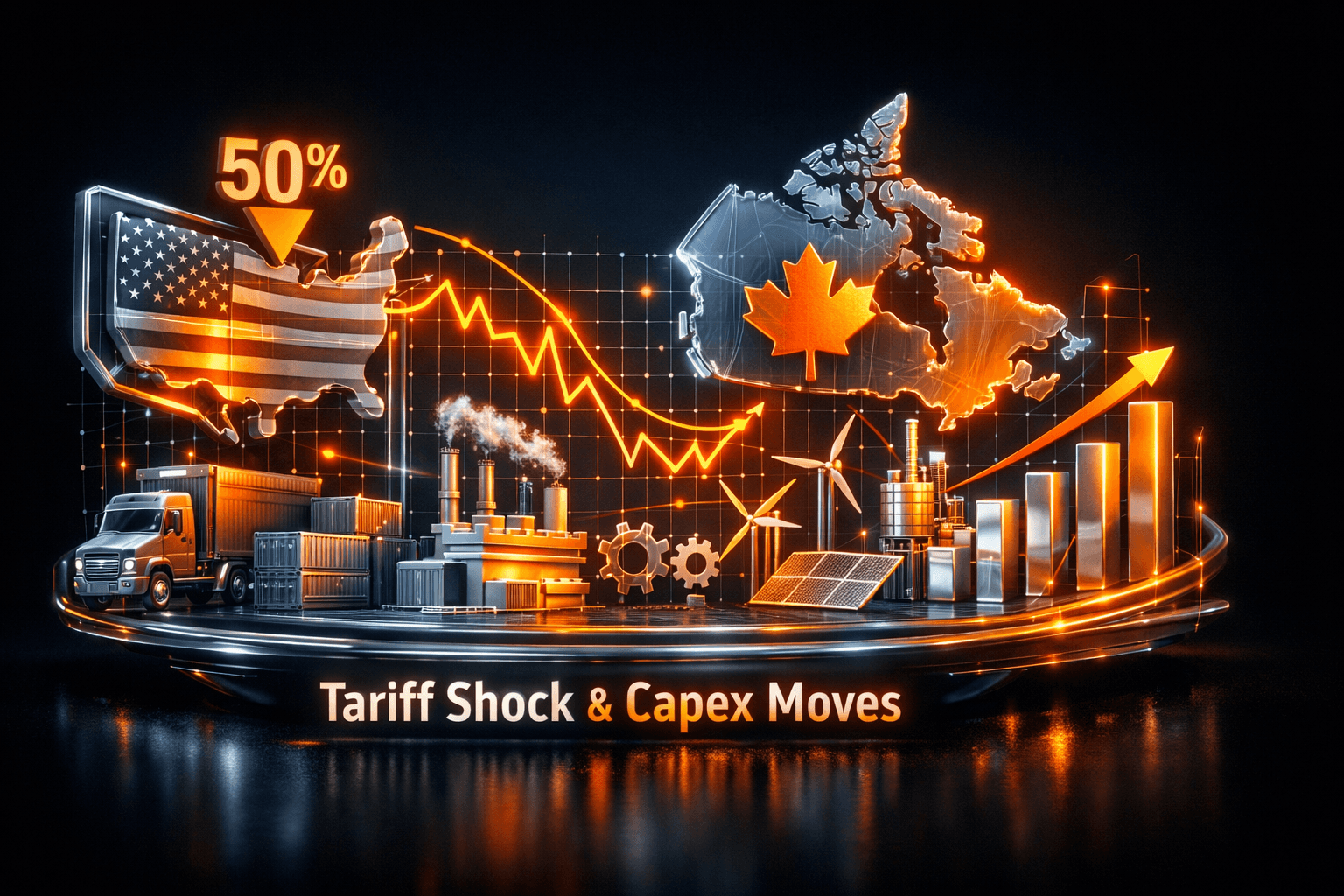
Today’s biggest development for industrials and manufacturers was a policy shock: the U.S. announced 50% tariffs on a broad set of Canadian imports, including cars, trucks, auto parts and steel, effective Jan 1. That move, and Canada's pledge to match tariffs dollar for dollar, immediately raises cross-border supply chain risks, cost pressure and potential production disruptions for firms that rely on integrated North American sourcing.
These trade actions matter because they affect raw material flows, input prices and inventory strategies across the sector. You should expect managers and supply-chain teams to be retooling plans, and you may see companies accelerate local sourcing, pricing changes, or legal and lobbying responses over the coming weeks.
Market Highlights
Here are the key facts and numbers from today’s headlines to help you scan the landscape quickly.
- Tariff headline: U.S. tariffs of 50% announced on many Canadian imports, with the measures set to take effect Jan 1 and Canada promising equivalent retaliation.
- $CLF: Cleveland-Cliffs announced a $1 billion investment in its Middletown blast furnace, a move environmental groups say walks back prior low-emissions plans.
- $ADM: Archer-Daniels-Midland plans a $100 million oilseed crush expansion across four U.S. plants, with six other facilities flagged for possible capacity increases.
- Packaging trend: Major packagers such as $WRK and PepsiCo (PEP) are increasing renewable energy and efficiency projects to cut costs amid rising energy prices.
- Retail logistics: Target (TGT) reported improved in-stock levels after prepositioning inventory and dedicating trailer capacity ahead of back-to-school demand.
Key Developments
Trade shock: 50% tariffs on Canadian imports
The administration announced steep 50% duties on cars, trucks, parts and steel from Canada, effective Jan 1, after talks failed to avert the penalties. Canada says it will match dollar for dollar. What does that mean for you and for manufacturers? Expect higher near-term input costs for companies that rely on Canadian steel and components, and more volatility in North American vehicle and parts supply chains.
Steel and domestic production: Cleveland-Cliffs' $1B Middletown move
$CLF’s decision to invest $1 billion in the Middletown blast furnace keeps domestic steel capacity coming but drew criticism for backing away from a previously announced low-emissions upgrade that would have relied on federal tax incentives. For investors and stakeholders, the takeaway is conflicted: the capex supports production and jobs, but environmental and regulatory scrutiny may increase and could affect permitting or future subsidies.
Capacity and efficiency plays: $ADM expansion, packaging renewables, $TGT logistics
$ADM’s $100 million oilseed crush expansion at four U.S. plants signals ongoing demand for processing capacity and a desire to capture margin in vegetable oil and protein markets. At the same time, packaging companies are pushing into renewables and energy efficiency to blunt rising power and feedstock costs. Retailers such as $TGT are also showing operational fixes, reporting better in-stock metrics after proactively prepositioning freight and inventory for back-to-school.
These moves show companies are trying to defend margins with capex and operational improvements. Still, will those measures offset the new trade and tariff risks? It will depend on industry exposure and how quickly firms can reconfigure sourcing.
What to Watch
Look for these near-term catalysts and risk points that will shape the sector’s trajectory and your understanding of it.
- Tariff timeline and negotiations: Jan 1 is the tariff start date. Monitor any rapid policy reversals, exemptions, or emergency talks between the U.S. and Canada, and watch for industry petitions or legal challenges.
- Company disclosures and capex plans: Watch Q3 operational updates and disclosures from steelmakers, auto suppliers and large packagers for commentary on tariff exposure, inventory builds and reshoring plans.
- Energy and input costs: Track oil, natural gas and electricity prices, since packaging and processing margins depend on energy. ADM’s expansion shows firms are acting, but rising energy could still squeeze returns.
- Regulatory and ESG scrutiny: Cleveland-Cliffs’ Middletown decision invites environmental review and potential permitting delays. Keep an eye on activist and regulatory responses that could change timelines or costs.
- Logistics and inventory signals: Retailers and manufacturers will reveal if they’re prepositioning stock or rerouting shipments. That signals supply chain stress or resilience.
Bottom Line
- Tariff action is the dominant near-term risk for industrials and manufacturers, creating cost and supply-chain uncertainty through at least Jan 1.
- Large capex moves like $CLF’s $1 billion investment and $ADM’s $100 million expansion show firms are shoring up capacity, but they don’t eliminate trade-driven price risk.
- Efficiency and renewable energy investments in packaging indicate managers are fighting cost inflation, and these projects could support margins over time.
- You should watch policy developments, company disclosures and energy prices for immediate signals about who is most exposed and who is adapting.
- Analysts note that the interplay between tariffs, domestic capex and energy strategy will determine which companies navigate the next quarters best.
FAQ Section
Q: How will the 50% tariffs affect steel and auto supply chains? A: Tariffs raise input costs for firms using Canadian steel and parts, risk production slowdowns, and may prompt rerouting or reshoring of supply chains which can increase near-term logistics and inventory costs.
Q: Does Cleveland-Cliffs' $1B Middletown investment reduce sector risk? A: The investment supports domestic supply capacity, but it also raises regulatory and environmental scrutiny because the company walked back a low-emissions upgrade, which could affect future permitting and incentives.
Q: What signs should you watch to gauge whether companies are coping? A: Look for company commentary on inventory levels, tariff exposure, capex pivots, energy procurement contracts, and any announced sourcing changes during upcoming earnings and operational updates.