The Big Picture
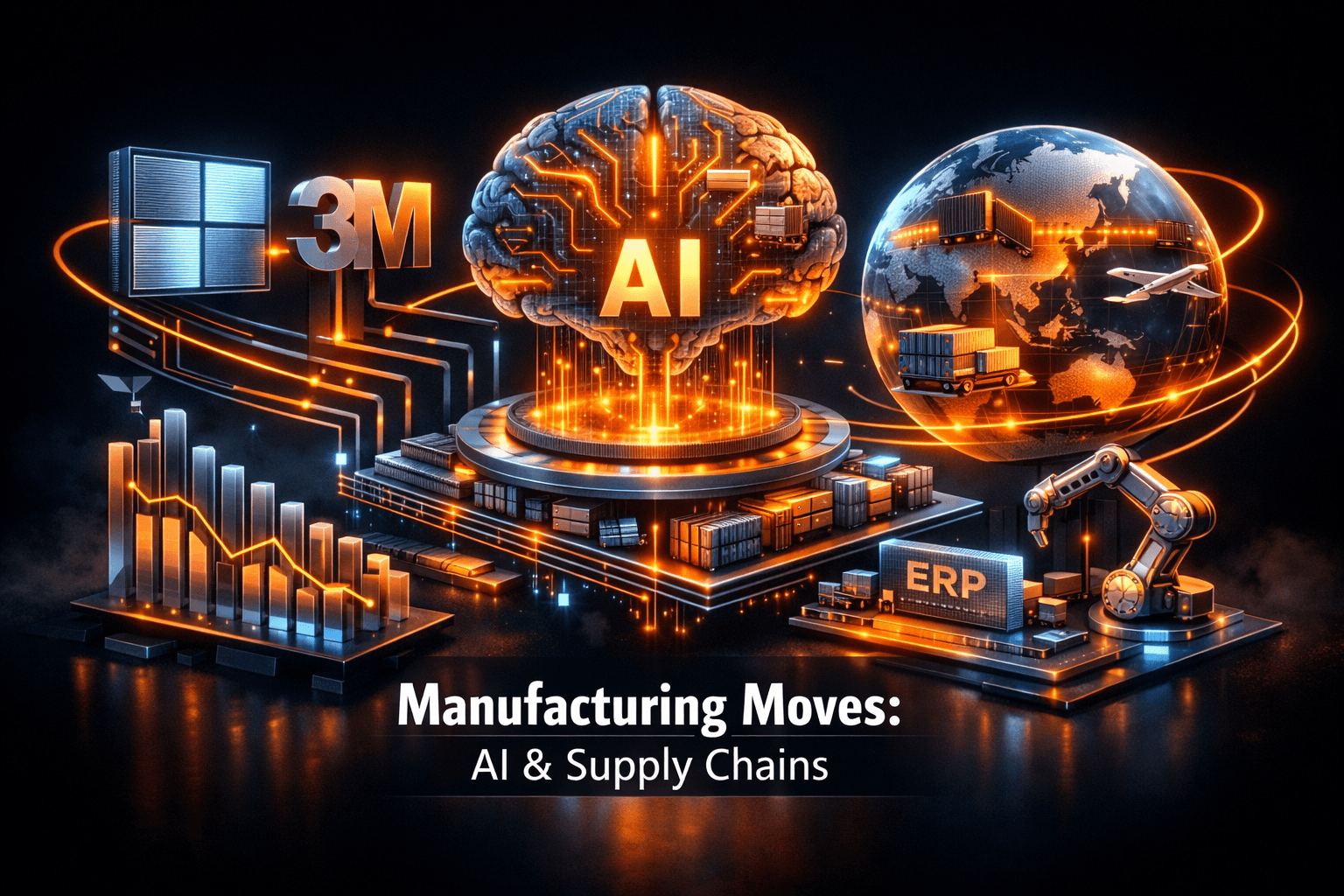
Microsoft and 3M announced a joint AI and data center R&D partnership that could reframe demand for electronic components, and experts say "always-on" supply chains are moving from pilot projects to the mainstream. That combination of stronger tech-driven demand and widespread digital adoption matters because it can lift supplier revenues, tighten supplier selection, and change capital expenditure priorities across the sector.
At the same time, some equipment demand softened in May, with new metalworking machinery orders down 1.8 percent from April. You should watch how much of that dip is cyclical versus structural as companies accelerate automation and compliance programs.
Market Highlights
Quick facts and figures to start your day.
- Microsoft and 3M announced an R&D partnership to develop electronic components for AI and data center demand, signaling potential upside for component makers and fiber suppliers, companies cited in reports include $MSFT and $MMM.
- The Association for Manufacturing Technology reported $583.4 million in new metalworking machinery orders for May, a decline of 1.8 percent from April. Cutting tool shipments were $239.8 million, down 7.4 percent month to month.
- Apparel and footwear players are investing in digital controls: Renfro expanded use of Inspectorio AI tools to tighten supply chain compliance, and Levi Strauss & Co. is consolidating ERP platforms with a target of mid-2027, reflecting broader modernization trends, including $LEVI.
Key Developments
Microsoft and 3M team up on AI and data-center components
The partnership announced yesterday focuses on R&D to develop and produce electronic components, including fiber and cable solutions for AI and hyperscale data centers. For suppliers and industrial manufacturers, this could mean more long-term, high-margin contracts tied to data center rollouts.
How might you track impact? Suppliers of specialty polymers, fiber-optic cable and semiconductor packaging could see demand translate into higher order books over multiple quarters, analysts note.
"Always-on" supply chains go mainstream
Experts at Supply Chain Dive’s outlook event said companies that adopted digital transformation and automation early are now reaping benefits, from better inventory uptime to faster response to disruptions. This trend implies you should favor companies that demonstrate operational visibility and strong supplier controls.
Renfro’s expansion of Inspectorio tools and Levi’s ERP consolidation are concrete examples of companies moving beyond point solutions. Those investments aim to reduce compliance risk and lower working capital needs over time.
Orders soften, but operational upgrades continue
May’s $583.4 million in new metalworking machinery orders was down 1.8 percent versus April, and cutting-tool shipments fell 7.4 percent. That signals some near-term softness in machine tool demand, especially in discretionary capex categories.
Still, Plant Engineering’s coverage of systems integrators and CMMS best practices suggests capital is shifting to automation, predictive maintenance, and long-term facility optimization. In other words, companies may buy fewer machines but invest more in smarter systems and integration.
What to Watch
Several near-term catalysts will help you separate the wheat from the chaff.
- Announcements and timelines from $MSFT and $MMM about their R&D work, pilot projects, and intended manufacturing scale. Those updates will indicate which suppliers could benefit and when.
- Next monthly machinery orders and cutting-tool shipment reports, which will show whether May’s dip was an anomaly or the start of a trend.
- Levi’s ERP rollout milestones, particularly the mid-2027 unified platform target, and Renfro’s compliance metrics that can affect margins and supplier selection.
- Macro indicators, including ISM manufacturing PMI and industrial production data, since you’ll want to see whether end-demand for manufactured goods is accelerating.
- Operational risk factors like cybersecurity for digital supply chains and supply disruptions for AI-critical materials, both of which can affect delivery schedules and margins.
What should you be asking right now? Are capex dollars shifting from raw machine purchases to integrated automation and services, and who stands to gain from that shift? Keep an eye on vendors that combine hardware with software services, because momentum indicates buyers want full solutions.
Bottom Line
- Strategic tech partnerships like $MSFT and $MMM are a bullish signal for manufacturers tied to AI and data-center supply chains, but pay attention to timelines and scale.
- Digital supply-chain moves and ERP consolidation, exemplified by Renfro and $LEVI, are creating operational resilience that should help margins over time.
- May’s decline in metalworking orders is a modest near-term headwind. Watch subsequent months for confirmation or reversal.
- Systems integrators, CMMS platforms, and compliance tooling are becoming differentiators for facility performance and long-term cost control.
- Be selective and follow order flows and corporate updates, because winners will be those that combine automation hardware with ongoing software and services revenue.
FAQ Section
Q: What does the Microsoft and 3M partnership mean for component makers? A: It signals potential long-term demand for specialty components serving AI and data centers, with pilots and scale-up announcements being key milestones to watch.
Q: Should a dip in metalworking orders worry you? A: A single-month decline of 1.8 percent is a cautionary sign, but analysts suggest you need multiple data points to judge a sustained slowdown in capex demand.
Q: How will ERP and AI tools change manufacturing operations? A: Consolidated ERP platforms and AI-driven compliance tools improve visibility, reduce risk, and can lower working capital needs over time, leading to more predictable operations.