The Big Picture
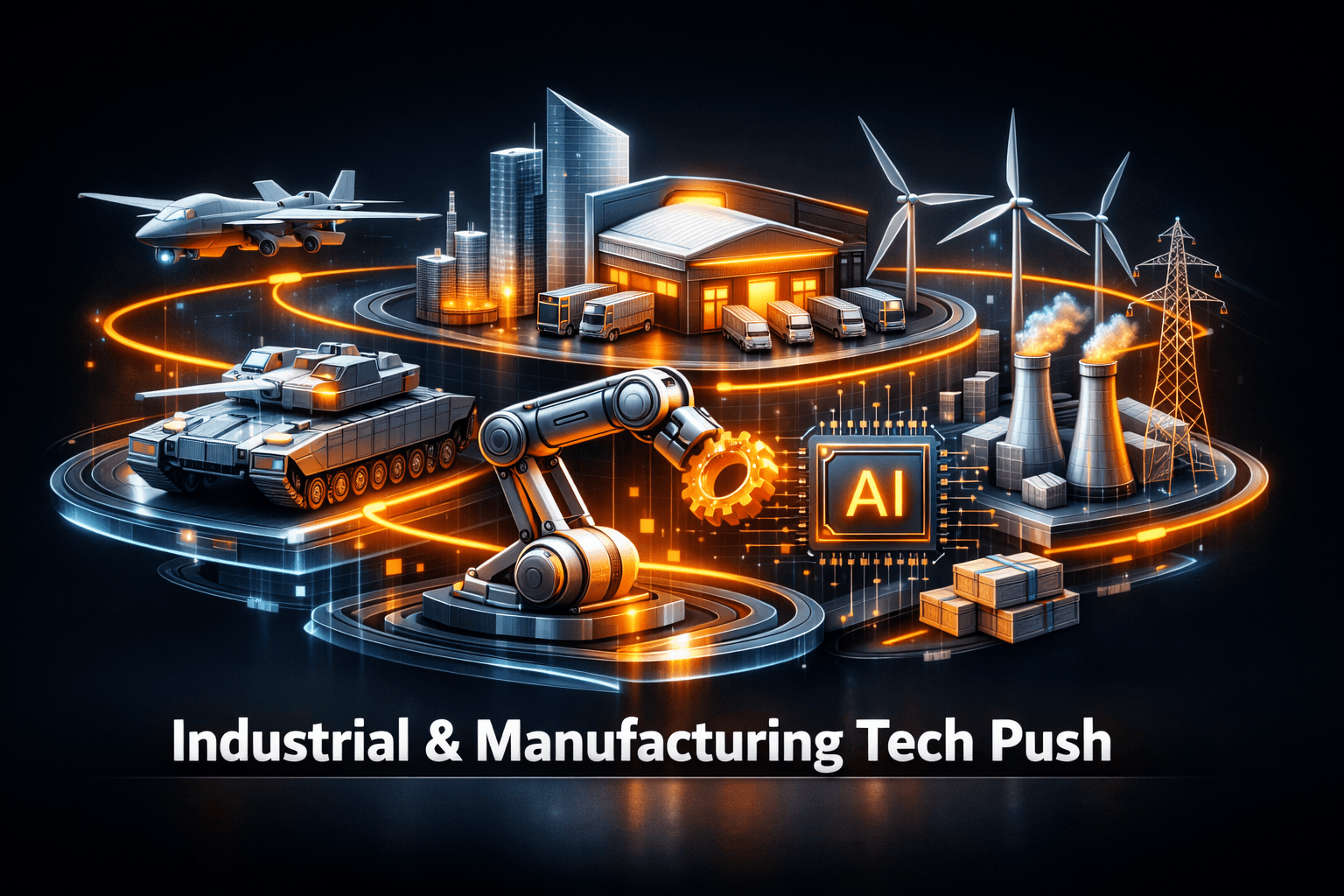
Today’s Industrial & Manufacturing news reinforced a clear theme, technology-led productivity driving near-term demand for equipment, software and logistics capacity. Across defense, supply chain, plant-floor automation and energy storage, companies moved from pilots to deployed solutions, which matters if you follow suppliers and service providers tied to industrial modernization.
These developments suggest companies are prioritizing uptime, speed and contamination-free processes, and that federal policy and commercial partnerships are nudging capacity decisions. If you own exposure to industrial automation, defense primes or logistics infrastructure, you’ll want to track the drivers summarized below.
Market Highlights
Quick facts and notable names from today’s coverage.
- FedEx $FDX signed a memorandum of understanding with China Southern Air Logistics to expand air cargo links via Guangzhou, potentially strengthening U.S. to Southeast Asia flows.
- GM Defense, a subsidiary of $GM, entered a collaboration with Lockheed Martin $LMT on U.S. defense manufacturing, a deal facilitated under the Defense Production Act voluntary provision.
- Burlington opened a 2 million square foot high-tech distribution center in Georgia featuring sortation and automation, a scale play for retail supply chain speed.
- Plant-floor tech items in focus included oil-free compressed air boosters and battery energy storage systems, both highlighted as uptime and contamination solutions.
- Pharma procurement modernization at Bristol Myers $BMY cut timelines from months to weeks using AI, reflecting broader adoption of enterprise automation.
Key Developments
Logistics tie-ups expand air cargo capacity
FedEx’s MOU with China Southern Air Logistics aims to make Guangzhou a stronger hub for U.S. shipments bound for Southeast Asia. Supply chain experts say the routing could shorten transit times and open new capacity lanes for express freight, which matters to shippers managing seasonal spikes and time-sensitive products.
For you following logistics stocks and freight equipment suppliers, this kind of relationship tends to support higher utilization of freighter networks and demand for handling and sorting technology at gateway hubs.
Defense collaboration signals manufacturing ramp
GM Defense and Lockheed Martin announced a collaboration backed by Pentagon assistance and the voluntary Defense Production Act mechanism invoked by the administration. This arrangement targets U.S. defense manufacturing scale up, combining automaker assembly strengths with weapons systems expertise.
Analysts note such partnerships often translate into longer production runs and supplier order books for component makers. What does this mean for small and midcap industrials linked to defense primes, and can it sustain multi-year demand? The initial sign is positive for firms positioned to supply parts, tooling and systems integration.
Automation and energy tech are moving from pilot to production
Several stories underscored equipment and software moving into production environments. Plant Engineering highlighted compressed air boosters, especially oil-free units, as a way to deliver higher pressures without taxing central systems, which reduces contamination risk for sensitive processes.
Battery energy storage systems or BESS were framed as more than sustainability assets. They’re now critical stabilizers for industrial uptime, helping plants ride through grid fluctuation and avoid costly downtime. Meanwhile Burlington’s new 2 million square foot DC and Bristol Myers’ AI procurement overhaul show examples of automation and software trimming cycle times and boosting throughput.
Robotics deployment lessons and startup realities
Executives from Fauna, Ultra and Standard Bots shared deployment challenges at New York Tech Week, highlighting integration, workforce training and repeatability as top hurdles. These are growing pains but they also point to a maturing market where proofs of concept lead to pragmatic scaling strategies.
If you track robotics suppliers, expect incremental revenue growth as companies move from prototypes to defended rollouts, but plan for uneven adoption timing across end markets.
What to Watch
Tomorrow and the coming weeks will bring several catalysts that could clarify momentum and risk. Keep an eye on earnings and conference updates from major automation and logistics names, and on contract awards tied to the GM Defense and Lockheed partnership.
Policy signals matter too. Watch for follow-ups on Defense Production Act usage and any new federal funding for industrial capacity. You should also watch adoption metrics for AI procurement tools in large corporates, and any case studies that quantify cost or time savings.
Risks include slower-than-expected capital spending among manufacturers, labor constraints for multi-shift automation, and supply chain bottlenecks that could delay equipment delivery. Can automation close the gap on product shortages like the Boston beer anecdote? Time and deployment scale will tell.
Bottom Line
- Technology and partnerships are the dominant themes today, with logistics, defense and plant-floor systems each showing tangible progress.
- BESS and oil-free compressed air boosters underline a shift to reliability-focused capital spending, not just sustainability or cost cutting.
- Defense manufacturing collaboration points to near-term contract flows for suppliers, supported by policy tools like the Defense Production Act.
- AI-driven procurement and large automated DCs show software and systems integration are reducing cycle times for major corporates.
- Monitor execution and timing risk, because deployment hurdles mean gains may be phased rather than immediate.
FAQ Section
Q: How will the FedEx MOU affect global supply chains? A: The MOU aims to expand air cargo capacity through Guangzhou, which could shorten transit times and add capacity for U.S. to Southeast Asia flows, easing pressure during peak demand.
Q: What does the GM Defense and Lockheed partnership mean for suppliers? A: The collaboration, aided by the Defense Production Act voluntary mechanism, suggests larger and longer production runs, which could increase order visibility for component and systems suppliers.
Q: Are automation and BESS proven enough for wide industrial adoption? A: Industry leaders say automation and battery storage have moved beyond pilot projects into production use cases that improve uptime and throughput, but adoption rates will vary by plant and sector.