The Big Picture
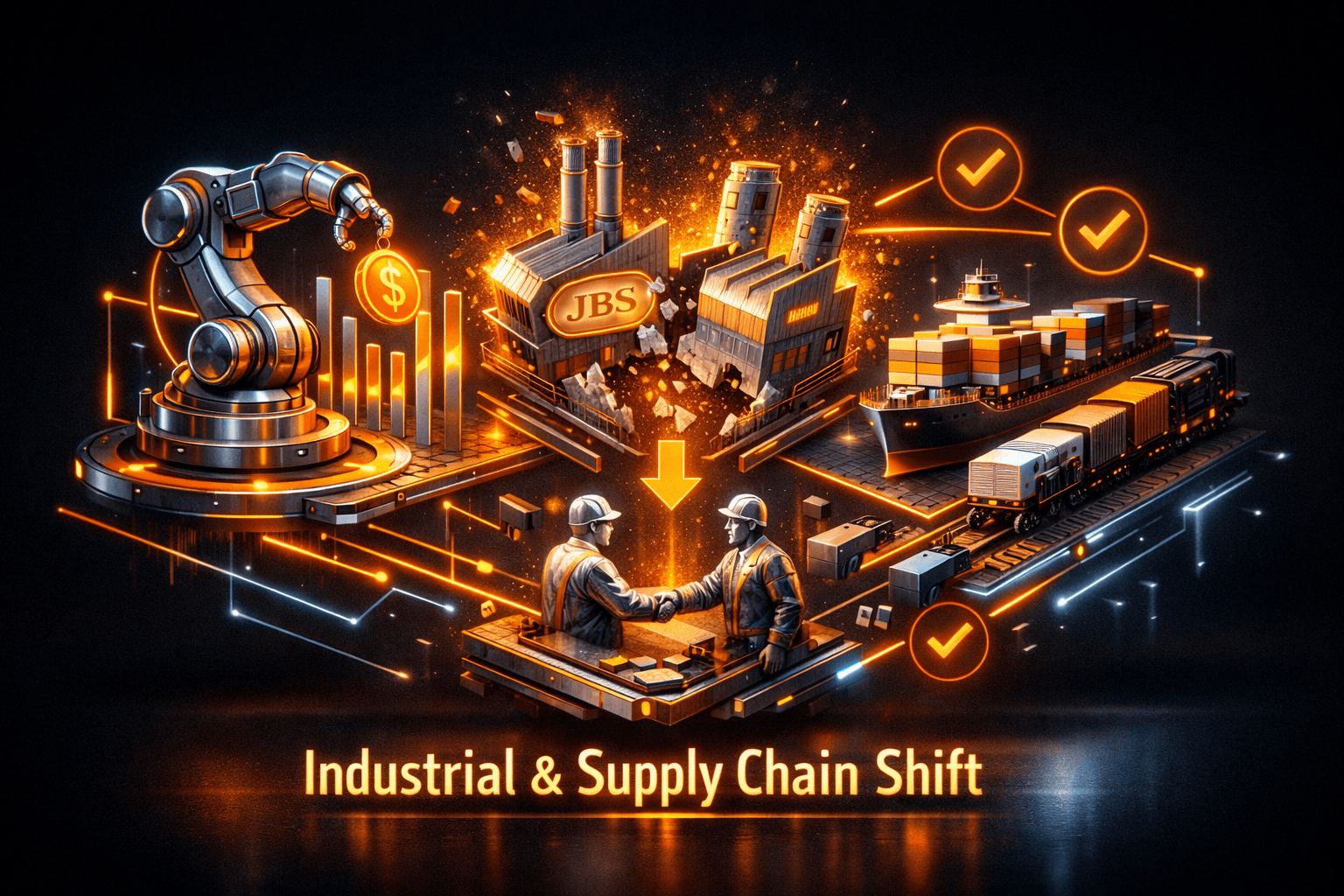
Today the Industrial & Manufacturing sector saw two strong themes: accelerated investment in automation and tangible supply chain productivity gains, alongside localized pain from a large meat-processor restructuring. You saw capital flowing into robotics and AI, while major manufacturers and retailers highlighted moves to cut complexity and scale automation.
That matters because automation and better network design can reduce costs and offset labor pressures over time, even as companies like JBS trim capacity and lay off workers. For your portfolio it means there are increasing structural tailwinds for automation and supply chain software, but there are near-term risks tied to industry-specific cutbacks and freight cost volatility.
Market Highlights
Quick facts and market moves to note from today’s headlines.
- Neura raises $1.4 billion to scale robot manufacturing and deployments, backed by Nvidia and Amazon, highlighting strong investor appetite for industrial robotics.
- JBS announces plant closures and at least 2,000 job cuts, a significant restructuring at the world’s largest meat processor that could pressure regional suppliers.
- Air freight spot rates spiked 41% year over year in May, though capacity returns from Middle East carriers may ease costs in June.
- $KMB (Kimberly-Clark) credits supply chain simplification and automation for multi-year productivity gains under a five-year plan.
- Labor disruptions eased after ratified deals at Dauch and $LMT, ending strikes that had threatened near-term production at a GM supplier and Lockheed Martin facilities.
- $GO (Grocery Outlet) moves to Afresh AI ordering tech to manage fast-turn assortments, signaling broader retail adoption of inventory AI.
- Schneider Electric earned Make It American certification with NEMA, a supply chain credential that supports localization efforts.
Key Developments
JBS Plant Closures and Workforce Reductions
JBS revealed plans to close a Pennsylvania beef processing plant and enact changes at majority-owned Pilgrim’s Pride, actions that will result in at least 2,000 layoffs. This is a material cut to capacity in specific geographies and could ripple through regional suppliers and logistics providers.
For you as an investor, watch processors, cold-chain logistics names, and local suppliers for potential earnings and volume impacts. The move underscores a consolidation trend where producers optimize capacity and margins.
Robotics Funding Surge: Neura’s $1.4B Round
Neura’s $1.4 billion raise, backed by heavyweights including Nvidia and Amazon, is a clear vote of confidence in deployed robotics and intelligence infrastructure. The funding is earmarked for ramping robot manufacturing and expanded training systems.
This represents a strategic shift from pilot projects to scale. If you own or track automation and semiconductor ecosystem plays, this development suggests accelerating demand for sensing, compute, and industrial integrations.
Supply Chain Wins and Cost Pressure Dynamics
Kimberly-Clark credited supply chain simplification and scaled automation for productivity gains across a five-year plan. Grocery Outlet is rolling Afresh AI ordering to better handle fast-turn SKUs. Schneider Electric secured NEMA’s Make It American certification to support localized sourcing.
Those are steady, constructive stories. They sit opposite a 41% YoY spike in air freight spot rates in May reported by Xeneta. The good news is capacity from Middle East carriers is returning, which should relieve spot pressure in coming weeks. So you get short-term cost swings but steady long-term efficiency gains.
What to Watch
Focus on catalysts and risks that could change the tape tomorrow and in the weeks ahead.
- Neura execution and partnerships, including which suppliers and chipmakers benefit from scaling robotics manufacturing, and how quickly deployments convert to revenue.
- Follow announcements from JBS and Pilgrim’s Pride on asset sales, impairment charges, or consolidation plans. Those could affect earnings forecasts and supplier order flows.
- Air freight capacity and forward contract pricing. Will the expected June easing materialize and translate to lower input costs for manufacturers and retailers?
- Upcoming earnings and guidance from large industrial names, especially $KMB and supply-chain tech players, for progress on productivity targets and automation ROI.
- Labor developments, especially any spillover from the resolved strikes. Could new contracts set precedent for bargaining at other suppliers?
How should you assess risk versus opportunity? Look for companies with clear automation road maps and flexible networks that can weather freight swings and local plant rationalizations.
Bottom Line
- Automation and supply chain tech are the day's dominant positives, backed by a major $1.4 billion funding event and corporate productivity gains.
- JBS's plant closures and 2,000 layoffs are a significant near-term headwind for regional supply chains and labor markets.
- Air freight rates remain volatile, up 41% YoY in May, but capacity returns suggest limited duration for the spike.
- Resolved strikes at Dauch and $LMT reduce near-term disruption risk for auto and defense supply chains.
- Be selective and track execution metrics for automation rollouts, freight pricing trends, and any further restructuring announcements.
FAQ Section
Q: How will Neura’s $1.4B raise affect industrial robotics adoption? A: The capital should speed manufacturing and deployments, which could increase component and software demand across the robotics supply chain.
Q: Should JBS’s plant closures worry you about food inflation? A: The closures are localized and may pressure regional supply lines, but broader price impacts will depend on how quickly capacity is redistributed.
Q: When will air freight costs ease? A: Data suggests relief is likely as Middle East carrier capacity returns in June, but monitor monthly spot and contract rates for confirmation.