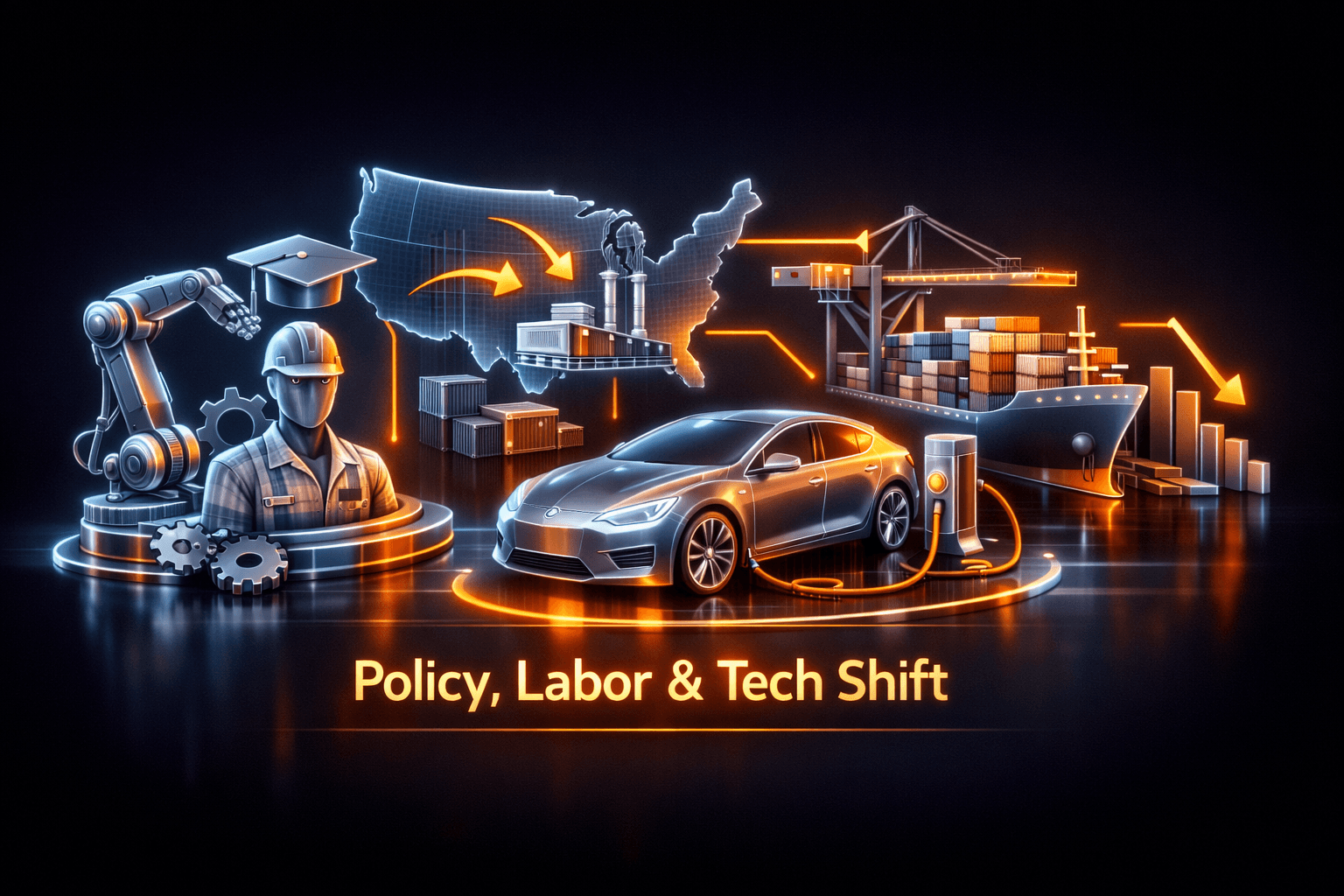
The Big Picture
Policy and workforce initiatives are pushing the industrial and manufacturing narrative into two directions, with long-term investment signals colliding with near-term trade and logistics headwinds. You saw that in high-profile commitments to skills and reshoring, and you also saw it in courts upholding tariffs and ocean shippers accelerating cargo movements.
Why does that matter to you as an investor? Because the next weeks will reveal whether supply-chain pressures and policy uncertainty outweigh the momentum from labor investments, EV pilots and targeted semiconductor incentives.
Market Highlights
The headlines that likely shaped sentiment heading into the long weekend included tech funding for trades, reshoring moves, and tariff-driven shipping changes. Here are the quick facts to keep on your radar.
- Google commitment: Alphabet's $GOOGL unit will put up $50 million to train more than 300,000 skilled trade workers, aiming to ease the U.S. labor gap in manufacturing and plant operations.
- Reshoring spotlight: Harley-Davidson $HOG is bringing some engine production back to U.S. plants in Pennsylvania and Wisconsin, a visible example of localized manufacturing coming back online.
- EV pilot savings: Kenvue $KVUE reported a Fuel Transport electric truck pilot delivered 44.7% diesel-cost savings on short-haul runs in the Toronto area.
- Tariff and shipping pressure: A federal appeals court temporarily upheld the administration's 10% global tariff, and ocean shippers are frontloading cargo amid tariff and fuel worries, according to industry sources including $CHRW commentary.
- Emerging tech policy: A House and Senate bill would open CHIPS program support to space-based semiconductor manufacturing, signaling new capital flows into LEO microgravity projects.
Key Developments
Tariffs and Ocean Shipping: Short-term Disruption
A federal appeals court temporarily blocked relief for two importers and the state of Washington, allowing collection of a 10% global tariff to proceed while appeals continue. That decision kept tariff risk front and center for manufacturers reliant on imported components.
Ocean carriers and freight forwarders reported frontloading of cargo as shippers accelerate shipments to beat tariff implementation and to preempt expected fuel cost rises. What does that mean for you, and for inventories? Expect uneven order timing and pockets of congestion that could affect margins and lead times into Q3.
Skills and Reshoring: Investment in Capacity
Alphabet's $GOOGL $50 million training pledge targets more than 300,000 skilled trade workers, a large-scale effort to address persistent labor shortages across manufacturing. Programs like this aim to reduce one of the main bottlenecks to reshoring and factory scale-up.
Harley-Davidson $HOG moving engine production back to Pennsylvania and Wisconsin shows reshoring can be practical for some lines, but the story notes limits and readiness challenges for wider adoption. You should view this as a strategic signal that companies are preparing for more localized supply strategies, even if it's not universal overnight.
Technology and Incentives: Space, Digital Threads, and EV Pilots
Lawmakers are pushing a bill to allow CHIPS funding for space-based semiconductor projects, targeting microgravity manufacturing to help the U.S. compete with China. That would expand the definition of eligible projects and could funnel R&D and capex into low-Earth orbit technology firms and suppliers.
At the same time, an EY and Aerospace Industries Association survey flagged that aerospace and defense firms are struggling to scale digital threads across operations. That implementation gap is a warning that tech promises may take longer to translate into productivity gains than you might expect.
Separately, Kenvue $KVUE's short-haul EV truck pilot cut diesel costs by 44.7%, offering a near-term proof point for decarbonization strategies in distribution and last-mile logistics.
What to Watch
Heading into Monday and the rest of the month, several catalysts will determine which narrative wins out. Will policy and logistics shocks slow investment, or will workforce and technology moves offset those pressures?
- Policy timeline: Monitor appeals court action on the 10% tariff and any legislative responses. Changes here could swing costs for import-reliant manufacturers.
- Shipping flows: Watch container rates and port dwell times. Continued frontloading could create an early demand peak, then a lull in shipments.
- Workforce programs: Track rollout details and employer uptake for training funds, including Google $GOOGL program metrics. Employment gains could ease capacity constraints over several quarters.
- CHIPS/space funding: Follow committee actions and bill language to see whether CHIPS eligibility expands to space-based projects, and which firms might qualify.
- Tech implementation: Look for updates from aerospace and defense primes on digital thread pilots. Adoption speed will influence productivity gains and margin prospects.
Bottom Line
- Near-term headwinds from tariffs and shipping frontloading create uncertainty for supply chains and costs.
- Major investments in workforce training and targeted reshoring signal structural support for capacity and competitiveness.
- Policy moves to include space-based chipmaking could open new R&D and capex channels, but adoption will take time.
- EV pilots and efficiency gains are showing measurable savings, offering operational levers to offset some cost pressure.
- Take a selective approach, and watch legal and logistical developments closely into next week.
FAQ Section
Q: How will the temporarily upheld 10% tariff affect manufacturers? A: The tariff raises input costs for import-dependent firms and may prompt inventory acceleration, higher prices, or margin pressure until the legal process resolves.
Q: Will Google’s $50 million training program quickly ease the skilled labor shortage? A: It’s a significant step that can expand the pipeline, but large-scale workforce shifts typically take quarters to materialize in plant-level capacity.
Q: Are space-based chip projects likely to get CHIPS funding soon? A: Lawmakers are advancing bills to allow that, but funding eligibility depends on final legislative language and agency implementation, so timelines are uncertain.
Remember, analysts note these developments shape the competitive landscape and operational costs, but they don't constitute investment advice. You should monitor the catalysts above and validate any investment moves against your own objectives.