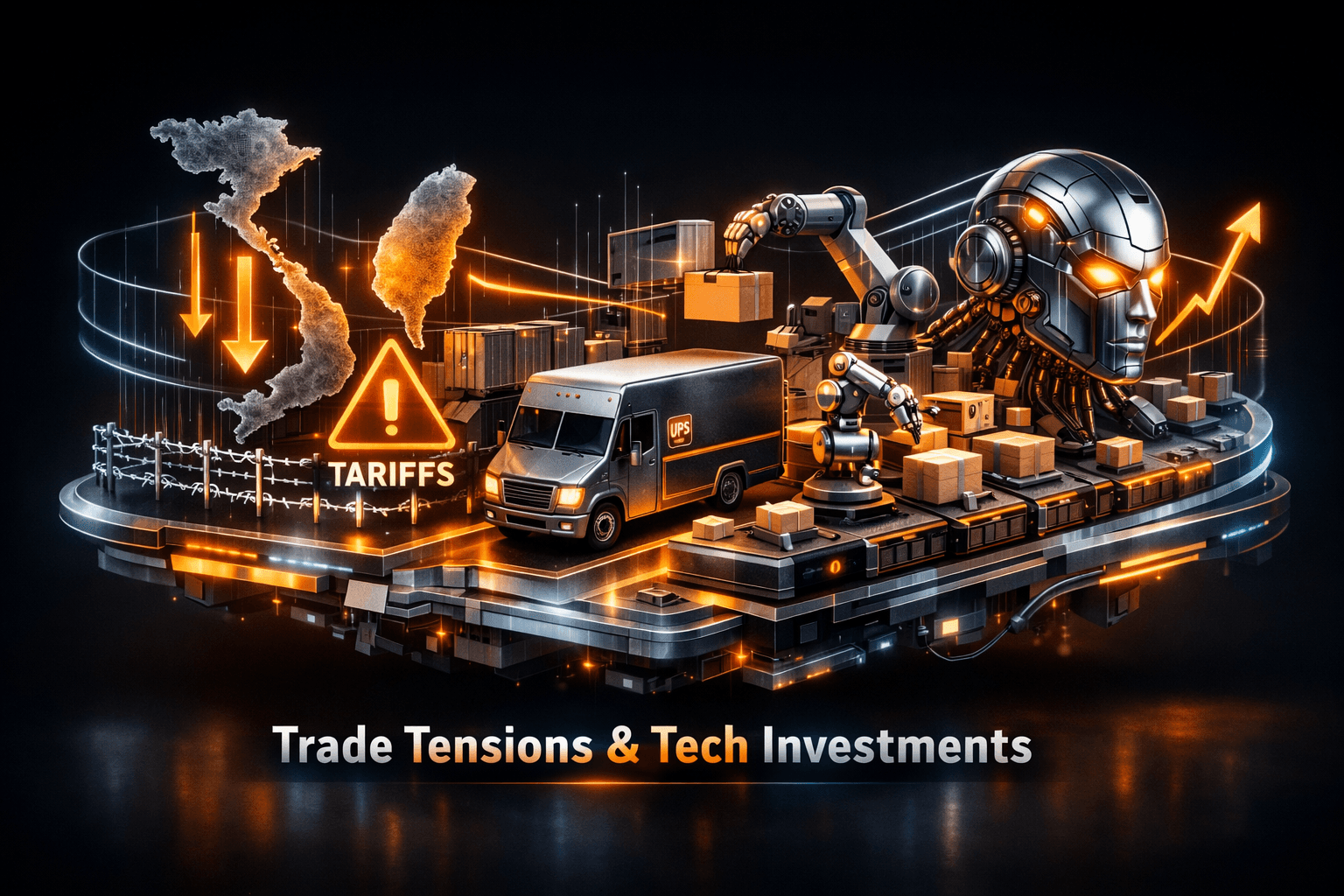
The Big Picture
The most impactful development heading into the long weekend is the widening U.S. trade focus, with a Section 301 probe of Vietnam and a finalized 15 percent tariff on select Taiwanese goods announced on May 29. Those policy moves raise the prospect of higher input costs and supply disruptions for some manufacturers.
At the same time, private and corporate investment is accelerating in logistics and factory automation, from a $50 million $UPS push into heavy logistics to new physical AI and robotics partnerships. What does this mean for manufacturers and your portfolio exposure? It means short term policy risk meets longer term productivity investments.
Market Highlights
Markets were closed on Saturday, May 30. The last trading day was Friday, May 29 and markets reopen Monday, June 1. Below are the quick facts and numbers investors should note.
- U.S. launches Section 301 probe of Vietnam, announced May 29, to examine intellectual property policies and practices.
- U.S. sets targeted tariffs at 15 percent on certain Taiwan imports, focused on auto parts, wood, and aircraft parts under a Section 232 framework.
- $50 million — UPS announces a $50M investment to expand time-definite heavy air freight services to and from Mexico and to hire specialists in automotive and industrial logistics.
- $1 billion — Vinyl record sales reached $1 billion in 2025, showing niche manufacturing growth and resilient consumer demand for collectibles.
- Industrial AI and robotics deals expand, including collaborations involving Fanuc, Alphabet ($GOOGL), Stellantis ($STLA) with Accenture ($ACN) and Nvidia ($NVDA).
Key Developments
USTR Section 301 probe of Vietnam
The U.S. Trade Representative opened a Section 301 investigation into Vietnam's intellectual property acts, policies and practices on May 29. Section 301 probes are often a precursor to tariffs or other trade remedies, and the process will identify specific industries and practices under scrutiny.
For you as an investor, the immediate implication is elevated policy risk for companies that have shifted manufacturing to Vietnam to cut costs. Analysts note that this could prompt some reshoring or supplier diversification, but those moves can increase costs in the near term.
Tariffs on Taiwan goods, narrow but meaningful
The U.S. finalized a 15 percent tariff on a narrowly defined list of Taiwanese imports, notably auto parts, wood products, and aircraft parts. The measure stems from a January framework and targets sensitive categories under Section 232.
Manufacturers reliant on those specific inputs may face higher landed costs or will need to find alternate suppliers. Could domestic suppliers pick up the slack? Possibly in time, but transition costs and qualification timelines matter for industrial buyers.
Logistics and automation investments gain traction
$UPS is investing $50M to expand time-definite heavy air freight services and to support cross-border automotive supply chains with Mexico. That capital and hiring push aims to shorten lead times for heavy, high-priority shipments.
At the same time, physical AI and robotics partnerships are accelerating. CreateMe's CEO says physical AI is ready for broader adoption in controlled tasks, while Fanuc and $GOOGL collaborations, Kawasaki's Silicon Valley center, and $STLA teaming with $ACN and $NVDA on digital twins highlight a race to automate factory operations. These moves point to productivity gains, but integration risk remains as companies adopt new systems.
What to Watch
Monitor the USTR probe timeline and any product lists, since outcomes could lead to tariffs or countermeasures that affect supplier chains. How fast will the probe move from investigation to remedies? That timing will shape near term supplier decisions.
Watch implementation dates and scope for the 15 percent Taiwan tariffs, and review corporate filings or supplier disclosures from firms with Taiwan-sourced components. You should check which suppliers are exposed and how companies plan to mitigate cost increases.
On the upside, track deployment milestones for logistics and automation projects. Look for pilot outcomes, capex guidance updates, and joint announcements from robotics and AI partners. Those signals will indicate whether productivity gains start to show up in margins.
Bottom Line
- Policy risk and tariffs are the main near-term headwinds, especially for manufacturers with Vietnam or Taiwan supply exposure.
- Investment in logistics and physical AI is a clear growth theme, with $UPS and major OEMs expanding capacity and digital capabilities.
- Expect mixed earnings and guidance as rising input costs from tariffs compete with efficiency gains from automation.
- Analysts note this is a mixed bag for the sector, so your focus should be on supplier exposure, capex plans, and execution timelines.
- Markets were closed May 30; traders will reprice on Monday, June 1 as details and corporate responses emerge.
FAQ Section
Q: How will the USTR Section 301 probe affect manufacturers? A: The probe increases short-term uncertainty for firms with Vietnam supply chains, and could lead to tariffs or other trade remedies that raise input costs or force supplier shifts.
Q: Which companies stand to benefit from increased logistics investment? A: Logistics providers and firms that reduce lead times may see improved service and pricing power, but benefits depend on successful scale up and contract wins. Analysts note $UPS is a direct example of expanded capability.
Q: Is physical AI ready to change factory operations now? A: Data suggests physical AI is ready for limited, well-defined tasks and pilot deployments, but broader adoption will depend on integration speed, cost, and reliability improvements.