The Big Picture
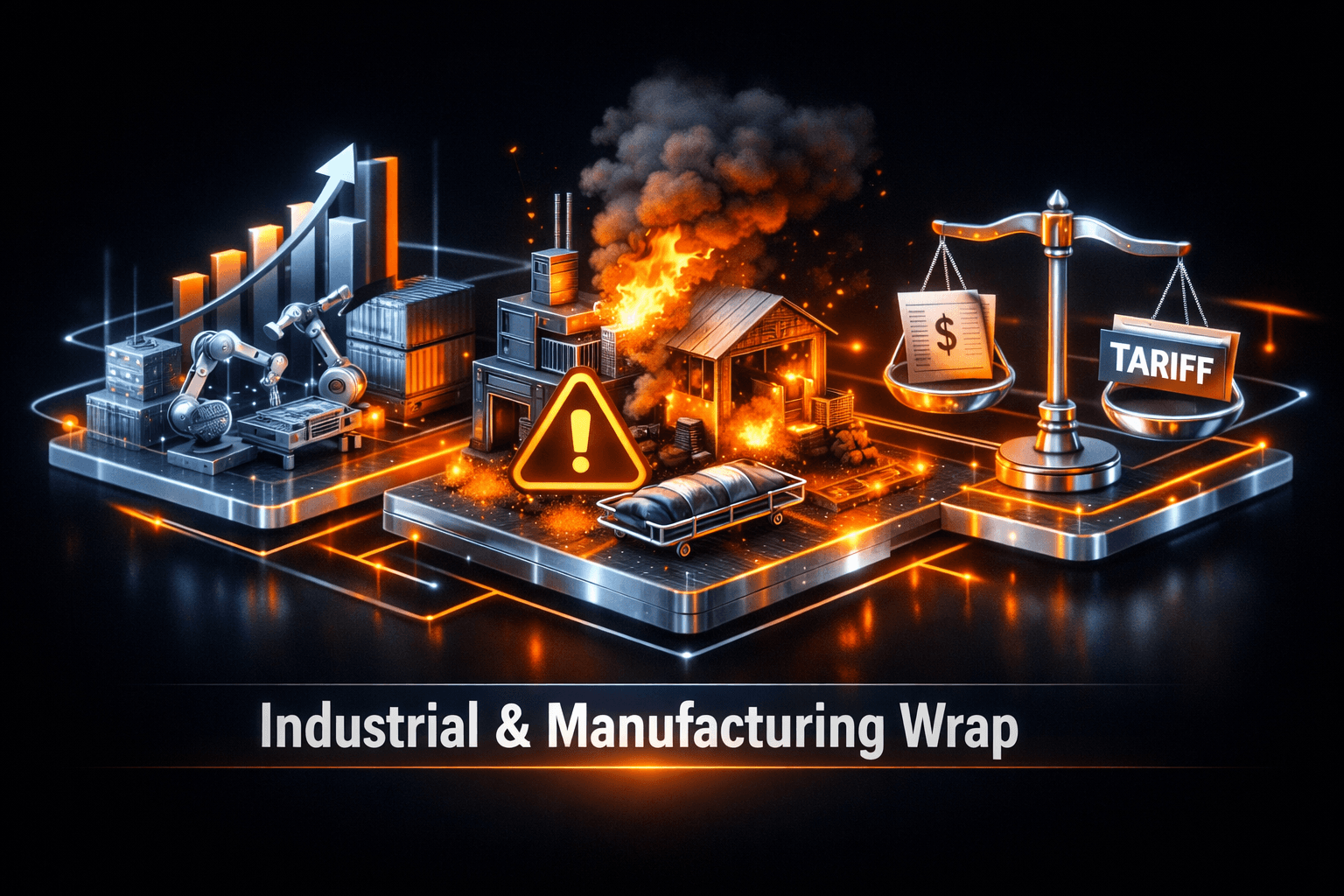
Today delivered a split picture for industrial and manufacturing investors, with growth signals from factory expansions and new supply-chain deals offset by a fatal mill incident and a legal setback on tariff refunds. You should take note of both the momentum and the risks, because each can affect production, logistics and costs in different ways.
Expansions and restarts point to capacity coming back online and strategic reshoring moves that may broaden supply options. At the same time you need to monitor safety, regulatory and trade developments closely, since those can create abrupt disruptions.
Market Highlights
Key market moves and company-specific updates today included several notable items investors are parsing.
- Target $TGT highlighted better inventory turns in Q1, pointing to improved in-stock metrics as it leans on AI and two new distribution facilities.
- Blue Origin announced a $600 million expansion of its Cape Canaveral manufacturing campus, a project expected to create about 500 jobs.
- Posco and ReElement signed a U.S. rare-earth and magnet production agreement aimed at reducing reliance on Chinese sources, a strategic supply-chain shift that could matter to electric vehicle and aerospace suppliers. Posco trades as $PKX.
- Nippon Dynawave Packaging, a unit of Nippon Paper, is assessing impacts after a Washington mill implosion that killed at least one worker, raising questions about near-term shipments and local operations.
- Novelis has started commissioning its New York aluminum plant after fire damage and expects to ramp up hot mill production in the coming weeks.
Key Developments
Nippon Paper mill incident raises supply and safety questions
The deadly implosion at a Nippon Dynawave Packaging facility in Longview, Washington, is the most acute negative of the day. The company said it is evaluating shipment impacts after a Tuesday incident that produced at least one fatality and local operational disruption.
For you that means potential short-term paperboard and packaging tightness for customers tied to that plant. Analysts note outages at single-source facilities can ripple through regional supply chains, so watch for official status updates and any notice on force majeure or rerouting plans.
Rare-earth JV with Posco targets supply diversification
ReElement and $PKX Posco inked a deal to build U.S. rare-earth and magnet production capacity linking South Korean feedstocks to U.S. manufacturing. The joint venture is aimed at cutting global dependence on China for critical materials used in EV motors, defense systems and industrial magnets.
This is a strategic development for long-term supply security. If the plan advances, you may see reduced pricing volatility for certain magnet-dependent suppliers and a new supplier pathway for OEMs that need predictable access to rare-earth elements.
Capacity additions and restarts add tangible momentum
Blue Origin’s $600 million expansion in Florida and Novelis’ commissioning of its New York plant both signal capacity coming online. Blue Origin's project is expected to create roughly 500 jobs at Cape Canaveral and expand aerospace manufacturing footprint in the Southeast.
Novelis expects to ramp hot mill production in the coming weeks after fire repairs. Taken together, these items suggest a near-term uptick in activity for suppliers of aluminum, aerospace components and associated logistics services.
What to Watch
Expect volatility around a few specific catalysts in the near term. First, watch official updates from Nippon Paper on shipments and repair timetables. How long the outage lasts will determine the scope of downstream impacts, and you should look for customer notices and order reassignments.
Second, monitor progress and permitting for the ReElement-Posco venture and Blue Origin’s construction timeline. These projects will move from announcements to procurement, hiring and subcontracting stages. That flow will highlight beneficiaries in equipment and services supply chains.
Third, keep an eye on trade and legal developments tied to tariff refunds. The Justice Department’s rebuttal to a suit seeking full tariff refunds for de minimis imports keeps uncertainty high in cross-border cost planning. That could influence import decisions and landed-cost models for manufacturers and distributors.
Finally, if you are tracking energy storage for industrial sites, the BESS design and risk mitigation guidance published today is useful. Integrating a battery energy storage system takes planning for thermal, fire and electrical risks, so expect engineering and insurance costs to figure into project timelines.
Bottom Line
- Sector sentiment is mixed, with expansion and restart news offset by safety and trade risks.
- Watch Nippon Paper’s operational updates closely, because plant outages can produce immediate supply-chain effects.
- Supply-chain diversification in rare earths via the ReElement and Posco deal could ease long-term material risks for EV and aerospace supply chains.
- Blue Origin’s $600 million expansion and Novelis’ restart point to incremental capacity and hiring that can boost regional manufacturing activity.
- Legal uncertainty over de minimis tariff refunds adds a cost and planning risk for import-heavy operations.
FAQ Section
Q: What immediate impact will the Nippon Paper mill incident have on suppliers and customers? A: The company is still evaluating shipment impacts, but outages at single plants often force short-term rerouting, higher freight costs, or temporary shortages for customers dependent on that facility.
Q: How material is the ReElement and Posco deal for rare-earth supply chains? A: The joint venture is a strategic step toward U.S. capacity and reduced reliance on China, though scaling production will take time and require permitting and investment before supply effects are felt.
Q: Should I expect tariff costs to change after the de minimis refund litigation? A: The Justice Department’s rebuttal means full tariff refunds are not assured, so companies should plan for tariffs to remain a potential landed-cost factor while the legal process unfolds.