The Big Picture
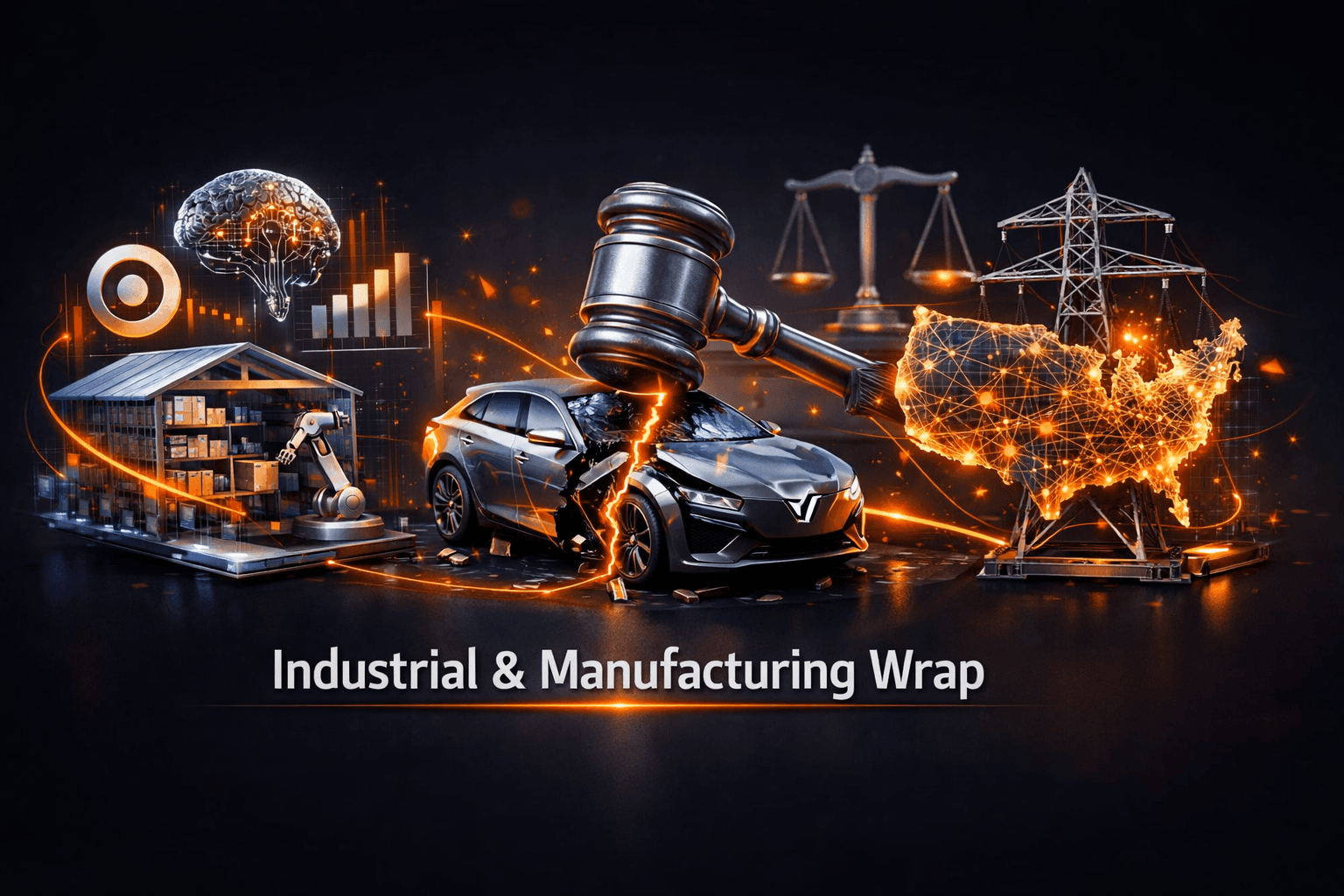
Today’s Industrial & Manufacturing news delivered a split message, with technology and inventory wins on one side and legal and infrastructure risks on the other. You saw retailers and warehouse operators lean into AI and robotics to reduce volatility, even as a high-profile EV project stalled and the U.S. power grid drew fresh concern.
Why does this matter to you as an investor? These themes point to selective capital spending and a two-speed sector, where companies that can adopt software and resiliency tools may gain operational edge, while others face increased project and energy risk.
Market Highlights
Trading was driven by company-specific headlines rather than a broad sector move. Below are the key market reactions and quick facts from today.
- Target, $TGT: Announced improved Q1 inventory turns and plans to use AI tools plus two new facilities to cut in-stock volatility.
- VinFast, $VFS: North Carolina sued to reclaim a megasite tied to a delayed $3 billion auto and battery plant, posing a material setback for the project.
- Warehouse robotics and software: Coverage highlighted growing attention to intelligent software as the missing ingredient for many robotics deployments.
- Energy and manufacturing: Analysts and trade pieces warned the U.S. grid’s stress could force manufacturers to create contingency plans for power disruptions.
Key Developments
Target’s inventory gains, AI and new facilities
Target reported better inventory turns in Q1 and emphasized using artificial intelligence alongside two new fulfillment facilities to reduce stock volatility. For you, that suggests inventory-led margin and sales stability is improving at large omnichannel retailers.
The implication is practical: better turns reduce markdown risk and free up cash for other investments. Companies that can combine physical footprint changes with software upgrades may be ahead of the curve.
VinFast legal fight threatens a $3 billion plant
North Carolina filed suit to take control of a megasite linked to a proposed $3 billion VinFast automotive and battery facility after construction and investment delays. The state is seeking to protect taxpayer funds tied to the project.
This raises questions about execution risk for large greenfield projects and the durability of public-private deals. If you own exposure to suppliers or regional contractors, monitor contract and payment risk closely.
Robotics without brains is only half the story
Industry reporting emphasized that many warehouse deployments still lack sophisticated software, which limits throughput and flexibility. Investing in intelligent systems appears essential for operators using autonomous robots at scale.
That means software vendors and integrators could see more pipeline opportunity, while hardware-only suppliers might face pressure to bundle smarter control layers. Are you positioned to follow the software-led winners?
What to Watch
Look ahead to these catalysts and risks that could move stocks and project outcomes over the coming weeks.
- Legal and contract updates on VinFast, $VFS: Any settlement, re-bid or state action will change investment and supplier exposure.
- Retail earnings and inventory metrics: Watch other retailers for similar inventory turn moves, and look for commentary on AI-driven replenishment tools.
- Grid and energy developments: Federal or state policy responses to grid stress, plus utility rate changes, could affect manufacturers’ operating costs and capex plans.
- Robotics & software deal flow: Monitor announcements from warehouse software vendors and integrators. New partnerships or deployments will signal wider adoption.
- Capital spending trends: Data on industrial capex and factory builds will show whether firms are prioritizing resilience over cost in planning.
Bottom Line
- Mixed signals dominate: software and AI are beginning to improve operations, but adoption is uneven and execution risk remains high for greenfield projects.
- Target’s inventory improvements show the value of combining facilities with AI, data that analysts note may translate to steadier sales and margin outcomes.
- The VinFast lawsuit underscores project and political risk for large manufacturing investments backed by public incentives.
- Energy stress on the U.S. grid is a growing operational risk that could shift manufacturer priorities toward resiliency over cost.
- For you, selectivity counts: track software-enabled players and companies with clear resiliency plans, and watch legal and energy developments closely.
FAQ Section
Q: How will Target’s inventory turn improvement affect retail peers? A: Improved turns suggest peers may pursue similar AI-driven replenishment and fulfillment investments to reduce out-of-stocks and markdowns.
Q: What does North Carolina’s suit against VinFast mean for suppliers? A: The suit increases uncertainty over payments and timelines, so suppliers and contractors should monitor contract enforcement and state actions.
Q: Should you expect rapid adoption of AI and automation across manufacturing? A: Data suggests adoption will be uneven. Many firms face cost and skills barriers, so gains will likely cluster with larger or digitally-ready companies.