The Big Picture
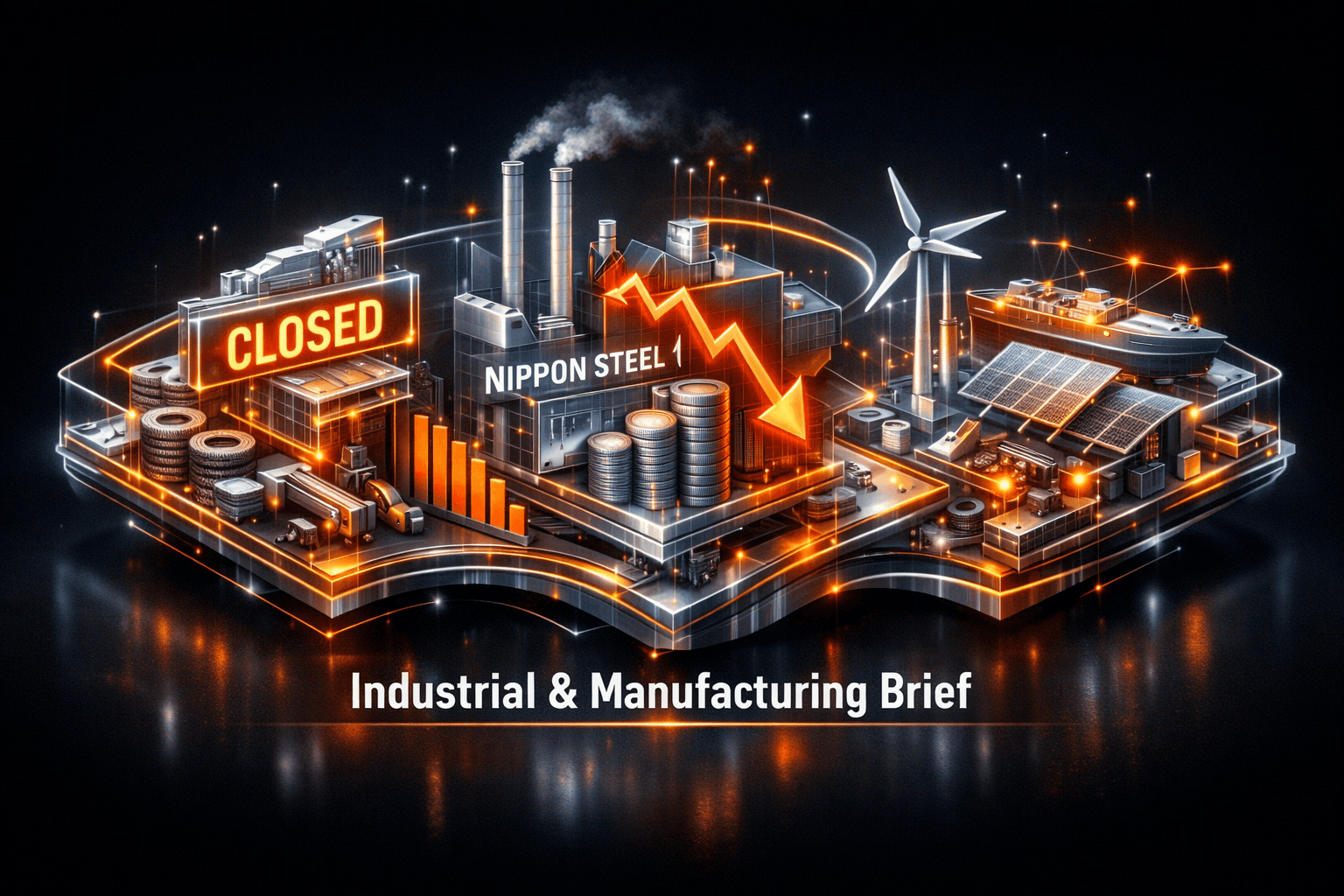
Today’s Industrial & Manufacturing sector is on the defensive after a string of downside headlines. Clean-energy manufacturing lost 5,900 jobs in Q1, Goodyear is weighing a closure that would affect 1,700 workers, and Nippon Steel reported a 95% plunge in FY2025 profit.
These developments matter because they highlight demand weakness, policy-driven investment shifts, and industry-specific shocks that could pressure earnings and margins across the supply chain. At the same time, a handful of strategic moves by major companies show how some firms are adapting to higher costs and policy volatility.
Market Highlights
Quick facts and figures to start your trading day.
- Renewable manufacturing jobs, Q1: net loss of 5,900, per Environmental Defense Fund, tied to roughly $1.4 billion in canceled investments.
- Goodyear Tire & Rubber, $GT, in talks to close its Fayetteville, North Carolina plant, affecting about 1,700 employees amid weak demand and raw material disruptions.
- Nippon Steel reported FY2025 profit down 95%, following a weak global steel market and one-off issues, including a Hokkaido fire, as it integrates U.S. operations tied to $X.
- General Motors, $GM, said it now sources 100% renewable energy for U.S. operations and had matched 70% of global electricity use with renewables in 2025.
- FedEx, $FDX, expanded its ServiceNow partnership with procurement integration to boost supplier visibility and data-driven sourcing.
Key Developments
Clean-energy manufacturing faces a policy-driven pullback
The Environmental Defense Fund reported a net loss of 5,900 clean-energy manufacturing jobs in Q1, linked to about $1.4 billion in canceled renewable investments after changes to federal EV, renewable, and tailpipe policies. That suggests policy shifts can translate quickly into canceled capacity and slower demand for component makers.
If you follow renewable equipment and battery suppliers, this is a reminder that federal policy remains a material risk to near-term demand. What happens next in Washington will matter for capital planning across the supply chain.
Plant-level pain: Goodyear talks and steel earnings shock
Goodyear, $GT, is in talks to close a North Carolina tire factory that employs about 1,700 people, according to reporting. Management is said to be restructuring its manufacturing footprint amid weak tire demand and raw material volatility.
At the same time Nippon Steel posted a 95% drop in FY2025 profit as global steel demand cooled and the firm navigated one-off events and integration costs linked to its U.S. operations. These stories underline how both cyclical demand and operational disruptions can compress margins at scale.
Supply-chain moves and sustainability push show selective resilience
FedEx, $FDX, advanced its ServiceNow partnership to integrate procurement and supplier data, aiming to improve visibility and decision-making across logistics and sourcing. You should watch how faster data flows affect supplier risk and inventory turns.
Meanwhile General Motors, $GM, claims 100% renewable sourcing for U.S. operations, and matched 70% globally in 2025. That commitment reduces energy-cost exposure over time and may shift supplier expectations for renewable procurement.
What to Watch
Look ahead to the catalysts that could move names within the sector and the risks you'll want to monitor. First, policy clarity on EV incentives and emissions rules is likely to shape renewable equipment demand and could reverse some of the job losses if investment resumes.
Second, keep an eye on manufacturing footprint announcements and union responses after the Goodyear news. Plant closures can create temporary cost savings but also lead to customer or contract disruptions.
Third, monitor commodity and raw material prices, and how companies communicate margin management. Tariff volatility and input-cost swings remain front-line issues for product design, sourcing, and margin protection. Can manufacturers weather the tariff storm or will price pressure force further restructuring?
Finally, track rollout timelines for supply-chain tech integrations, like $FDX and ServiceNow. Faster procurement analytics can reduce supplier risk exposure, but benefits may lag while systems are implemented.
Bottom Line
- Sector tone is cautious, driven by job losses, a potential $GT plant closure, and tier-one earnings weakness at Nippon Steel.
- Policy shifts are materially affecting renewable manufacturing. Analysts note $1.4 billion in canceled investments and thousands of lost jobs in Q1.
- Selective positives exist, including $GM's U.S. renewable milestone and $FDX's procurement integration. These are strategic moves, not immediate demand cures.
- Watch policy updates, raw material prices, and specific corporate cost actions for signals you can use to reassess exposure to manufacturing names.
- Data suggests the near term favors selectivity and risk management across the industrial complex rather than broad exposure.
FAQ Section
Q: How serious are the clean-energy manufacturing job losses? A: The EDF reports a net loss of 5,900 jobs in Q1 tied to roughly $1.4 billion in canceled renewable investments, indicating meaningful near-term disruption to equipment and component manufacturers.
Q: Could the Goodyear plant closure ripple through the supply chain? A: Yes, closing a 1,700-worker plant can affect local suppliers and logistics flows, and may prompt contract rebalancing or pricing changes for tire customers.
Q: Will corporate sustainability pledges like GM's reduce cost volatility? A: Renewable sourcing can lower long-term energy exposure and supply risk, but the near-term impact on margins depends on contract timing and energy market prices.