The Big Picture
Industrial and manufacturing stocks traded under pressure today as fresh evidence of demand and policy-driven disruption hit the sector. You saw a mix of structural shifts in clean energy hiring, supply chain adjustments, and major cost shocks that together suggest investors should be cautious heading into next week.
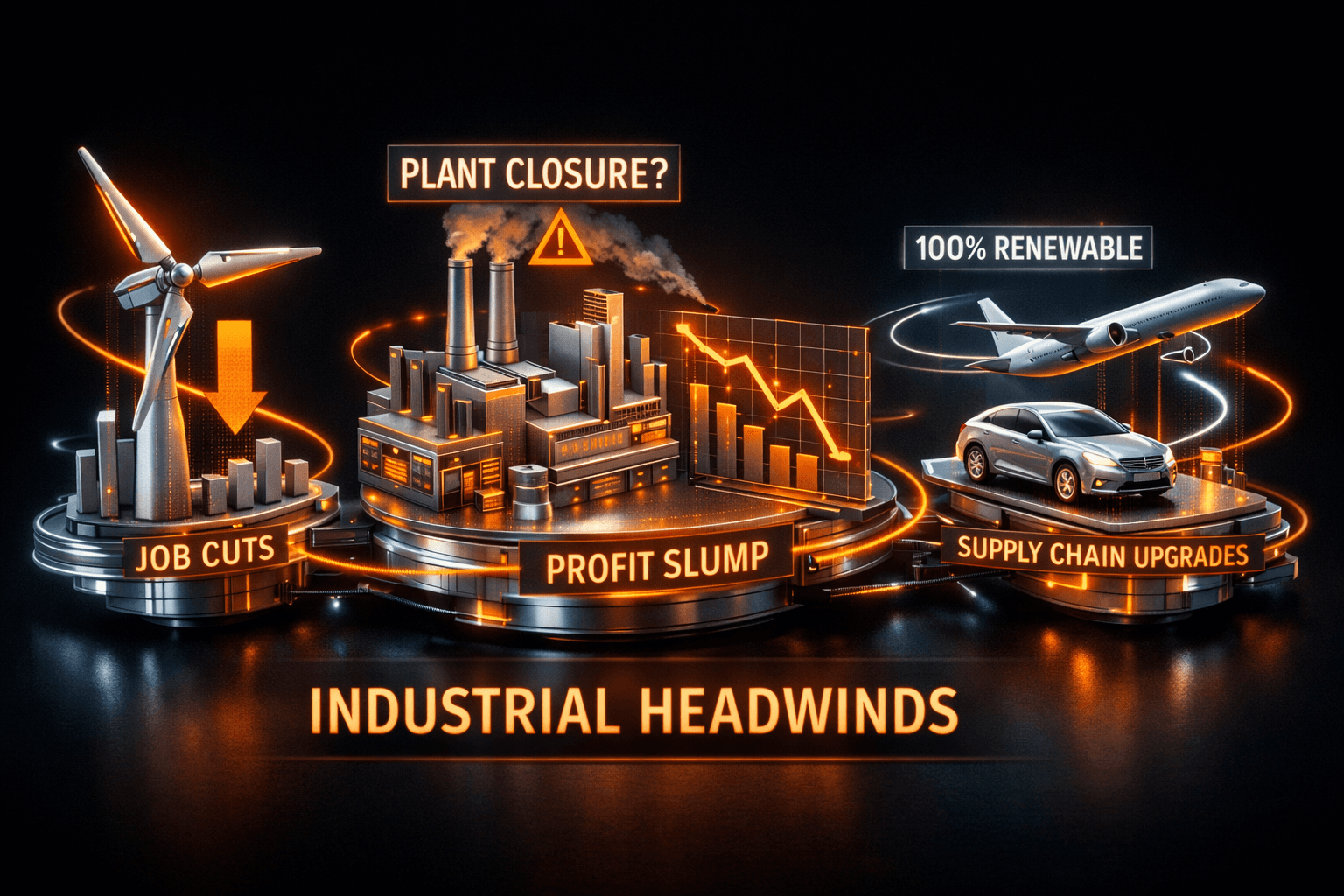
The most impactful items were the Environmental Defense Fund's finding that clean-energy manufacturing lost 5,900 jobs in Q1 and reports that Goodyear $GT is discussing closure of a Fayetteville, North Carolina tire factory employing about 1,700 people. Those developments, along with a steep 95% profit drop at Nippon Steel $NSS, highlight near-term headwinds even as companies like General Motors $GM advance sustainability goals.
Market Highlights
Here are the quick facts and numbers you need to know from today's headlines.
- Clean-energy manufacturing, Q1: net loss of 5,900 jobs, per an EDF analysis tied to roughly $1.4 billion in canceled renewable investments.
- Goodyear $GT: in talks to close its Fayetteville, NC tire plant, which employs about 1,700 workers as the company reshapes its footprint amid weak demand and raw material volatility.
- General Motors $GM: said it sources 100% renewable electricity for its U.S. operations and matched 70% of global electricity use with renewables in 2025.
- Nippon Steel $NSS: reported a FY2025 profit plunge of 95%, driven by a weak global metals market, a fire at a Hokkaido plant, and integration costs after U.S. operations deals.
- Supply-chain moves: FedEx $FDX advanced its ServiceNow $NOW procurement integration to improve supplier visibility, and smaller manufacturers like Bazooka shifted supplier strategies to absorb tariff pain.
Key Developments
Clean-energy job losses and canceled investments
The Environmental Defense Fund reported a net loss of 5,900 renewable energy manufacturing jobs in Q1, linked to about $1.4 billion in canceled investments. For you that means the green transition is still uneven, with policy shifts having material effects on factory-level employment and near-term demand for equipment makers.
Goodyear $GT plant talks amid weak demand
Goodyear is reportedly in discussions to close its Fayetteville, NC tire plant, a move that would affect 1,700 workers. The story signals continued pressure on cyclical producers from softer end-market demand and supply disruptions; supplier and regional economic impacts could ripple beyond the factory gates.
Nippon Steel $NSS profit plunge and integration pain
$NSS posted a 95% drop in FY2025 profit, citing a weak metals market, a damaging fire at a Hokkaido facility, and costs tied to integrating U.S. operations. That result underscores how one-off events and macro weakness can quickly erode margins in heavy manufacturing, and it raises questions about capital allocation and near-term cash flow for steel-exposed names.
Supply-chain adaptations and sustainability pushes
On the operational side, $FDX expanded its ServiceNow $NOW procurement integration to boost supplier visibility, which should help firms manage risk and contain costs. Bazooka's supplier collaboration in response to tariffs and $GM’s pledge to source 100% renewable power in the U.S. reflect two parallel trends: firms are both reshaping supplier deals to protect margins and accelerating sustainability actions that can alter long-term cost structures.
What to Watch
Expect a bumpy near-term outlook for cyclical manufacturers. You should watch upcoming earnings from tire and auto suppliers for margin and volume commentary. When will demand normalize, and how soon will policy clarity around clean energy return? Those are the key questions for the next several reporting cycles.
Key catalysts to monitor include next week’s earnings for major suppliers, any formal announcement from $GT on plant status, $NSS management commentary on cost controls and integration, and follow-up reporting on canceled renewable projects tied to federal policy changes.
Risk factors include tariff volatility, raw material disruptions, and further policy shifts that could cancel or delay projects. Keep an eye on order books and backlog metrics, because they’ll tell you whether demand is rebounding or continuing to cool.
Bottom Line
- Headwinds are material: job cuts in renewables, potential factory closures at $GT, and a steep earnings decline at $NSS point to near-term weakness.
- Operational resilience helps: $FDX’s procurement integration and Bazooka’s supplier collaboration are examples of businesses adapting to protect margins.
- Sustainability is a longer-term tailwind, but it won’t fully offset cyclical softness in the near term, even with $GM sourcing 100% renewable power in the U.S.
- Watch earnings and order books closely, and be ready to reassess exposure as firms update guidance and cost outlooks.
- Data suggests caution is warranted while companies and policymakers sort through demand, tariffs, and integration issues. Remember, firms will need to weather the storm before momentum can sustainably return.
FAQ Section
Q: How will the $GT plant talks affect tire supply? A: If the Fayetteville plant closes, production capacity would shift to other facilities and could tighten regional supply in the near term, depending on Goodyear's redeployment plans.
Q: Does $GM’s 100% U.S. renewable sourcing change earnings outlook? A: The move improves long-term energy cost visibility and ESG credentials, but it’s unlikely to be an immediate earnings lever; analysts will watch any near-term cost impacts and contracts tied to renewables.
Q: What should you watch next on the clean-energy job losses? A: Look for state or federal follow-up on canceled projects, updates from affected manufacturers, and hiring trends in upcoming monthly employment reports to gauge whether job cuts persist or reverse.