The Big Picture
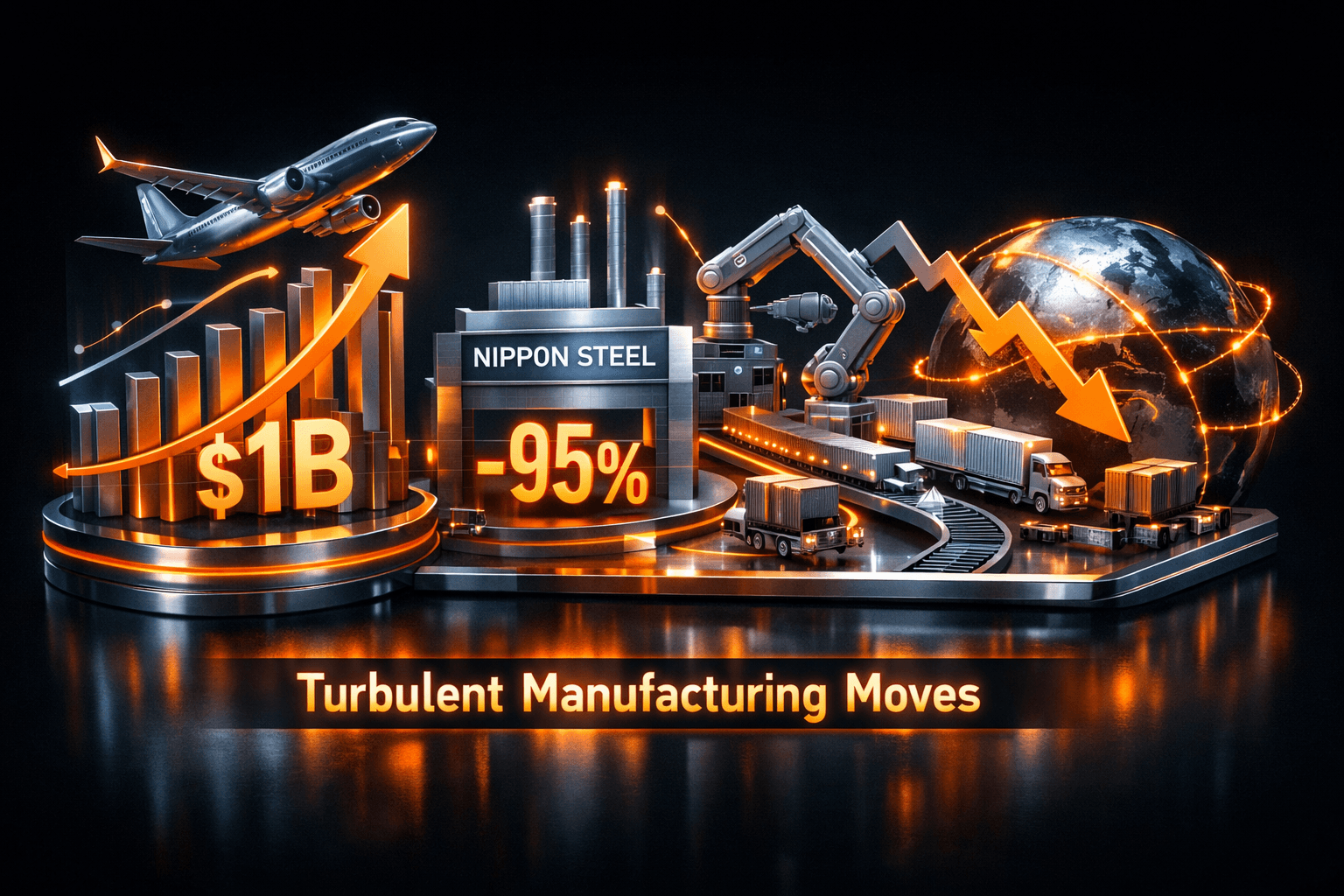
Today delivered a mixed set of signals for the Industrial & Manufacturing sector, with a large capital commitment from Boeing contrasting sharply with a profit collapse at Nippon Steel. You need to weigh growth and automation catalysts against demand weakness and cost pressures when you think about the space.
Boeing's $1 billion investment in Kansas and plant automation projects point to capacity and productivity gains, while Nippon Steel's 95 percent drop in full-year profit highlights persistent commodity and one-off headwinds. Can incumbents weather tech disruption and rising policy complexity at the same time?
Market Highlights
Quick facts and market-moving numbers from today's coverage.
- Boeing, $BA, announced a $1 billion investment in Kansas facilities and is preparing to raise 737 Max monthly production from 42 to 47 this summer.
- Nippon Steel saw FY2025 profit plunge 95 percent, driven by weak global demand and a Hokkaido plant fire as it integrates U.S. operations tied to $X ownership.
- Logistics leaders $FDX, $AMKBY and $GXO publicly downplayed the competitive threat from $AMZN's new Supply Chain Services offering, saying their service mix and scale differ.
- Smurfit Westrock and partners opened a high-automation box plant in Wisconsin that uses about 60 percent of the labor of a traditional facility, signaling efficiency gains for packaging, cited alongside $WRK.
- Bob's Discount Furniture is contending with a 25 percent upholstery tariff and outlined a three-step mitigation playbook to offset duties and fuel cost swings.
Key Developments
Nippon Steel's earnings shock and what it means
Nippon Steel reported a 95 percent drop in FY2025 profit, blaming weak global steel markets, integration costs after the U.S. deal and a fire at a Hokkaido site. The magnitude of the decline underscores commodity cyclicality and the execution risk of large cross-border integrations tied to U.S. Steel assets, referenced by $X involvement.
For you as an investor, the takeaway is clear: steel exposure remains sensitive to macro demand and one-off events. Analysts note this could pressure margins across suppliers and OEMs that rely on steel-intensive supply chains.
Boeing pushes capacity with $1B Kansas investment
$BA said it will invest $1 billion in Kansas facilities as it integrates Spirit AeroSystems fuselage operations and prepares to lift 737 Max output from 42 to 47 planes per month. The move aims to accelerate deliveries and relieve supply bottlenecks ahead of summer production ramping.
This is a concrete capacity catalyst. If Boeing hits the ramp targets, it could ease production logjams for suppliers and signal improving commercial demand. You should watch supplier backlogs and delivery schedules for early confirmation.
Automation, logistics and policy: the operating mix
Automation headlines came from Smurfit Westrock's 'superplant' in Wisconsin, which uses robotics to achieve roughly 40 percent labor savings compared with a traditional box plant. Plant-level AI guidance for manufacturers also entered the conversation, with experts framing AI as a systems discipline changing plant design and operations.
At the same time, logistics incumbents $FDX, $GXO and global carrier $AMKBY downplayed competitive risks from $AMZN's Supply Chain Services, arguing that scale and specialized offerings set them apart. Meanwhile, retailers such as Bob's face a 25 percent upholstery tariff and are deploying mitigation strategies to protect margins. CalRecycle published SB 54 guidance for packaging producers, clarifying who is a covered producer and which materials may be excluded under EPR rules.
Taken together, automation and AI are offering cost relief, but regulatory and tariff complexity are raising operating costs in parts of the value chain. How will you judge the balance between productivity gains and new policy headwinds?
What to Watch
Focus on the near-term catalysts and risks that could move names you follow tomorrow and in the coming weeks.
- Production ramp confirmation: monitor Boeing delivery schedules and supplier orders as $BA moves from 42 to 47 737 Max units per month.
- Steel demand indicators: watch global steel prices, shipping volumes and end-market demand for construction and autos after Nippon Steel's profit miss.
- Tariff and regulatory updates: keep an eye on tariff appeals, mitigation outcomes and state-level implementation of SB 54, which will affect packaging producers and recyclers.
- Automation adoption signals: follow order growth or capital plans from packaging and contract manufacturers like $WRK and robotics suppliers, plus AI implementation case studies that show productivity lift.
- Logistics competition: monitor statements and contract wins by $FDX, $GXO and $AMZN to see whether Amazon's move gains enterprise customers or remains a niche play.
Bottom Line
- Neutral near term, because strong capacity and automation investment is balanced by demand weakness and policy costs.
- $BA's $1 billion Kansas investment and the 42 to 47 monthly ramp are positive operational catalysts to watch for supply chain effects.
- Nippon Steel's 95 percent profit plunge highlights cyclical and execution risks in commodity supply chains that could pressure related suppliers.
- Automation and AI are driving efficiency gains, but tariffs and packaging regulations like SB 54 add complexity and potential cost for producers and retailers.
- Stay selective and follow delivery schedules, pricing trends and regulatory rulings to separate the wheat from the chaff in your industrial exposure.
FAQ Section
Q: What does Boeing's $1B Kansas investment mean for suppliers? A: It suggests higher near-term production demand, so suppliers should see increased work if Boeing meets ramp targets, analysts note.
Q: How will Nippon Steel's profit drop affect steel-dependent manufacturers? A: The 95 percent profit decline signals softer demand and potential price pressure, which could squeeze margins for steel-intensive OEMs.
Q: Should I worry about Amazon entering logistics services? A: Incumbents such as $FDX and $GXO are downplaying the threat today, but you should monitor contract announcements and enterprise adoption as a leading indicator.