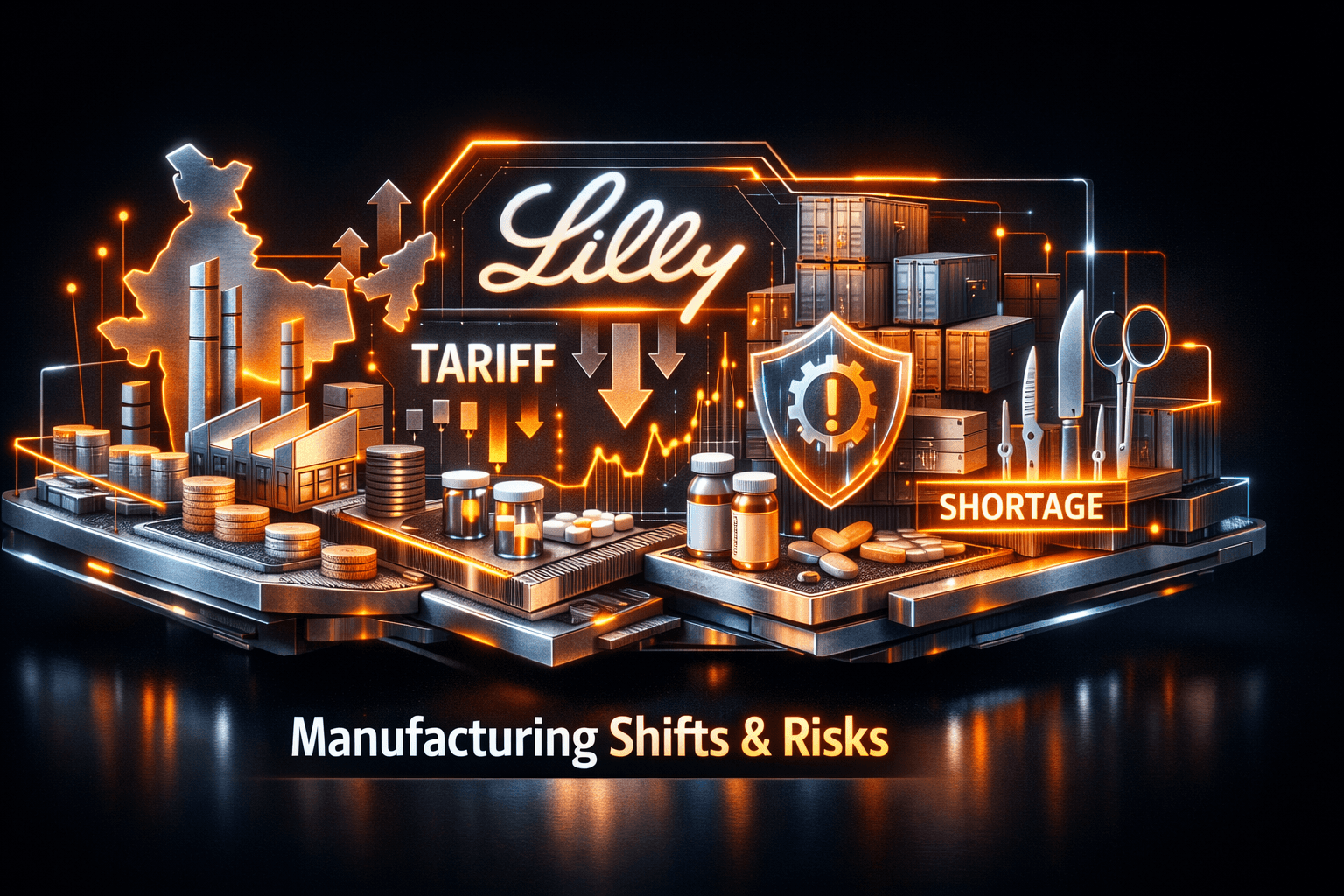
The Big Picture
Global capital commitments and industrial tech moves dominated headlines over the past 48 hours, even though U.S. markets were closed on Sunday. You saw big dollar figures and big policy headlines that could reshape supply chains and plant economics heading into the next trading session.
Investments totaling roughly $24.5 billion in U.S. manufacturing capacity, paired with faster automation rollouts, point to strengthening industrial demand. At the same time, tariff threats and production disruptions mean you should keep a close eye on policy and supplier continuity risks.
Market Highlights
Here are the quick facts and figures that matter to your industrial and manufacturing watchlist as of Friday, May 8.
- India-based companies announced a record roughly $20 billion of U.S. investments at the SelectUSA summit, expecting to expand manufacturing and R&D footprints.
- Eli Lilly, $LLY, said it will increase U.S. manufacturing investment by $4.5 billion across Indiana to support genetic therapies and weight-loss drugs.
- Procter & Gamble, $PG, moved Supply Chain 3.0 and related platforms into a large-scale global rollout aimed at boosting warehouse and plant productivity.
- The U.S. Court of International Trade ruled the administration's 10% global tariff unlawful for three parties, while the White House set a July 4 deadline for the EU to implement a tariff deal, adding policy uncertainty.
- The FDA warned of ongoing neurosurgical supply disruptions affecting items like patties and sponges, which could squeeze hospitals and med-tech suppliers through 2026.
Key Developments
India-led $20B investment wave lands in the U.S.
At the SelectUSA summit Maryland and other state leaders welcomed roughly $20 billion in announced U.S. investments by India-based firms, plus additional partnerships with France, Korea, Jordan and South Africa. This wave of foreign direct investment supports more factory builds and advanced manufacturing jobs in states vying for high-tech production.
For you that means more demand for industrial real estate, tooling, and domestic supply chains. It also suggests longer term order visibility for equipment makers and systems integrators that supply greenfield sites.
Lilly's $4.5B boost and the med-tech supply squeeze
Eli Lilly's plan to pour another $4.5 billion into Indiana manufacturing is aimed at capacity for genetic therapies and popular weight-loss drugs. That expansion underlines how pharma capex remains a bright spot for industrial equipment and construction services.
Yet the FDA's warning about neurosurgical supply shortages shows the other side of medical manufacturing, where single-source items can cause persistent bottlenecks. How you balance exposure to large pharma spend and smaller but critical med-tech supply chains could matter for portfolio risk.
Tariff drama and automation push reshape the operating backdrop
The political headlines were loud: the president gave the EU until July 4 to ratify a tariff deal while a trade court found the 10% global tariff unlawful for the litigants in the case. That mix increases near-term policy volatility for import-dependent manufacturers.
Meanwhile $PG's broad rollout of Supply Chain 3.0 and the growing emphasis on predictive maintenance, highlighted in a Limble CEO interview, show how companies are responding by leaning into automation and analytics. The trend points to lower operating costs over time even as trade policy keeps margins unpredictable.
What to Watch
Here are the catalysts and risks that could move industrial narratives when markets reopen on Monday, May 11. Will capital spending announcements translate into orders for suppliers, and will policy noise slow supply chain rebuilds?
- Policy dates and rulings: Track any follow-up to the trade court decision and the EU-U.S. tariff timeline ahead of July 4. Regulatory moves can shift input costs for import-reliant firms.
- Capex signaling: Watch supplier order books and backlog commentary from industrial equipment makers and construction services after the Lilly and India investment news.
- Supply continuity: Monitor FDA updates on neurosurgical supplies and company filings from med-tech names for revenue or margin impacts.
- Tech deployments: Look for progress reports from $PG and software vendors on automation rollouts and predictive maintenance adoption, which affect productivity and capital intensity.
- Earnings season cues: When firms report, focus on guidance revisions tied to input-cost inflation, tariff exposure, and the pace of automation spending.
Bottom Line
- Large investment announcements from India-based firms and $LLY's $4.5 billion commitment signal healthy industrial capex demand, but benefits will arrive over quarters not days.
- Trade policy remains a wildcard, with legal wins and political deadlines creating both downside risk and the potential for rapid cost shifts.
- Automation and predictive maintenance adoption, led by large CPG and software providers, point to productivity gains that can offset some margin pressure.
- Supply disruptions in critical med-tech items underline the importance of supplier diversification, especially for hospital-facing product lines.
- Stay selective and watch company-level order books and guidance, since headline dollars don't translate equally across suppliers and contractors.
FAQ Section
Q: How should you think about the $20 billion in India-based U.S. investments? A: The announcements indicate stronger FDI into manufacturing hubs, which should boost demand for construction, equipment, and local suppliers over several quarters.
Q: Will Eli Lilly's $4.5 billion spend immediately lift medical-equipment makers? A: Not immediately, since plant builds and commissioning take time, but it does increase medium-term demand visibility for contractors and equipment vendors.
Q: Should you expect tariffs to raise costs for industrials soon? A: Tariff risk is elevated because of political deadlines and court rulings, so watch specific company disclosures about import exposure and hedging strategies.