The Big Picture
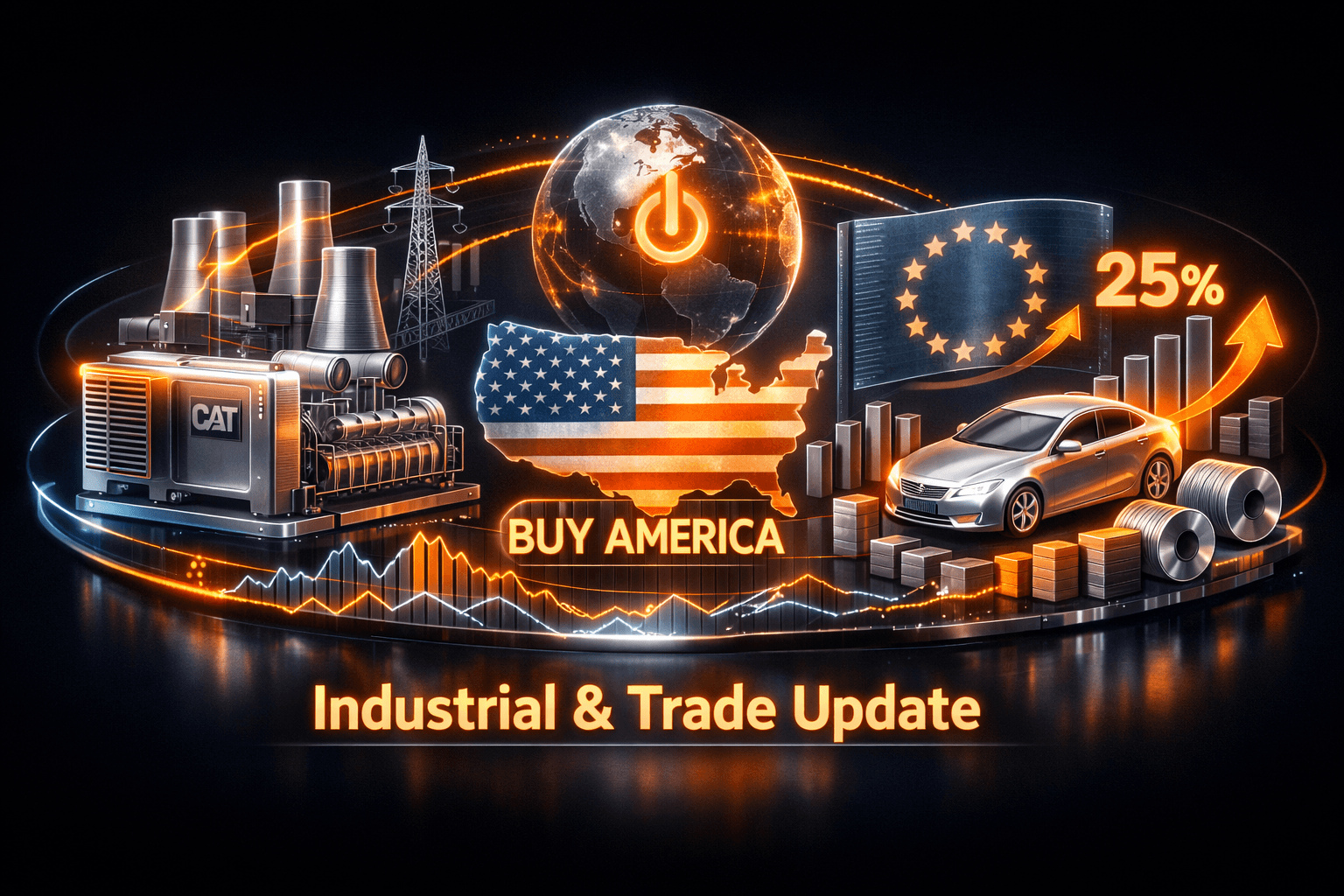
As of Friday, May 1 U.S. markets are closed for the weekend, but several developments over the last session and into Sunday reshape the outlook for industrial and manufacturing investors. Caterpillar's plan to sharply expand power-generation capacity and a new Senate bill to enforce Buy America rules point to stronger demand for domestic equipment and components.
At the same time, a proposed 25% tariff on EU cars and trucks and persistent price pressures reported by the ISM signal fresh headwinds for global supply chains and margins. You should be thinking about which firms can weather higher input costs, and which may benefit from onshoring and infrastructure-driven spending.
Market Highlights
Quick facts and what moved in the headlines as of Friday, May 1 and over the weekend.
- Caterpillar $CAT announced plans to roughly triple its power generation capacity to meet demand from data centers and oil and gas customers, and raised its 2030 targets, reflecting stronger industrial spending.
- President announced a planned 25% tariff on EU cars and trucks, citing noncompliance with a recent trade agreement, a move that could disrupt auto supply chains and shift production economics.
- Senators introduced legislation to tighten Buy America and Build America compliance after an OIG audit found the FAA omitted required Buy American clauses in IIJA-funded contracts.
- The ISM manufacturing report showed expansion for a fourth month, but all six of the largest manufacturing industries reported price increases, keeping input-cost pressure top of mind.
- Moody’s warned that software-defined vehicles may raise input costs and strain supplier relationships as vehicles shift to updatable platforms.
Key Developments
Caterpillar to triple power capacity, raises 2030 targets
Caterpillar $CAT told investors it will sharply expand power-generation capacity, driven by demand from hyperscale data centers and higher energy prices tied to geopolitical disruptions. The company raised its 2030 targets, signaling confidence in long-term demand for distributed power equipment.
For you, that means equipment makers and industrial suppliers tied to power and gas-fired generation may see order books lengthen. Analysts note capital intensity of these projects benefits established OEMs with service networks, though supply chains must scale to meet demand.
Senators push Buy America enforcement after OIG audit
A bipartisan group of senators introduced a bill to enforce Buy America clauses more strictly after a Department of Transportation OIG audit found the FAA failed to include required Buy American language in some IIJA-funded contracts. The move aims to close loopholes and strengthen domestic sourcing for federally funded projects.
If enacted, the bill could channel more federal project spending toward U.S. manufacturers and component suppliers. You should watch which subsectors stand to gain from IIJA-related procurement, especially electrical equipment, steel, and heavy machinery.
Tariff threat and software-defined vehicles add strain
The White House announced plans to impose a 25% tariff on EU-made cars and trucks next week, citing noncompliance with an agreement struck last summer. The announcement injects uncertainty into auto sourcing and pricing, and could trigger retaliatory measures.
At the same time, Moody’s warned that software-defined vehicles, which rely on updatable software platforms, are testing supplier relationships by increasing component complexity and input-cost variability. Taken together, tariffs and technological transitions mean auto suppliers and logistics providers face a double squeeze on costs and contract terms.
What to Watch
Heading into the next trading week, here are the catalysts and risks to monitor. What catalysts will alter your view of the sector, and how quickly could policy shifts translate into orders?
- Legislative movement on the Buy America enforcement bill. Passage or amendments could change procurement timelines and winner lists for IIJA projects.
- Tariff implementation and EU response. Look for details on exemptions, timelines, and targeted product lists. Auto OEMs and suppliers could announce production or sourcing changes fast.
- Company-level updates from major suppliers and OEMs. Earnings calls and investor days may reveal how firms plan to manage higher input prices and supply constraints.
- ISM and other manufacturing data. Continued expansion paired with rising input prices would suggest margins come under pressure unless firms pass costs along.
- Technology and supplier-readiness for software-defined vehicles. Watch contract wins or losses among Tier 1 suppliers as a signal of who can handle the transition.
Bottom Line
- The sector shows mixed signals: infrastructure and corporate capex are supporting demand, but trade policy and rising input costs increase uncertainty.
- Buy America enforcement could benefit domestic suppliers if the bill advances, analysts note, but implementation timing matters.
- Caterpillar's capacity ramp highlights pockets of durable demand, particularly in energy and data center segments.
- Auto supply chains face elevated risk from a proposed 25% EU tariff and the cost implications of software-defined vehicles.
- Stay selective, watch upcoming policy confirmations, and monitor ISM data and company guidance for margin signals.
FAQ Section
Q: How will Buy America enforcement affect manufacturers? A: Stronger enforcement will likely direct more federal project spending to U.S. suppliers, boosting demand for domestically made steel, machinery, and electrical equipment, though timelines depend on legislative action and agency implementation.
Q: Will the 25% tariff on EU autos hit U.S. manufacturers? A: The tariff is intended to penalize EU producers, but it could raise costs for U.S. automakers that rely on EU parts or face retaliatory measures. Supply-chain retooling and price pass-through are likely outcomes to monitor.
Q: What does 'software-defined vehicle' mean for suppliers? A: It means cars and trucks increasingly rely on centralized software platforms and frequent updates, which raises component complexity and integration costs and may favor suppliers with software capabilities and scale.