The Big Picture
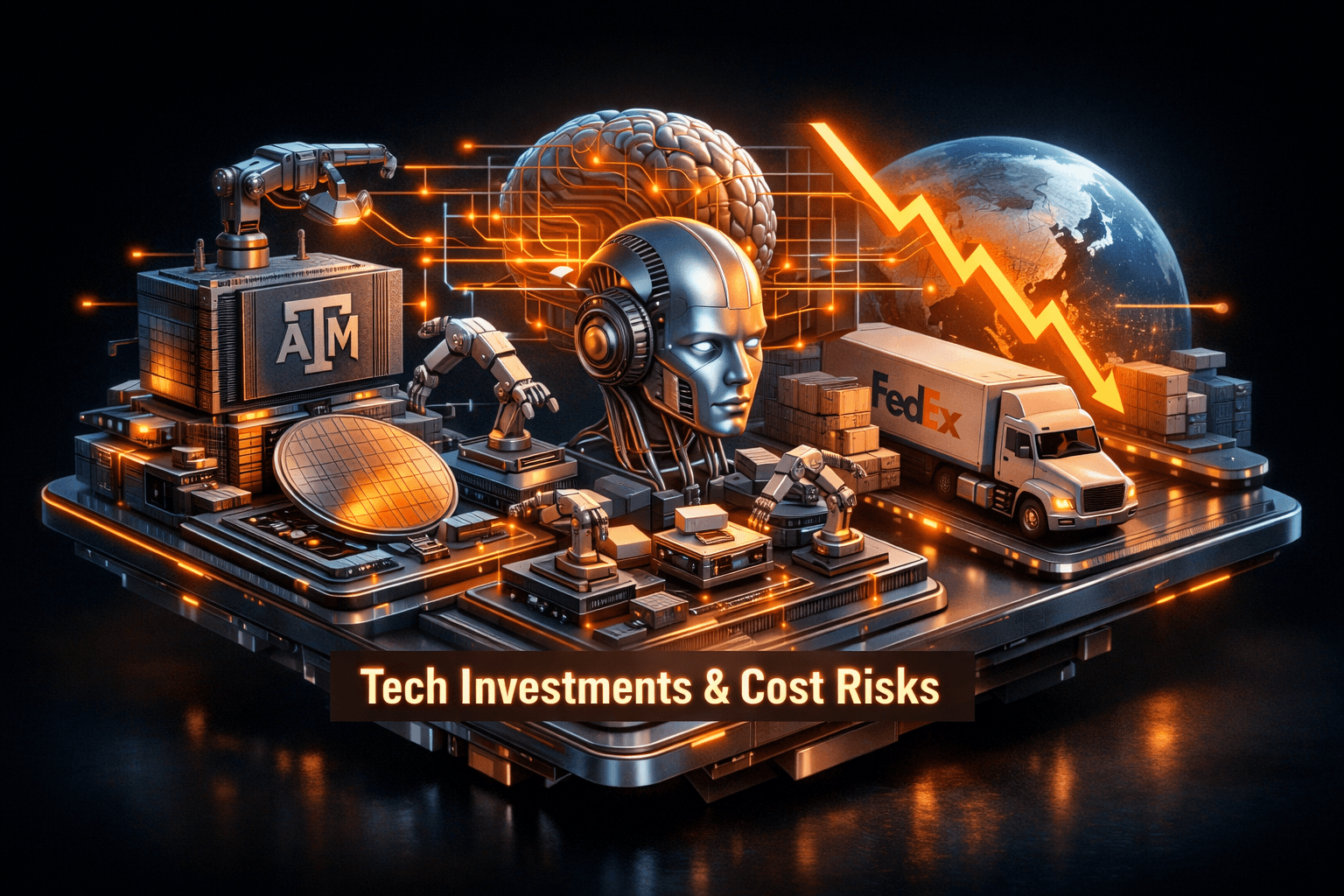
Higher-education and private-capital investment is backing industrial innovation this week, but rising logistics costs and geopolitical strain are tempering excitement. Texas A&M broke ground on a $226 million semiconductor research facility overnight, a tangible sign that public and private money is flowing into domestic chip development.
At the same time, you should note that manufacturers are running physical AI pilots before committing capital, and shippers are raising rates. That combination means growth catalysts are present, but so are near-term cost and supply risks for many industrial and manufacturing companies.
Market Highlights
Quick facts to help you orient before the opening bell.
- Texas A&M announced a $226 million Semiconductor Institute building, part of the Texas CHIPS Act effort to expand domestic R&D and workforce pipelines.
- Manufacturers are using third-party testing centers from Deloitte, Tata Consultancy Services and $MSFT partners to validate physical AI and automation before larger investments.
- FedEx announced One Rate price increases averaging about 7 percent in April, a direct cost headwind for shippers and consumer brands, reported this morning.
- Packaging supply chains continue to be disrupted by tariffs and the Iran war, driving CPGs to rethink sourcing strategies and resilience planning.
- Rail operator $NSC is pursuing freight growth through local switching partnerships, as Norfolk Southern works to expand capacity and service options for shippers.
Key Developments
Semiconductor R&D Boosts U.S. Capacity
Texas A&M’s ground breaking on a $226 million Semiconductor Institute is the most concrete near-term development. The facility is tied to the Texas CHIPS Act and aims to broaden research, training and collaboration between universities and industry. For you, that means more regional capacity for development and a potential talent pipeline that could ease longer term chip shortages.
AI and Automation Testing Centers Gain Traction
Manufacturers are not leaping into robotics and AI blind. Firms including Deloitte, Tata Consultancy Services and $MSFT-linked programs are offering physical testing environments so OEMs and contract manufacturers can pilot hardware and integration before scaling. That approach reduces implementation risk and helps you evaluate whether automation drives real margin improvement or just adds complexity.
Supply-Chain Strains and Logistics Moves
Geopolitical pressure from tariffs and the Iran war is still reshaping packaging supply chains. Brands say they can’t simply onshore everything, so they’re pursuing diversified sourcing and longer runway planning. At the same time, FedEx’s One Rate price hike of roughly 7 percent raises distribution costs, while $NSC’s partnership to expand switching operations in Georgia points to incremental capacity additions in the rail network.
What to Watch
Several near-term catalysts and risks will shape performance across the industrial and manufacturing space. What should you look for today and in the coming weeks?
- Chip ecosystem announcements, funding or partnerships tied to the new Texas A&M facility, which could signal broader regional investment opportunities.
- Pilot results from physical AI and automation testing labs, especially published case studies that quantify cycle-time, defect and labor impacts. Will automation deliver predictable ROI at scale?
- Updates from logistics providers on pricing and capacity. FedEx’s 7 percent One Rate increase is already official, but watch for responses from rivals and any immediate margin commentary from shippers or retailers.
- Packaging sourcing moves in response to tariffs and geopolitical risk. Companies that disclose near-term inventory or freight cost impacts will tell you how much margin pressure is happening now.
- Rail network capacity and contract changes. Partnerships like the one between Norfolk Southern and Jaguar Transport Holdings may relieve local bottlenecks. Keep an eye on service metrics and throughput numbers.
Ask yourself, which exposures matter most to your portfolio? If you have industrial names tied to logistics or CPG supply chains, you will want to pay particular attention to rate changes and sourcing shifts. If you follow semiconductor suppliers or automation vendors, watch announcements that could accelerate capital spending.
Bottom Line
- Neutral tone for the sector: investment and innovation are balanced by tangible cost and supply risks.
- Texas A&M’s $226 million semiconductor R&D project is a clear long-term positive for U.S. chip capability, pointing to more public-private engagement.
- Manufacturers are testing physical AI before scale, which should reduce integration risk and help separate the wheat from the chaff among automation vendors.
- Higher shipping costs from FedEx, about a 7 percent One Rate increase, and geopolitical disruption to packaging supply chains are immediate headwinds for margins.
- Logistics moves like the $NSC switching partnership add capacity, but they won’t erase the near-term cost pressures facing shippers and consumer brands.
FAQ Section
Q: How will the Texas A&M semiconductor facility affect chip supply? A: The new $226 million R&D center expands research and workforce capacity, which analysts note could ease development bottlenecks over time but will not instantly change production constraints.
Q: Should manufacturers invest in physical AI now? A: Testing centers allow companies to validate automation with lower risk, and data suggests pilots can clarify ROI before large capital commitments.
Q: What impact will FedEx’s price hike have on margins? A: A roughly 7 percent rise in One Rate pricing raises distribution costs for shippers and CPGs, so expect margin pressure or pricing adjustments downstream until carriers or shippers find offsets.