The Big Picture
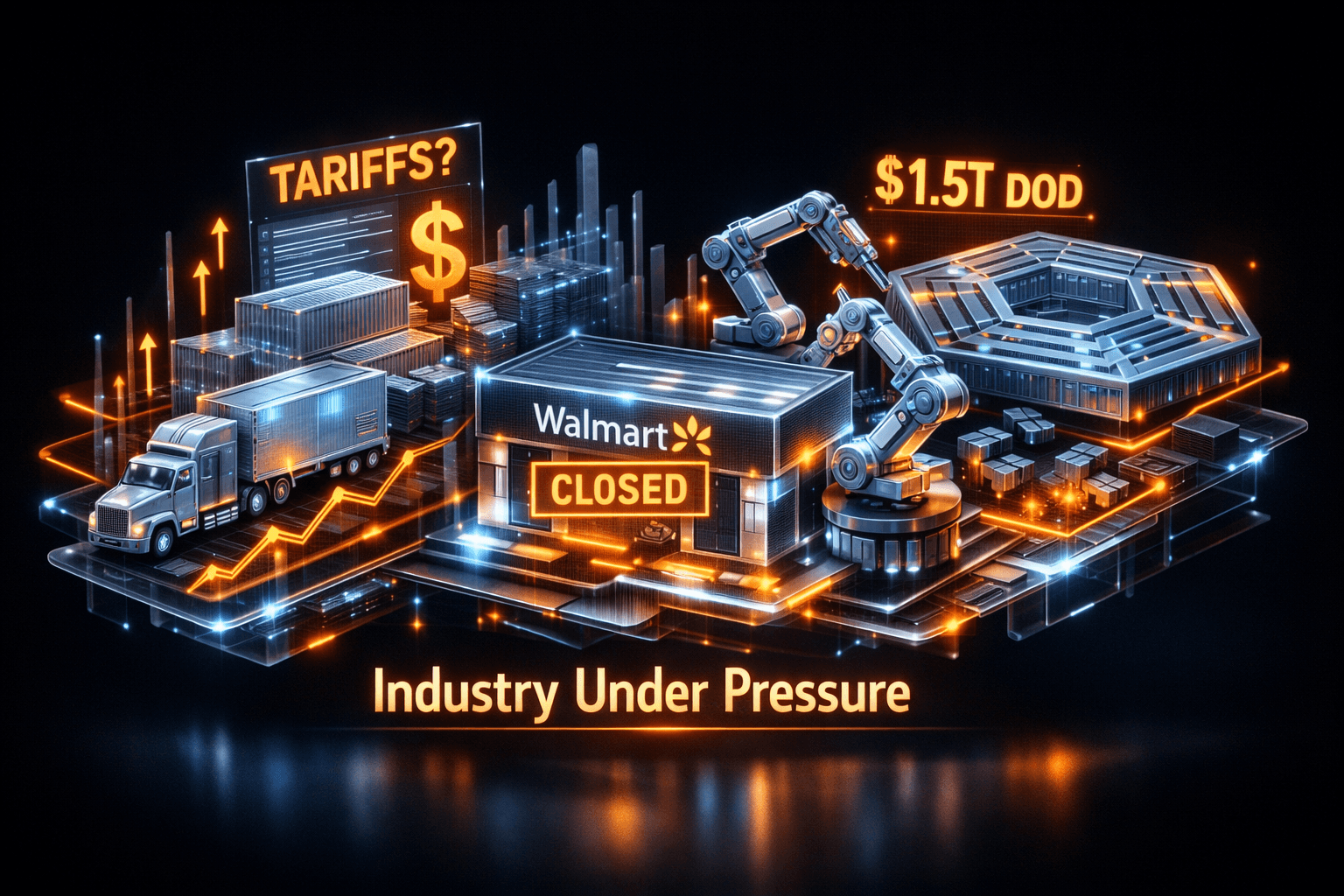
Today the industrial and manufacturing sector felt the squeeze from higher logistics costs and regulatory uncertainty, even as pockets of investment showed up in automation and defense spending. You saw concrete pain points on tariffs and freight rates, while companies and policymakers signaled longer-term shifts in production and procurement.
Why does this matter for you as an investor? Higher input and freight costs can compress margins across exposed manufacturers, and unresolved tariff issues add legal and cash-flow uncertainty. At the same time, automation deals and a large defense budget proposal point to selective upside for firms aligned with those themes.
Market Highlights
Here are the quick takeaways from today’s headlines and sector moves. Read this and you’ll know which themes drove the tape, and why some names moved relative to peers.
- Walmart ($WMT) announced it will close its Matteson, Illinois fulfillment center and reassign operations to other NextGen facilities, affecting 111 employees, a reminder of continued network optimization in retail logistics.
- Huntington Ingalls Industries ($HII) teamed with GrayMatter Robotics on physical AI as shipbuilding ramps automation, building on $HII’s earlier welding pact with Path Robotics.
- Air cargo rates from Northeast and Southeast Asia to North America jumped mid to high double digits, according to Xeneta, a sharp near-term cost shock for exporters and importers.
- Washington scrutiny of tariff strategies, including the First Sale valuation method, and widespread confusion over potential tariff refunds add regulatory risk for retailers and manufacturers.
Key Developments
Walmart facility closure, small workforce impact but wider note on cost optimization
Walmart will relocate operations from the Matteson fulfillment center to other NextGen sites, affecting 111 workers. You should view this as part of broader network rationalization, not an isolated sign of retail demand collapse. For suppliers and logistics partners, the move underscores efficiency drives that can change local volume flows.
Automation and physical AI gain traction at U.S. shipbuilder $HII
HII’s agreement with GrayMatter Robotics advances the company’s automation push after a February welding deal with Path Robotics. Analysts note automation can raise throughput, lower labor dependence, and tighten schedules for complex builds. If you follow industrial tech, ask which suppliers will benefit from higher automation integration.
Tariff uncertainty and congressional scrutiny create legal and cost risk
Manufacturers and retailers face growing confusion over whether they can recoup tariffs after recent court rulings, and Congress is taking aim at First Sale valuation rules. One attorney said, “No one really knows for certain what they should be doing,” which captures the operational and cash-management dilemma many firms now face.
Airfreight costs spike as geopolitical risk filters into logistics
Fighting related to Iran has pushed jet fuel and air cargo rates up sharply, with Xeneta reporting mid to high double-digit increases along some Asia-to-North America lanes. That raises near-term input costs for manufacturers and retailers who rely on air freight for inventory replenishment, and it may accelerate shifting orders to ocean routes where feasible.
Defense budget proposal signals long-term manufacturing demand
The White House’s proposed $1.5 trillion DOD budget for fiscal 2027 calls for more munitions production, shipbuilding and spending on domestic critical minerals and the F-47 fighter program. That suggests a sustained procurement runway for defense contractors such as $NOC, $LMT, $GD and $HII, but execution will depend on appropriations and program timelines.
What to Watch
As you plan your next moves, focus on catalysts and risks that will steer the sector over the coming weeks.
- Tariff outcomes and refund pathways: watch administrative filings, court rulings, and congressional hearings on First Sale valuation closely. Clarity, or the lack of it, will affect cash flows and cost forecasting for retailers and import-reliant manufacturers.
- Freight and fuel price trends: monitor jet fuel futures and Xeneta spot indices. Will air rates stay elevated, or will shippers shift to ocean freight and accept longer lead times? That timing will impact inventory strategies and working capital.
- Defense appropriation progress: the DOD proposal sets a tone, but you need to follow congressional markup and appropriations votes. Contract awards and prime subcontracting decisions will determine which firms see revenue boosts and when.
- Automation adoption and capex announcements: keep an eye on additional robotics and AI integration deals, especially among shipbuilders and heavy manufacturers. They can improve margins over time, but require upfront capital.
What should you be ready for tomorrow? Expect the tape to track any new regulatory comments on tariffs, fresh shipping rate data, and follow-ups from automation or defense contract announcements. How will companies balance margin pressure with capex needs? That’s the question management teams will be answering in conference calls and filings.
Bottom Line
- Headwinds today were driven by higher logistics costs and tariff uncertainty, which create near-term margin risks for manufacturers and retailers.
- Automation deals and the $1.5 trillion DOD budget proposal provide selective support for defense primes and industrial automation suppliers, suggesting pockets of opportunity.
- Watch tariff litigation, congressional action on valuation rules, and jet fuel and airfreight indices for the next moves in working capital and cost pass-through strategies.
- Expect company-level divergence, so your approach should be selective and focused on balance sheet resilience and exposure to freight and tariff risk.
FAQ Section
Q: How will higher air cargo rates affect manufacturers? A: Higher air rates push up landed costs for time-sensitive goods, which can compress gross margins and incentivize shifts to ocean transport when lead times allow.
Q: Does the DOD $1.5T proposal mean immediate wins for defense contractors? A: The proposal signals demand, but appropriations and contract awards will determine timing and winners, so watch procurement notices and prime-subcontractor announcements.
Q: What should companies do about tariff refund uncertainty? A: Many are consulting legal and trade advisors, filing administrative claims, or waiting for court clarity. The path you choose will depend on cost-benefit analysis and your tolerance for legal uncertainty.