The Big Picture
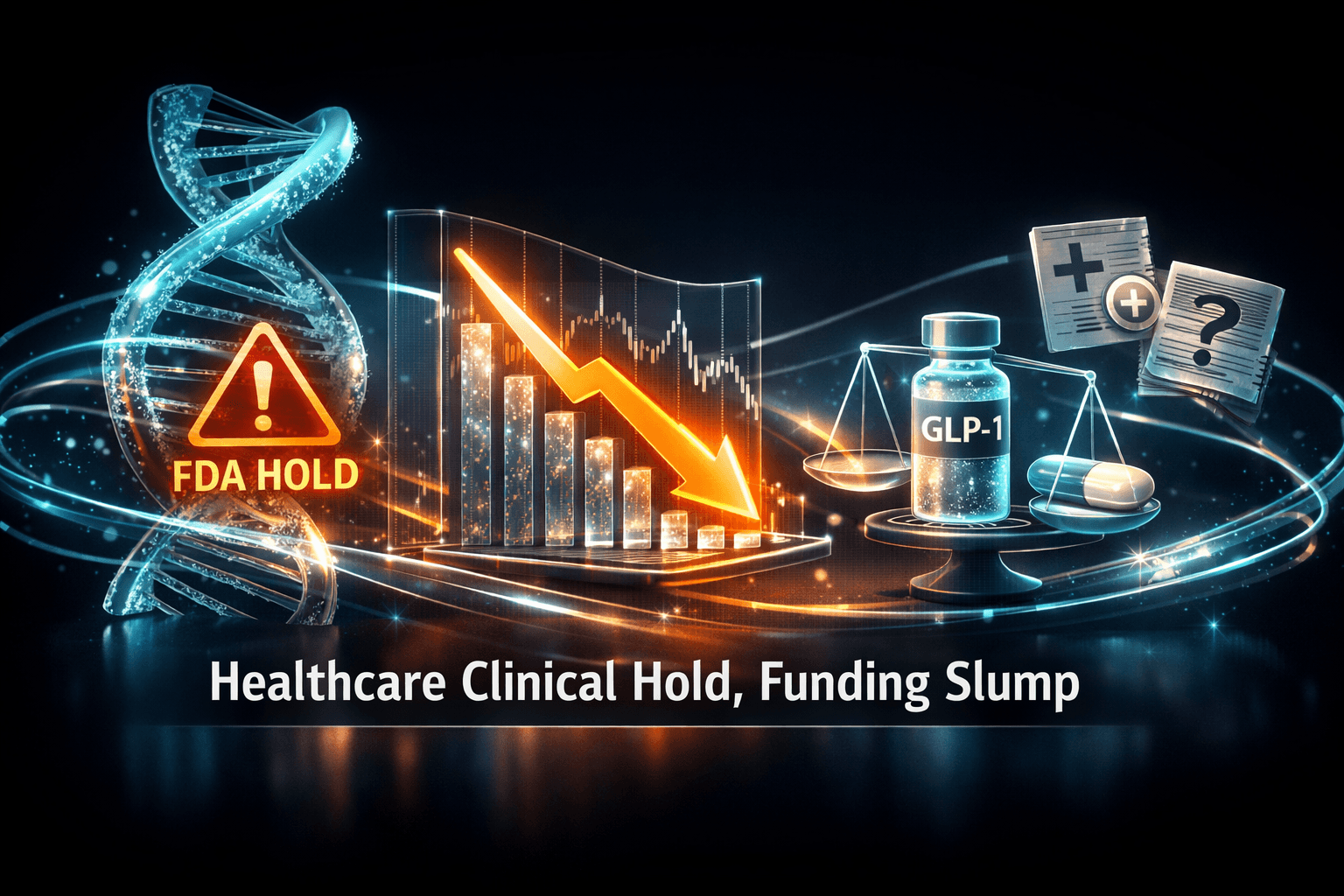
Regulatory risk and tightening venture dollars set the tone for healthcare this morning, as a new FDA clinical hold on Regenxbio's gene therapy program landed alongside a MassBio report showing smaller seed and Series A rounds for early-stage biotech. Those developments matter because they can delay drug timelines and make it harder for young companies to bridge to later-stage funding, which in turn affects valuations and deal flow you care about.
At the same time, policy and access stories around GLP-1 drugs, hospital AI tools for drug diversion, and several public health research reports add mixed signals. So you'll want to weigh near-term regulatory and capital constraints against longer-term demand trends in obesity, gene therapy, and health tech.
Market Highlights
Key facts and numbers from overnight and premarket reporting that investors should note.
- Regenxbio $RGNX, clinical program halted again after investigators found masses on the spines of five patients who received its Hunter syndrome gene therapy; this is the second clinical hold this year.
- Medicare GLP-1 Bridge program could offer access to popular weight loss drugs for as little as $50 a month for eligible beneficiaries, but some patients with the very conditions the drugs target do not qualify for the discount.
- MassBio report finds early-stage funding patterns diverging in Massachusetts, with seed rounds shrinking and Series A activity shifting, signaling slower capital access for young biotech firms focused on high-risk science.
- Public health studies: JAMA Pediatrics reports no association between prenatal organophosphate pesticide exposure and autism traits; a Mass General Brigham and BU study found at least 1 in 4 former NFL players who died between 2016 and 2021 had CTE.
Key Developments
Regenxbio Clinical Hold Raises Safety and Timing Questions
BioPharma Dive reports the FDA has again paused testing of Regenxbio's gene therapy for Hunter syndrome after spinal masses were detected in five patients. This is the program's second clinical hold this year, and it highlights how safety signals can quickly stall a therapy even after initial progress.
For you as an investor, safety-related holds can mean months of review, additional studies, and material uncertainty for timelines and capital needs. Analysts note that gene therapy developers face heightened scrutiny on durability and off-target effects, and smaller firms may need fresh capital if trials are extended.
Medicare GLP-1 Discount Helps Many, But Leaves Some Out
KFF Health News flags a major policy development that has a clear market impact. The Medicare GLP-1 Bridge program can reduce patient costs to as low as $50 a month, expanding potential demand for GLP-1 drugs. Yet a significant caveat is that certain patients with qualifying medical conditions are excluded from the discount, limiting immediate uptake for the sickest beneficiaries.
What does this mean for makers like $LLY and $NVO? The program could broaden access and support longer term revenue growth, but the exclusion rules create uneven adoption and add policy risk that could temper the initial sales bump you might expect.
Funding Squeeze for Young Biotechs, and a Niche for AI Tools in Hospitals
BioPharma Dive's coverage of the MassBio report shows seed rounds shrinking while Series A terms evolve, meaning startups with the riskiest science are finding it harder to get traction. That could slow innovation in early discovery and force more creative licensing or partnership deals with larger biopharma firms.
On the health-tech front, STAT reports that AI systems can catch drug theft in hospitals, but only when human teams maintain strong oversight. That creates a niche opportunity for software companies that can demonstrate integration and measurable savings, but scaling those solutions will be harder in a tight funding environment.
What to Watch
Regulatory updates and financing data will drive headlines and market reactions today and in coming weeks. Here are the specific catalysts and risks to monitor.
- FDA communications on the Regenxbio $RGNX clinical hold, including whether additional imaging, protocol changes, or pausing of enrollment will be required. Timing and scope of the agency's review will shape near-term valuation implications.
- Implementation details for the Medicare GLP-1 Bridge program and any clarifications on eligibility rules. Will CMS adjust criteria based on stakeholder feedback? That could materially change projected patient uptake.
- Further data from MassBio or other regional reports tracking venture activity. Watch seed and Series A median sizes and the pace of follow-on financings. Will early-stage startups find alternate capital or strategic partnerships?
- Adoption metrics for hospital AI drug-diversion tools, and any case studies showing cost savings. Evidence of ROI is key if you are assessing health-tech exposure.
Keep an eye on broader macro signals too. Tight capital markets can amplify company-specific issues. Will funding trends slow innovation, or will industry partnerships fill the gap?
Bottom Line
- Regulatory risk is front and center after the second FDA hold on Regenxbio, creating near-term uncertainty for gene therapy timelines and capital needs.
- Policy moves on GLP-1 access expand potential market size, but exclusions in the Medicare Bridge program limit immediate upside for some patient cohorts.
- Early-stage biotech funding is cooling, which may slow high-risk discovery work and drive more deal-making or consolidation.
- Health-tech AI shows promise for hospital drug diversion prevention, but human oversight remains crucial and scaling will require demonstrated ROI.
- Maintain selectivity and watch regulatory and financing catalysts closely, because they will largely determine which names lead or lag in the near term.
FAQ Section
Q: Will the Regenxbio clinical hold affect other gene therapy developers? A: Possibly, yes. Safety holds raise scrutiny across the class and may prompt sponsors to reexamine monitoring plans, but each program is judged on its own data.
Q: Does the Medicare GLP-1 Bridge program mean immediate big sales gains for makers like $LLY and $NVO? A: The program can expand access and help sales, but eligibility exclusions mean the impact will be uneven and is likely to ramp over time rather than overnight.
Q: How should I track early-stage biotech funding trends? A: Watch regional reports from groups like MassBio, monitor seed and Series A median round sizes, and follow partnership and licensing activity as a sign companies are finding alternative capital routes.
Note: This briefing is for informational purposes only. Analysts note and data suggest current trends, but this is not personalized investment advice.