The Big Picture
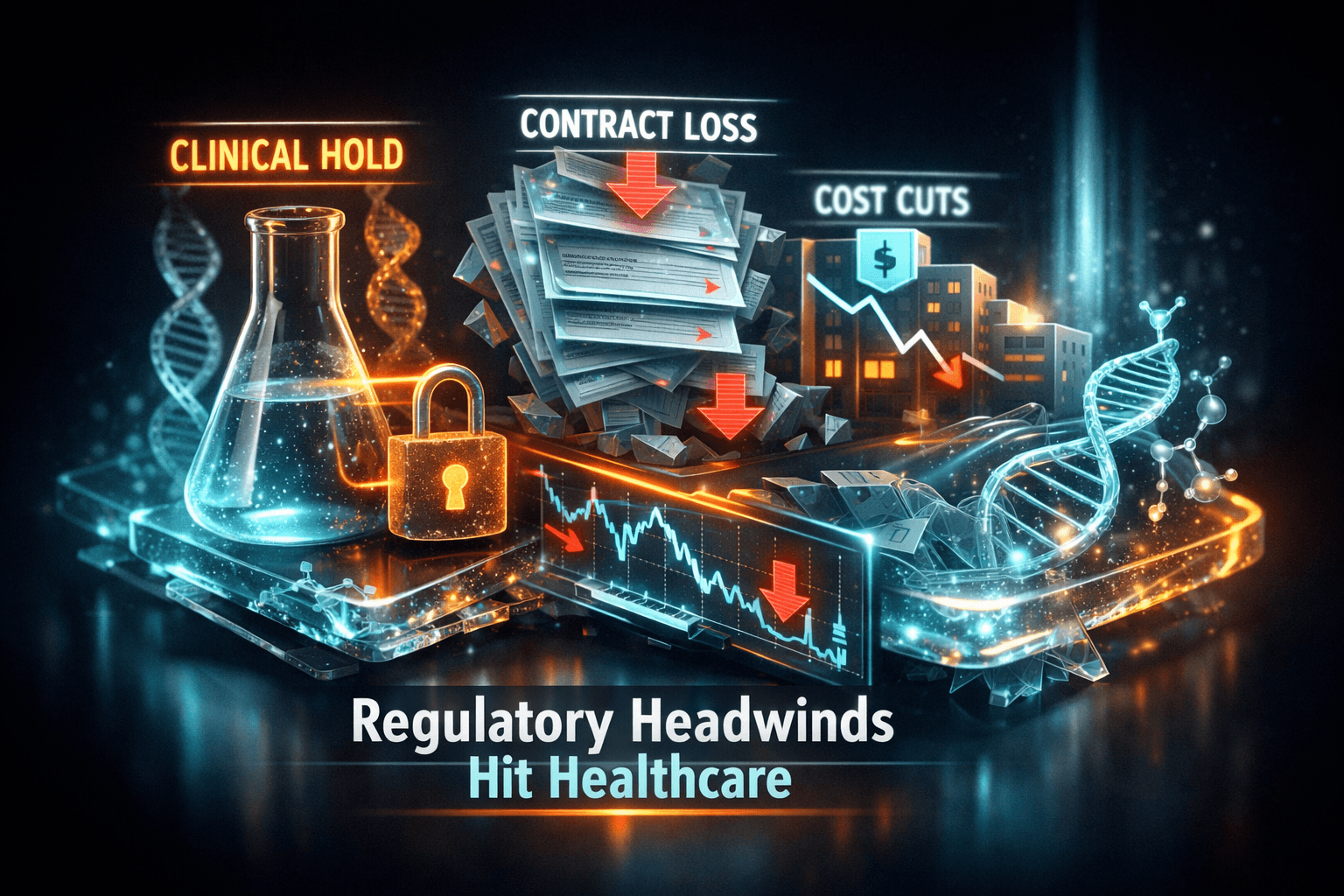
Today’s headlines were dominated by regulatory and contract setbacks that put a cautionary spotlight on the healthcare sector. A second FDA clinical hold on Regenxbio’s program and a major contract loss that prompted layoffs at cell therapy manufacturer Cellares were the most market-sensitive items of the day.
Those developments matter because clinical holds and client terminations can quickly curtail revenue for small- and mid-cap biotech and manufacturing firms, while state-level cost controls and rising insurance costs pressure provider margins. You’ll want to track near-term catalysts closely given the potential for further downside volatility.
Market Highlights
Key moves and headlines to note from today’s coverage.
- Regenxbio, $RGNX: FDA placed its Hunter syndrome gene therapy program on a second clinical hold after investigators found spinal masses in five treated patients, raising fresh safety concerns.
- Cellares: The cell therapy manufacturing specialist said it will lay off 100 employees after a large pharmaceutical customer terminated a contract, signaling demand and revenue pressure in CDMO services.
- Capricor, $CAPR: The FDA extended review of an updated application for deramiocel with a refined indication, prolonging regulatory uncertainty for the cell therapy candidate.
- Policy and cost pressures: California is weighing penalties for providers that don’t rein in spending growth, while Aon, Aon (AON), warned that 2027 will be tough for employer-sponsored premiums.
- Science and public health: Columbia researchers identified a new cell type that helps lung tumors evade immunity, and the CDC reported changing mpox epidemiology with fewer cases in 2025 overall but a September–October spike versus 2024.
Key Developments
Regulatory and clinical setbacks: Regenxbio and Capricor
FDA investigators detected masses on the spines of five patients treated with Regenxbio’s Hunter syndrome gene therapy, prompting a second clinical hold this year. That pause adds to uncertainty for $RGNX and underscores how safety signals can halt trial progress and investor sentiment.
Separately, the FDA has extended review of Capricor’s updated deramiocel application, which now carries a refined indication. Extended reviews leave timelines unclear, so you should expect continued headline risk for $CAPR until the agency completes its review.
Contract losses and restructuring at cell therapy suppliers
Cellares said an unnamed large pharmaceutical customer terminated a contract, leading to about 100 layoffs. This highlights the concentration risk many contract manufacturing organizations face when they depend on a few big customers.
For investors, that means margin and revenue predictability at CDMOs is less secure than it looks on paper. If you follow supply-chain names you’ll want to watch customer diversification and backlog disclosure closely.
Policy, public health, and scientific advances
California’s proposal to impose penalties on providers that exceed state spending growth targets and Aon’s warning about 2027 premium pressure point to tougher operating conditions for hospitals and insurers. About half of U.S. adults report they can’t afford care, which keeps cost-control measures politically salient.
On the science front, Columbia University’s discovery of a cell type that shields lung tumors from immune attack, published in Nature Immunology, points to a new therapeutic vulnerability. That kind of discovery can seed long-term runway for oncology R&D, even though it won’t offset near-term regulatory and commercial headwinds.
Other items — a medical study linking juvenile exercise to adult movement efficiency in birds, a spike in MyChart-branded phishing attempts, and a celebrity-backed biotech startup — are notable but have limited immediate market impact.
What to Watch
Focus on a short list of clear catalysts and risks between now and the next quarter. First, will the FDA lift or extend the Regenxbio clinical hold, and what mitigation plan will the company file? That answer will move $RGNX materially.
Second, monitor contract updates and customer commentary from Cellares and other CDMOs for signs of further cancellations. Who’s replacing lost revenue, and how fast can fixed costs be trimmed?
Third, track state and federal policy actions on healthcare spending. If California moves forward with enforcement penalties, other states could follow, pressuring hospital margins and potentially altering acquisition and capital allocation plans.
Finally, keep an eye on follow-up data from the Columbia lung-tumor study and on any partnering or licensing activity. Scientific breakthroughs can take time to generate revenue, but you don’t want to miss early collaborations that validate commercial potential.
Bottom Line
- Clinical and regulatory risk is front and center, as shown by $RGNX’s clinical hold and $CAPR’s extended review, analysts note this raises short-term volatility for biotech exposure.
- Contract concentration remains a real business risk for CDMOs after Cellares’ 100-person layoff; you should watch backlog and customer diversification metrics.
- Policy moves on healthcare spending and insurer premium pressure, highlighted by California proposals and Aon’s outlook, could squeeze provider earnings into 2027.
- Scientific advances, like Columbia’s lung tumor cell discovery, show longer-term innovation that could create new therapeutic pathways, but they don’t negate near-term headwinds.
- This article is for informational purposes only; it doesn’t recommend buying, selling, or holding any securities and you should consult independent advisors before making investment decisions.
FAQ Section
Q: How will an FDA clinical hold affect a biotech’s stock? A: A clinical hold typically increases uncertainty and can cause sharp share declines while safety issues are investigated, because trial timelines and potential approvals are delayed.
Q: Should I worry about a CDMO laying off workers after a lost contract? A: Yes, layoffs signal revenue disruption and client concentration risk; watch for updated backlog, replacement contracts, and cost-cutting measures to assess recovery prospects.
Q: What immediate signs should I watch for with state healthcare cost controls? A: Monitor proposed penalty structures, provider reporting requirements, and any transitional funding or carve-outs, because those details determine financial impact on hospitals and clinics.