The Big Picture
The healthcare sector is presenting mixed signals as we head into the long weekend. Industrial-scale investment and policy-level discussion on vaccines sit alongside public-health alerts and workforce strain, so you should be prepared for both opportunity and friction early this week.
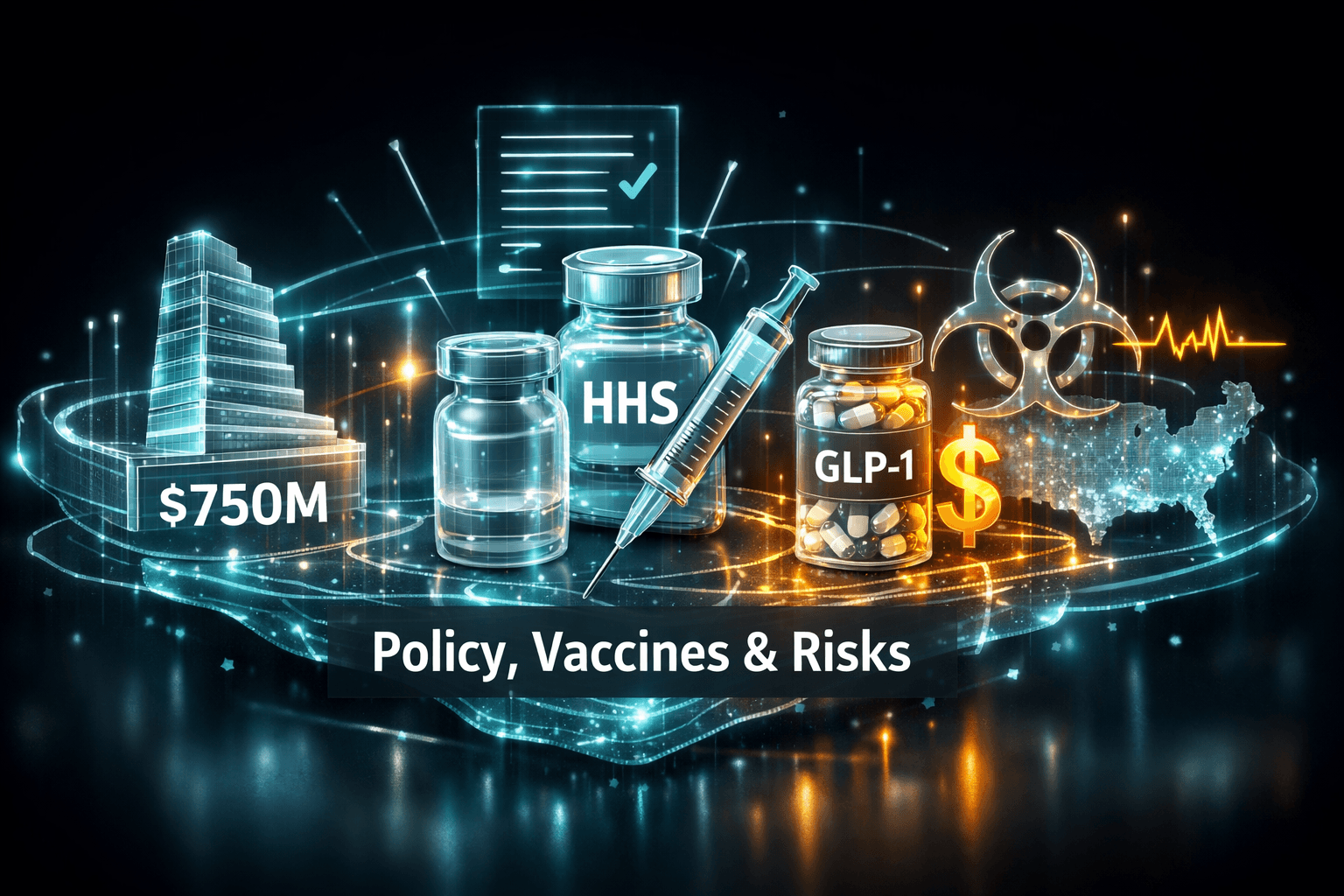
Roche's $750 million U.S. expansion and HHS documents hinting at vaccine-rule changes are big-picture positives for capacity and long-term policy clarity. At the same time, infectious-disease developments and growing clinician burnout keep near-term risk squarely on investors' radar.
Market Highlights
Markets were closed Sunday, Aug 23. The last trading day was Friday, Aug 21; expect the next session to factor in these developments.
- Roche/Genentech announced a $750 million investment to double a U.S. production facility in Oregon, a capacity bet for biologics and vaccines, reported Aug 21; Roche trades in U.S. markets as $RHHBY.
- Eli Lilly and Novo Nordisk continue to shape the obesity and metabolic market amid affordability questions, a trend that could influence prescribing and payer strategies for GLP-1 drugs, per analysis on Aug 21, with $LLY and $NVO central to that race.
- Corporate governance pressure surfaced at Capricor, with activist Kaos Capital pressing for a strategic reset, news that may create near-term volatility for $CAPR.
Key Developments
Roche pumps $750M into U.S. production
STAT's PharmaLotto coverage reported that Roche's Genentech will invest $750 million to double the size of an Oregon production site. That level of capital spending signals confidence in long-term demand for biologics and vaccines, and it adds U.S. manufacturing capacity that could ease future supply bottlenecks.
For you, this means capacity-sensitive names may benefit if demand holds, and contract manufacturers could see follow-on demand.
HHS signals potential vaccine policy changes
STAT's reporting on an HHS document tied to an official named Kennedy shows the agency is seeking feedback on new vaccine recommendation categories and testing approaches. Analysts note that any shift in recommendation structure could alter how vaccines are recommended, reimbursed, and procured.
How might this affect vaccine makers and public-health planning? Expect market participants to look for more detailed guidance and timing next week.
Public-health, safety and workforce pressure
Medical Xpress reported a fifth West Nile virus death in North Macedonia and renewed mosquito control efforts, a reminder that infectious-disease risks remain global. Another Medical Xpress piece warned wildland firefighters about the safety of an unproven supplement for smoke exposure, underscoring how frontline-worker health issues can prompt advisories and liability questions.
Meanwhile, a Healthcare Dive survey flagged rising burnout and the feeling among doctors that they must prioritize corporate interests over patients. That report points to potential productivity and retention risks for health systems and could pressure staffing-sensitive margins.
What to Watch
Expect the following catalysts to shape healthcare headlines and investor reaction in the coming days.
- HHS policy updates: Watch for follow-up documents or comment periods tied to the vaccine recommendation discussion. Any timeline or draft changes will matter for vaccine makers and public-health procurement.
- GLP-1 affordability and adoption: Surveys suggest cost and prescribing behavior will influence market share between $LLY and $NVO. Pay close attention to payer statements, FDA filings, and pricing actions you may see next week.
- Capricor governance developments: Activist pressure can accelerate strategic reviews, asset sales, or board changes. If you follow small-cap biotech, monitor proxy filings and company responses for potential volatility in $CAPR.
- Supply and workforce signals: The Roche investment reduces long-term capacity risk, but short-term supply issues persist in some areas, like reported estrogen patch shortages. You should track manufacturing updates and staffing announcements from major health systems.
- Public-health alerts: New infectious-disease reports like West Nile fatalities can influence travel, vaccine demand, and insurer forecasts. How will regulators and local authorities respond? That matters for related product demand.
Bottom Line
- Sector sentiment is mixed, with sizable industrial investment and policy signals balanced by public-health and workforce headwinds.
- Policy moves from HHS on vaccine guidance are a key macro catalyst you should monitor, they could reshape recommendation frameworks and procurement.
- Big-cap biologics capacity is getting a boost from Roche's $750 million Oregon expansion, a positive for long-term supply stability.
- Affordability concerns for GLP-1s could determine market share rather than clinical efficacy alone, so watch payer actions and pricing news closely.
- Short-term risk remains in public health and staffing; infectious outbreaks and clinician burnout are operational risks for some companies and systems.
FAQ Section
Q: How should I interpret the Roche $750M investment? A: It signals confidence in biologics and vaccine demand and expands U.S. manufacturing capacity, which may ease future supply constraints and support industry pricing power.
Q: Will HHS guidance on vaccines change market dynamics? A: Potentially, yes. New recommendation categories or testing rules could affect how vaccines are recommended and reimbursed, and you should track any official timelines or public comment opportunities.
Q: Do public-health alerts like West Nile deaths affect healthcare stocks? A: They can, especially for companies tied to infectious-disease diagnostics, vaccines, or regional healthcare delivery. Such events often alter short-term demand and regulatory focus.