The Big Picture
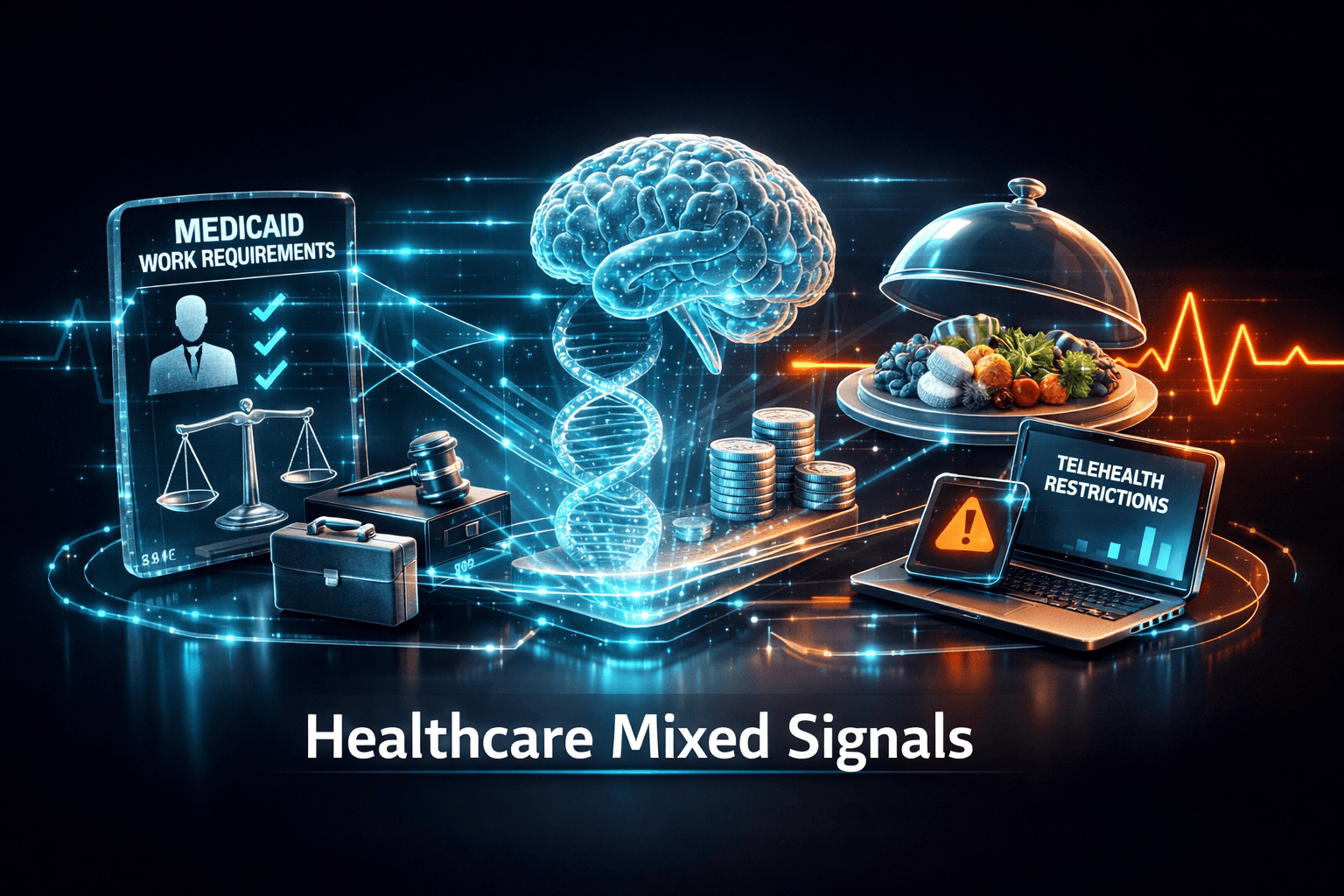
Today’s healthcare headlines split between near-term policy pressure and longer-term scientific and operational opportunities. New federal guidance on Medicaid work requirements and growing state crackdowns on telehealth corporate structures create regulatory uncertainty that could reshape access and business models.
At the same time researchers reported promising advances from an experimental Alzheimer’s molecule and a genetic study on aging, while pilots for medically tailored meals and interest in U.S. manufactured packaging equipment point to cost and supply-chain themes investors will want to follow. What does this mean for you, and which developments are likely to move markets?
Market Highlights
Here are the quick facts you need this morning. No single theme dominates, so selective positioning and attention to policy calendars matter.
- Federal and state policy: CMS and the administration released guidance on Medicaid work requirements, prompting state-level action to meet a 2027 implementation window.
- Telehealth scrutiny: STAT reports expanding state efforts to limit corporate practice of medicine, a trend that draws attention to virtual care names such as $TDOC and $AMWL, though no consistent market reaction is reported across those stocks.
- Biotech M&A: RallyBio is pursuing another reverse merger, this time with Avenzo, keeping $RLYB on the radar for rare disease investors.
- Science and cost-savings: An experimental molecule called OLE showed microglial reprogramming against beta-amyloid, while medically tailored meals pilots expanded through Medicaid in at least a dozen states, suggesting downstream savings and utilization changes.
Key Developments
Medicaid work requirements and state implementation
CMS issued interim guidance to help states roll out new Medicaid work and reporting rules by next year. The guidance aims to resolve technical questions, but gaps and legal challenges remain, and critics warn of coverage losses for vulnerable people.
For the market, that means insurers, managed-care plans, and state contractors face operational risk and potential enrollment shifts. You should watch waiver approvals and state procurement timelines closely.
Telehealth under pressure from state-level corporate practice rules
STAT’s reporting shows multiple states are moving against the corporate structures that underpin many direct-to-consumer telehealth platforms. The push targets how virtual care companies hire clinicians and prescribe remotely, not just reimbursement.
That brings regulatory risk to virtual care providers and their partners. Who benefits if corporate models are restricted? Traditional health systems and clinician-led networks may gain leverage, while pure-play telehealth platforms may need to revisit their operating models.
Scientific advances and health-cost interventions
Researchers highlighted a candidate molecule called OLE that appears to reprogram microglia and reduce beta-amyloid plaque toxicity, a preclinical result published in Cell Death and Disease. Such early laboratory findings are promising, but clinical validation will determine commercial relevance.
Separately, a genetic study linked the vgll3 gene to a trade-off between early-life growth and later aging and cancer risk. And an analysis found medically tailored meals can improve outcomes and lower costs, spurring Medicaid pilots in at least a dozen states. Together these stories point to sustained R&D potential and near-term programmatic opportunities for payers and providers.
Industry operations and M&A
BioPharma Dive discussed the strategic importance of U.S.-manufactured pharmaceutical packaging equipment as manufacturers modernize operations and weigh supply-chain security. That theme supports capital spending for equipment OEMs if reshoring and quality control drive procurement.
Meanwhile RallyBio’s renewed reverse merger plans with Avenzo keep its development pathway and corporate strategy in play. Deal mechanics and investor sentiment around reverse mergers will be worth monitoring for speculative biotech exposure.
What to Watch
There are several near-term catalysts and risk points that could change the tone for healthcare stocks and subthemes this week and beyond.
- CMS and state rulemaking: Watch for state waiver filings, federal clarifications, and legal challenges tied to the Medicaid work requirement guidance. These events could affect enrollment and revenue flows for Medicaid-focused plans.
- State telehealth legislation: Track bills and enforcement actions in states highlighted by STAT. Changes to corporate practice rules could force operating model shifts for virtual care platforms and their acquirers.
- Biotech pipeline milestones: Follow any company updates on OLE development, preclinical-to-clinical transitions, and RallyBio merger notices. Clinical readouts or regulatory submissions remain primary value drivers for biotech names.
- Pilot outcomes and procurement cycles: Results from medically tailored meals pilots and procurement decisions for packaging equipment will inform adoption and capex trends. Who captures the business matters for small- and mid-cap healthcare suppliers.
- Legal and political risk: Federal and state political shifts could alter Medicaid policy quickly. Stay tuned around court rulings and election-year policy moves.
Bottom Line
- Policy and regulation are the dominant near-term story, with Medicaid work rules and telehealth corporate scrutiny creating uncertainty for access and business models.
- Scientific advances such as the OLE molecule offer long-term upside, but clinical proof and commercial pathways are still several steps away.
- Operational themes like medically tailored meals and onshoring packaging equipment could drive predictable revenue streams for certain providers and suppliers.
- Expect selective volatility, especially among telehealth platforms and small biotech names, so you may want to watch legal and clinical catalysts closely.
- Analysts note mixed signals across the sector, suggesting a balanced, selective approach while monitoring policy developments.
FAQ
Q: How will Medicaid work requirements affect healthcare companies? A: The guidance lets states move toward implementation, which could change enrollment patterns and increase administrative costs for payers and state contractors.
Q: Should you expect immediate market moves from the Alzheimer’s molecule news? A: Early laboratory findings are scientifically interesting, but clinical trials and regulatory milestones will determine market impact over months to years.
Q: What should you monitor on telehealth regulation? A: Track state bills and enforcement actions that target corporate practice of medicine rules, since changes could force business model revisions for virtual care providers.