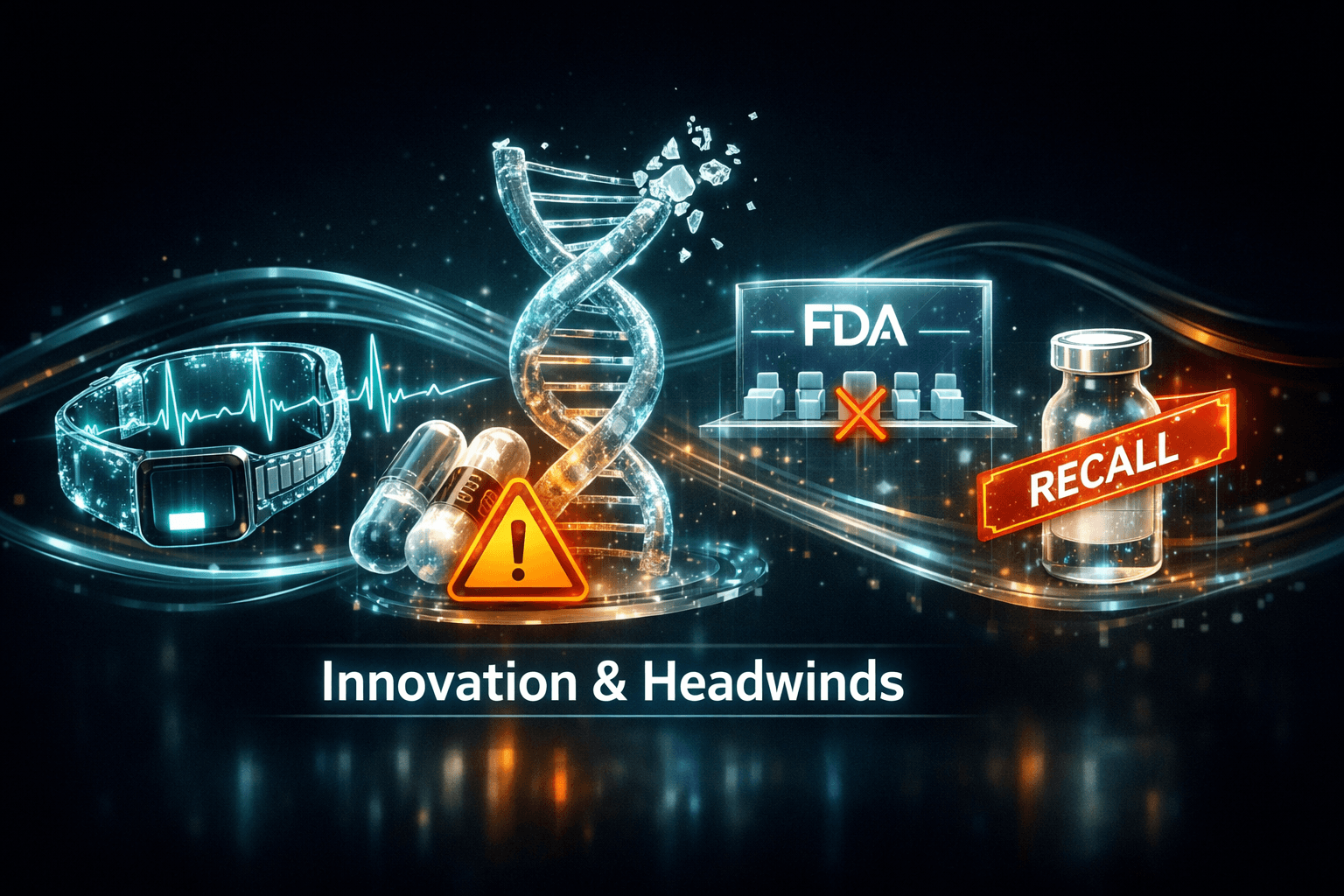
The Big Picture
Healthcare headlines today offered a mixed bag, with strong momentum in health IT and product innovation offset by regulatory and clinical setbacks. Advances in interoperability, wearable tech, and drug discovery sit alongside trial missteps and a consumer product recall, leaving sector direction dependent on near-term catalysts.
If you're watching healthcare stocks, you'll see growth stories and risk stories in the same feed. What does that mean for your positioning tomorrow, and which developments will drive price action? Keep an eye on regulatory decisions and earnings that could tilt sentiment quickly.
Market Highlights
Trading moved on news across payers, biotech, and device innovation, with company-level updates driving volatility in individual names.
- Moderna $MRNA, reported stronger international COVID vaccine sales that helped offset U.S. declines, extending its 2026 recovery and lifting sentiment around vaccine revenue streams.
- AstraZeneca $AZN faced a negative FDA advisory committee outcome for a breast cancer medicine, creating near-term pressure on sentiment for that program.
- Axsome $AXSM secured a label expansion, a positive regulatory development that supports commercial prospects for its psychiatric portfolio.
- Esperion $ESPR moved into the spotlight with a take-private proposal, highlighting strategic M&A interest in smaller cardiovascular players.
- Summit experienced a high-profile trial interim analysis that backfired, drawing investor scrutiny and volatility for its development-stage programs.
Key Developments
Health IT: Interoperability and Platform Modernization
InterSystems announced automation of bi-directional data exchange between Epic’s payer platform and health plan workflows, a practical win for data flow and claims processing. Blue Cross Blue Shield modernization efforts and a new interoperability strategy focused on analytics and AI signal broader momentum in digital transformation across payers and providers.
For you, that means improved operational efficiency and potential margin uplift for health IT vendors that enable these integrations. These trends also increase the addressable market for cloud and interoperability vendors, while creating integration risk if projects slip.
Biotech: Trials, Regulatory Votes, and Corporate Moves
Biopharma headlines were mixed. Summit’s interim analysis decision proved costly, highlighting execution risk around trial design and data timing. An FDA committee sided against an AstraZeneca breast cancer therapy, a reminder that advisory outcomes can change commercial timelines.
On the positive side, Axsome $AXSM won a label expansion that strengthens its commercialization path, and Esperion $ESPR drew buyout interest via a take-private deal. Moderna $MRNA’s international vaccine sales helped offset U.S. weakness, supporting its leadership in mRNA products and revenue diversification.
Innovation: Mental Health Research, Wearables, and Safety Alerts
Research progress continues to show promise. Weill Cornell investigators reverse engineered ketamine’s antidepressant effects, an insight that may inform next-generation antidepressants for treatment-resistant patients. Meanwhile, a Seoul National University team unveiled a battery-free skin-conformal ECG wearable, addressing a key power challenge in continuous monitoring.
Not all news was clinical or technological in nature. The FDA recalled several Ghirardelli powdered beverages over potential Salmonella contamination. While not a biotech story, foodborne safety recalls can touch healthcare through increased clinical visits and public health monitoring.
What to Watch
Expect volatility around the coming catalysts. Regulatory calendars, trial readouts, and commercial updates will be the main drivers of sentiment into next week. Which catalysts are most likely to move stocks?
- Regulatory events, including advisory panels and FDA decisions, remain critical, particularly for oncology and CNS programs like those from AstraZeneca $AZN and Axsome $AXSM.
- Trial milestones and interim analyses, after the Summit example, are high-impact. Pay attention to how companies communicate trial design and data monitoring plans.
- Earnings and revenue updates from vaccine makers and large-cap biotech, including international sales trends for $MRNA, could set the tone for sector rotation into biopharma versus health IT.
- Health IT contracts and integration announcements, such as the InterSystems-Epic payer linkage, will influence sentiment for enterprise software names serving payers and providers.
- Public health and safety items, like the Ghirardelli recall, may drive short-term attention to consumer safety and regulatory oversight, though the direct market impact on healthcare equities is likely limited.
You'll want to monitor headlines for follow-up details, because initial reports often leave questions about timing and scale.
Bottom Line
- Mixed signals dominate today: technological progress and commercial gains counterbalanced by clinical and regulatory setbacks.
- Health IT momentum on interoperability and AI is a durable positive, creating long-term demand for integration and analytics vendors.
- Biotech remains high-reward, high-risk, with trial design and advisory panels proving decisive for valuation swings.
- Monitor near-term catalysts closely, because outcomes from regulators and trial committees will drive volatility.
- Data suggests a selective approach makes sense, as sector breadth is weak while certain subsegments lead the market.
FAQ Section
Q: How will interoperability wins affect healthcare IT stocks? A: Improved interoperability typically increases vendor contract opportunities and may support revenue growth for companies that enable data exchange and analytics. Monitor deal announcements and implementation timelines.
Q: Should I worry about consumer product recalls like the Ghirardelli case? A: Food recalls can raise public health concerns, but they usually have limited direct impact on listed healthcare firms, unless the recall reveals broader supply chain or regulatory issues.
Q: What signals matter most from biotech trial updates? A: Investors watch trial design transparency, data cut timing, and regulatory feedback closely. Interim analyses and advisory committee votes often produce the largest short-term moves.