The Big Picture
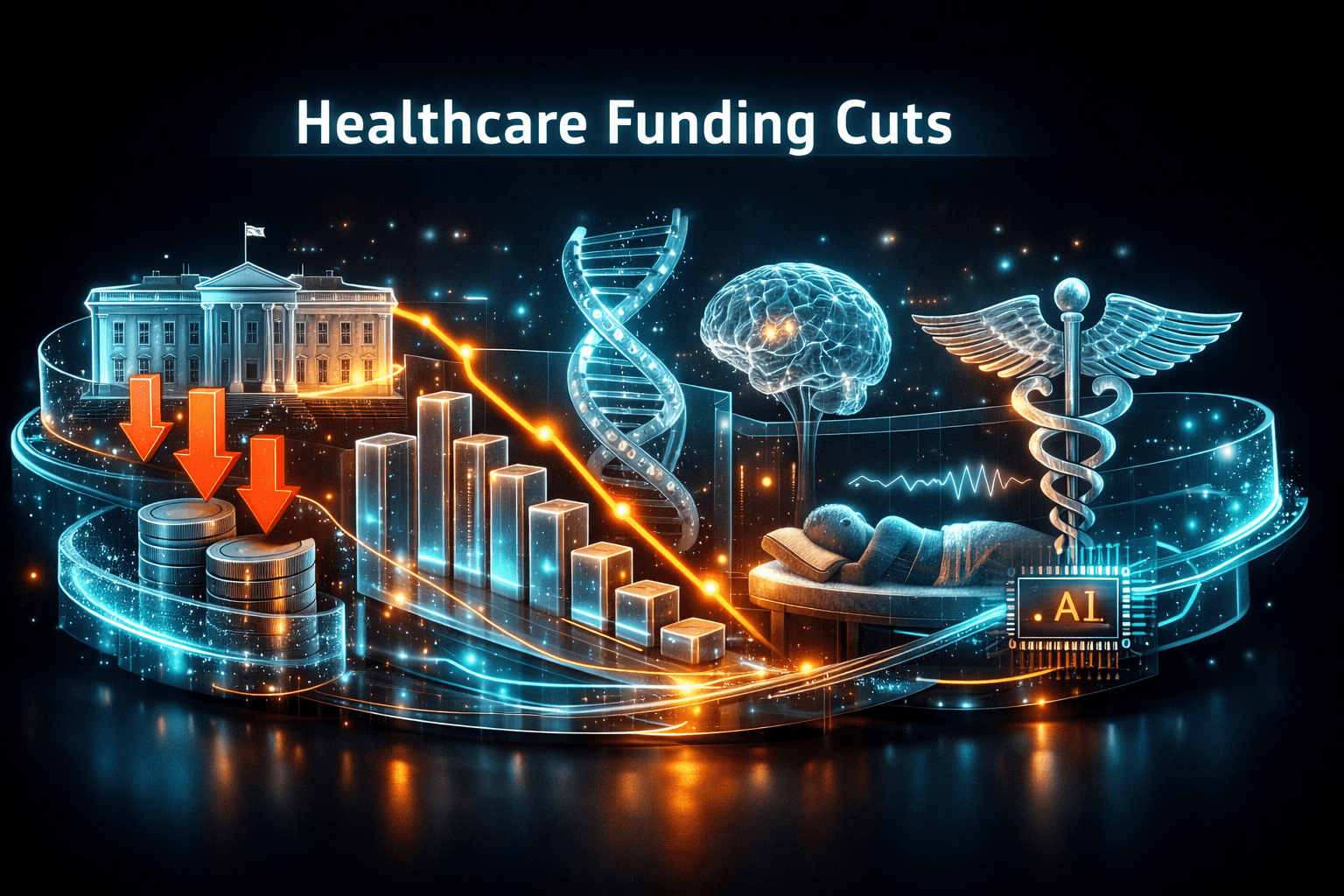
The biggest story heading into the long weekend is policy uncertainty: the White House has proposed a roughly 12% cut to HHS discretionary funding for fiscal 2027, and a separate proposal would slice about $5 billion from NIH. Those moves create near-term budget risk for grant-funded research and some public-health programs.
At the same time, the sector is seeing steady innovation and policy-driven opportunity, from interstate telehealth initiatives and new AI/quantum conversations at AWS to fresh genetic and sleep-health research. That mix leaves you with clear risks and a set of potential winners depending on how Congress and regulators react next week.
Market Highlights
US equity markets were closed on Saturday, Apr 4. Below are concise facts and figures from the key stories and how they tie to market-sensitive items as of Thursday, Apr 2.
- Federal funding: The White House is asking for about $111 billion in HHS discretionary funding for 2027, roughly $16 billion less than 2026, a cut described as about 12% in coverage from Healthcare Dive.
- NIH proposal: STAT reports a requested $5 billion reduction at NIH and a plan to reduce the number of institutes and centers from 27 to 22, a change that could affect research grant flows.
- Tech in healthcare: Amazon's cloud arm, AWS, is publicly discussing new AI agents and quantum computing for healthcare applications, a development tied to $AMZN’s ongoing push into healthcare software and infrastructure.
- Telehealth expansion: Johns Hopkins Medicine and the American Telemedicine Association have launched an interstate telehealth initiative, signaling continued policy and care-model momentum for virtual care providers and platforms.
Key Developments
Federal budget proposals raise funding risk
The White House budget request calls for about $111 billion in discretionary HHS funding for 2027, nearly $16 billion lower than 2026 levels. STAT separately highlights a requested $5 billion cut at NIH and a plan to shrink institutes and centers, a move that could tighten grant availability for academic labs and some biotech research programs.
For you as an investor, that means grant-dependent biotechs and academic spinouts could face funding headwinds in the near term, while companies servicing Medicaid and state-run programs could see shifting opportunity depending on execution of policy changes.
Telehealth and health IT continue to advance
Johns Hopkins Medicine and the ATA launched an interstate telehealth initiative, which aims to simplify cross-state care delivery and credentialing. Healthcare IT News also ran profiles emphasizing continued focus on interoperability from longtime HIE leaders.
Those developments support ongoing adoption of virtual care and health-data connectivity. If you follow healthcare IT, watch vendor positioning around interstate licensing and interoperability standards; the policy tailwinds could accelerate adoption of enterprise software and services.
Research and public-health surveillance: gene discovery, sleep risk, viral reversions
University of Tartu researchers identified an MGRN1 gene variant tied to fetal heart malformations. That kind of discovery helps clinicians identify and counsel affected families and may inform diagnostic panels over time. Separately, a University of Oulu study finds irregular bedtimes in midlife may double risk of serious cardiac events, especially for people sleeping under eight hours.
On infectious disease surveillance, teams in Japan described clustered reversions of the SARS-CoV-2 spike D614G back to D614 in delta and omicron BA.2 sequences. The pattern has implications for genomic surveillance strategies and variant tracking, but it’s an observational genomics finding rather than immediate clinical news.
What to Watch
Expect the policy story to dominate early next week. Will Congress accept proposed HHS and NIH cuts, or will appropriators push back? That outcome will shape funding flows for research and public-health programs over the next 12 months.
Also monitor these catalysts and risks you can act on information about:
- Congressional budget hearings and appropriations votes on HHS and NIH funding, starting the week of Apr 6.
- Telehealth regulatory guidance and state reciprocity rules tied to the Johns Hopkins/ATA initiative, which could influence platform revenues and utilization.
- Corporate disclosures from AWS and other cloud vendors on AI agents or quantum pilots in healthcare that may signal new revenue streams for cloud providers such as $AMZN.
- Academic publication follow-ups for the MGRN1 discovery and the sleep study, which could affect demand for diagnostic services and preventive cardiology programs.
- Surveillance reports on SARS-CoV-2 variants and any public-health advisories tied to genomic reversion patterns.
Bottom Line
- Policy risk is front and center, with proposed HHS and NIH cuts creating uncertainty for grant-funded research and public-health programs.
- Telehealth and interoperability advances offer offsetting commercial opportunities, particularly for vendors that can scale interstate services and data exchange.
- Scientific findings on the MGRN1 gene and sleep-related cardiovascular risk underscore the importance of diagnostic and preventive care trends you should follow.
- Tech adoption, including AWS’s AI and quantum discussions, keeps infrastructure players relevant to healthcare transformation even amid funding headwinds.
- Watch Congress and regulatory moves next week; funding decisions and implementation details will be key for sector positioning.
FAQ
Q: How could proposed HHS and NIH cuts affect healthcare companies? A: Analysts note cuts could reduce grant funding for academic research and slow some public-health initiatives, while procurement and service vendors might face contract uncertainty.
Q: Will telehealth’s interstate push change reimbursement or market share? A: The Johns Hopkins and ATA initiative aims to streamline cross-state care delivery, which may ease provider expansion and could influence payer and platform strategies over time.
Q: Should I be worried about the SARS-CoV-2 D614 reversions? A: Data suggests nonrandom reversion patterns in certain lineages, relevant for genomic surveillance, but this is a technical finding rather than an immediate clinical alarm.