The Big Picture
Today brought a clear run of constructive developments across drug approvals, biotech M&A, and clinical innovation that suggest momentum in the healthcare sector. Regulatory wins and acquisition activity led the headlines, giving markets fresh deal and growth narratives to digest.
At the same time, public-health leadership gaps and governance issues for AI add friction. If you follow healthcare names, you’ll want to balance these upside catalysts against policy and oversight risks heading into next week.
Market Highlights
Here are the quick facts and numbers you should know from today.
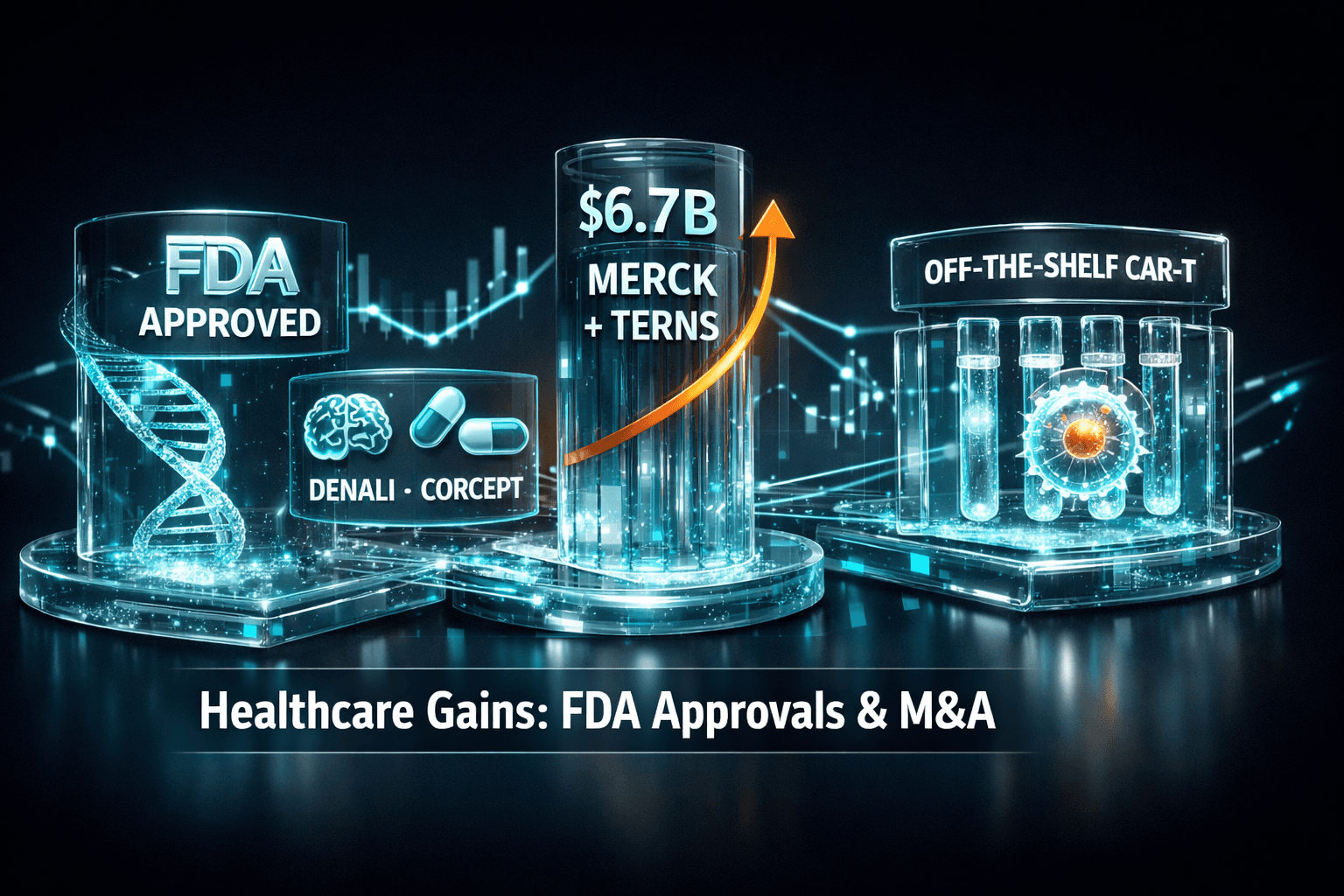
- Merck offered about $6.7 billion to acquire Terns Therapeutics, a deal that’s sparked debate about a possible biotech bidding war, and has investors watching $MRK and $TERN closely.
- STAT reported new FDA approvals for Denali Therapeutics and Corcept Therapeutics, a regulatory lift for $DNLI and $CORT that could support near-term commercial momentum.
- Allogene’s progress on off-the-shelf CAR-T programs and continued industry interest in engineered cell therapies were highlighted, keeping $ALLO in focus.
- Operational wins and cost savings showed up in the IT corner, with North Mississippi Health saving $2.7 million using a leadership platform.
- Scientific advances matter for long-term drug pipelines, including a MIT study explaining why tyrosine kinase inhibitors work in only 40% to 80% of expected patients.
Key Developments
Merck’s bid for Terns ignites debate and potential bidding dynamics
Merck’s roughly $6.7 billion offer for Terns is the day’s biggest corporate story. Analysts and investors are split, with some seeing the price as justified given Terns’ recent run, and others anticipating a higher offer from rival buyers.
For you, that means M&A chatter could lift related biotech names and trigger short-term trading flows. Watch $MRK and small-cap oncology names for volatility as the market prices the likelihood of a competing bid.
FDA approvals and regulatory momentum
STAT reported that Denali and Corcept received FDA approvals today, a concrete regulatory win that can unlock commercialization and partnership options. The market often rewards clarity from regulators, and these approvals add to that momentum.
Remember, approvals reduce binary regulatory risk and can validate technology platforms. Analysts note these events often attract renewed investor interest in peers pursuing adjacent indications.
Cell therapy and precision oncology advances
Allogene’s off-the-shelf CAR-T progress was highlighted across industry coverage, underlining ongoing enthusiasm for scalable cell therapies. Off-the-shelf approaches aim to lower manufacturing complexity versus bespoke autologous CAR-Ts.
Separately, MIT researchers identified a backup survival pathway that helps tumors resist tyrosine kinase inhibitors, explaining why these drugs work in only 40% to 80% of expected patients. That insight points to combination strategies and next-gen inhibitors as likely research priorities.
AI in care: tools, chatbots, and governance questions
Medical Xpress covered a new osteoarthritis AI chatbot backed by research, suggesting digital tools are moving from pilot to product. Healthcare IT News cautioned that deploying AI without strong governance creates difficulties, especially for clinical trust and compliance.
So you’ll see both product-driven upside and governance-related caution. Who governs the models may matter as much as how well they work.
Policy and leadership noise
KFF reported a gap at the Centers for Disease Control and Prevention after a missed nomination deadline, leaving the agency without a director. STAT also noted HHS convened a high-profile advisory panel that includes controversial figures, drawing attention to potential regulatory and reputational headwinds.
Those developments raise questions about public-health direction and could influence sentiment toward health policy sensitive names. How will regulators proceed under uncertain leadership?
What to Watch
Look ahead to the catalysts that could move names you own or follow. You’ll want to keep tabs on near-term events and risks.
- Potential competing bids for Terns, and any updated merger terms that could change valuations for small-cap biotech peers.
- Commercial rollouts and guidance from Denali $DNLI and Corcept $CORT after their FDA approvals, plus any analyst reactions or coverage changes.
- Data readouts and partnership updates from Allogene $ALLO on off-the-shelf CAR-T programs that could be a game changer for cell therapy economics.
- Regulatory clarity at the CDC and HHS policy signals. Leadership gaps can affect public-health funding and regulation timelines.
- AI governance developments from major health systems, and any regulatory guidance that clarifies acceptable clinical use of generative models.
Are you positioned for volatility around biotech M&A? Are you comfortable with the governance questions around AI in care? Those are practical questions to keep in mind over the next few sessions.
Bottom Line
- Today’s headlines skew positive, with FDA approvals and a major M&A bid providing tangible catalysts across the sector.
- Scientific advances in tumor resistance and off-the-shelf CAR-T progress point to longer-term therapy opportunities and combo strategies.
- AI-enabled care products are expanding, but governance and trust remain critical hurdles you should monitor.
- Policy and leadership uncertainty at the CDC and within HHS create headline risk that could sway sentiment intermittently.
- In short, momentum is building, but selectivity matters as regulatory and governance noise could create short-term swings.
FAQ Section
Q: How could Merck’s offer for Terns affect other biotech stocks? A: A large strategic bid often lifts peer valuations and can trigger takeover speculation, increasing M&A interest across small-cap oncology names.
Q: What does an FDA approval mean for a company like Denali or Corcept? A: Approval reduces regulatory uncertainty, may unlock revenue, and can lead to new analyst coverage and partnership or licensing opportunities.
Q: Should I worry about AI governance stories? A: Yes, because weak governance can slow deployments, invite regulatory scrutiny, and affect clinical adoption even when tools perform well.