The Big Picture
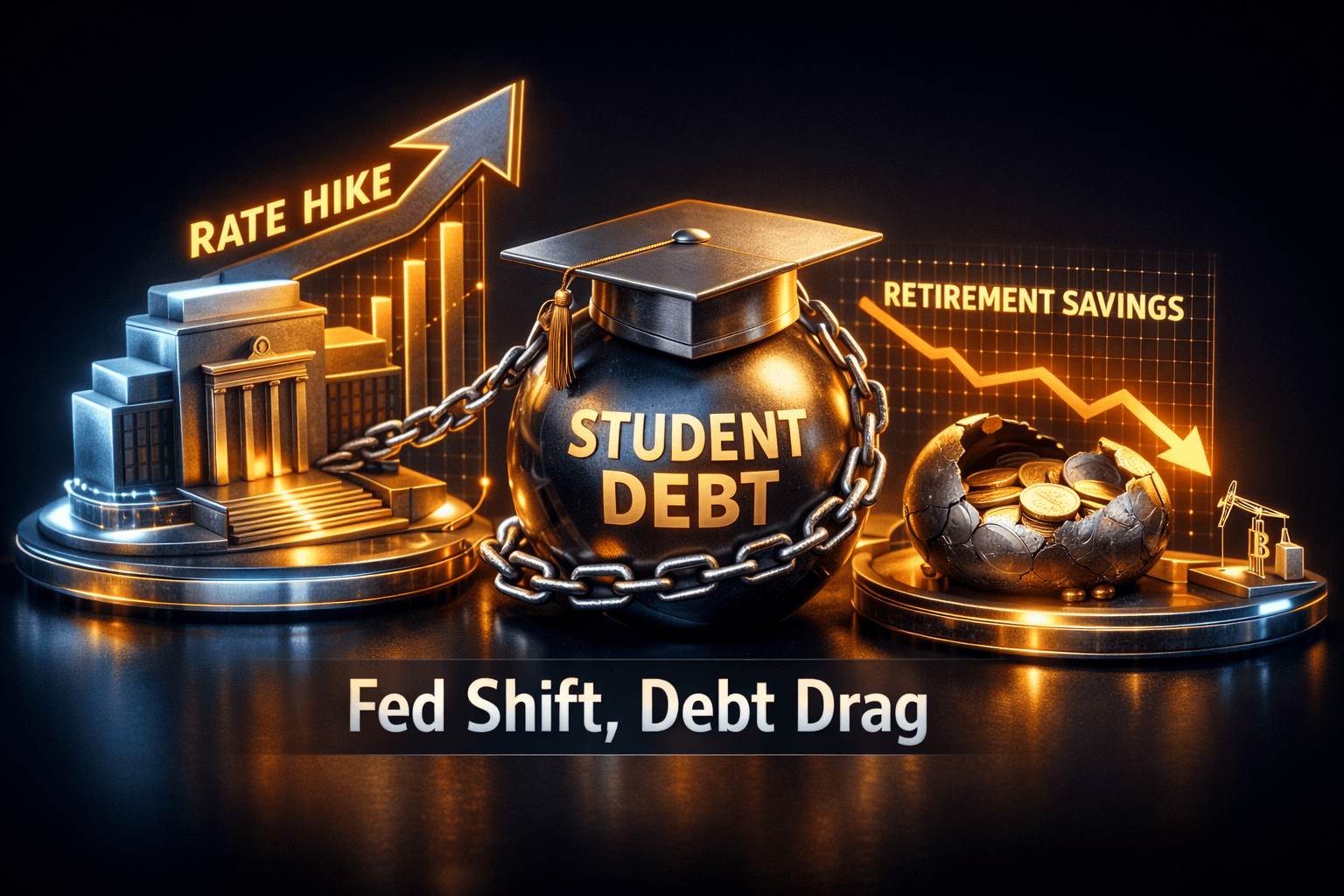
Wall Street’s narrative shifted overnight as Morgan Stanley and Goldman Sachs moved from forecasting no change to calling for a Federal Reserve rate hike, a development that matters to every investor in the finance and banking sector today. A potential policy tightening raises borrowing costs, reshapes bank trading and lending dynamics, and adds pressure to rate-sensitive assets.
At the same time, consumer-level research and sector writeups provide mixed signals. New analysis on student debt shows persistent retirement savings gaps, while pieces on offshore energy assets and bitcoin argue for selective reallocation. You’ll need to weigh macro risk against targeted opportunities in today's environment.
Market Highlights
Here are the quick facts and price movers to track before you act.
- Big banks flip on Fed odds: Morgan Stanley ($MS) joined Goldman Sachs ($GS) in switching its forecast from unchanged to expecting a Fed hike, a late Monday change reported by MarketWatch.
- Student debt and retirement: MarketWatch reports that if employers matched debt payments, workers would save more than $10 billion, highlighting a material drag on household retirement preparedness.
- Energy outlook: Seeking Alpha coverage of Talos Energy ($TALO) argues mature offshore assets can fund a longer-lived business model, which could matter for income-oriented energy investors.
- Crypto allocation case: A Seeking Alpha note on $BITB discusses diversifying risk with bitcoin exposure, offering readers an argument for non-correlated allocation.
- CEF caution: Seeking Alpha’s take on $NPFD flags its discount as unappealing in the current environment, suggesting yield chasing may carry valuation risk.
- Social Security planning: A MarketWatch Q&A explores survivor benefits after the death of a high-earning spouse, a reminder that policy and benefits remain part of household planning.
Key Developments
Banks Shift to Forecasting a Fed Hike
MarketWatch reports Morgan Stanley ($MS) late Monday joined Goldman Sachs ($GS) in revising its call to expect a Fed rate increase. That pivot tightens the macro story for financials and broader markets, because higher terminal rate expectations typically lift short-term yields and weigh on rate-sensitive sectors.
For banks you follow, this change could mean narrower mortgage origination margins but wider net interest margin potential over time, depending on loan mix. How will this affect your allocation to financials versus defensives in the near term?
Student Debt Cuts into Retirement Savings
A MarketWatch analysis underscores that people with student debt fall behind on retirement early and rarely catch up. The report notes that if all employers matched debt payments, workers would collectively save more than $10 billion, highlighting a structural headwind to retirement savings and future investment flows.
This is a reminder for you that household balance sheet stress can translate into weaker consumer demand for credit products, brokered investment flows, and long-term asset accumulation, all of which affect banks and wealth managers.
Sector-Specific Reads: Energy, Crypto and CEFs
Seeking Alpha’s piece on Talos Energy ($TALO) argues mature offshore assets could support a longer-lived business model, which matters for investors targeting energy income or asset-backed cash flows. That thesis sits against a backdrop of volatile commodity prices and capital discipline in the sector.
On alternative allocations, a $BITB analysis makes a diversification case for bitcoin exposure, while another Seeking Alpha article warns that $NPFD’s closed-end fund discount remains unappealing in the current environment. Together these pieces suggest selective opportunities exist, but valuation and volatility matter a lot.
What to Watch
Expect the Fed narrative to drive intraday moves, and keep an eye on communications from regional banks and major dealers for color on how a hike would affect funding and spreads. You should watch for clearer guidance around the timing of any hike and the Fed’s language on persistence of inflation.
On the consumer side, follow any new data on household leverage and savings rates, because student debt and Social Security concerns could change consumer behavior over years. Are banks adjusting underwriting in response to these signals, and are wealth managers revising retirement assumptions?
For sector picks, monitor energy asset valuations and producer cash-flow statements if you’re considering names like $TALO. If you’re thinking about crypto allocation, track volatility and custody risks for $BITB exposure. For income investors, watch closed-end fund discounts such as $NPFD for widening or compression, and consider how rising rates affect distribution coverage.
Bottom Line
- Macro first: The late switch by $MS and $GS to a Fed hike call shifts risk for the sector, so your exposure to rate-sensitive banks and credit should be assessed against a slightly tighter policy outlook.
- Consumer stress is real: Student debt is dragging retirement prep, and that can depress long-term deposit and investment flows, a structural factor for banks and wealth managers.
- Selective opportunities exist: Energy assets and targeted crypto exposure receive positive coverage, but valuation and commodity or volatility risk remain material.
- CEF and income caution: $NPFD’s discount signals that yield chasing can be costly when valuations are unattractive, especially if rates move higher.
- Stay defensive but selective: watch Fed language, consumer credit data, and company-level cash flows before increasing exposure.
FAQ Section
Q: How will a Fed hike forecast affect bank stocks? A: A shift toward a hike generally boosts short-term rates and can widen net interest margins over time, but it can also slow loan growth and hit rate-sensitive fee businesses.
Q: Should student debt findings change my allocation to financial or retirement products? A: Data suggests student debt depresses retirement savings, which could reduce long-term flows into managed accounts and retirement products, so you may want to review assumptions about future client inflows.
Q: Is a closed-end fund discount a buying signal now? A: Not always, $NPFD’s unappealing discount in the current environment shows discounts can reflect real valuation or cash-flow concerns, so check coverage, NAV trends, and distribution sustainability before acting.