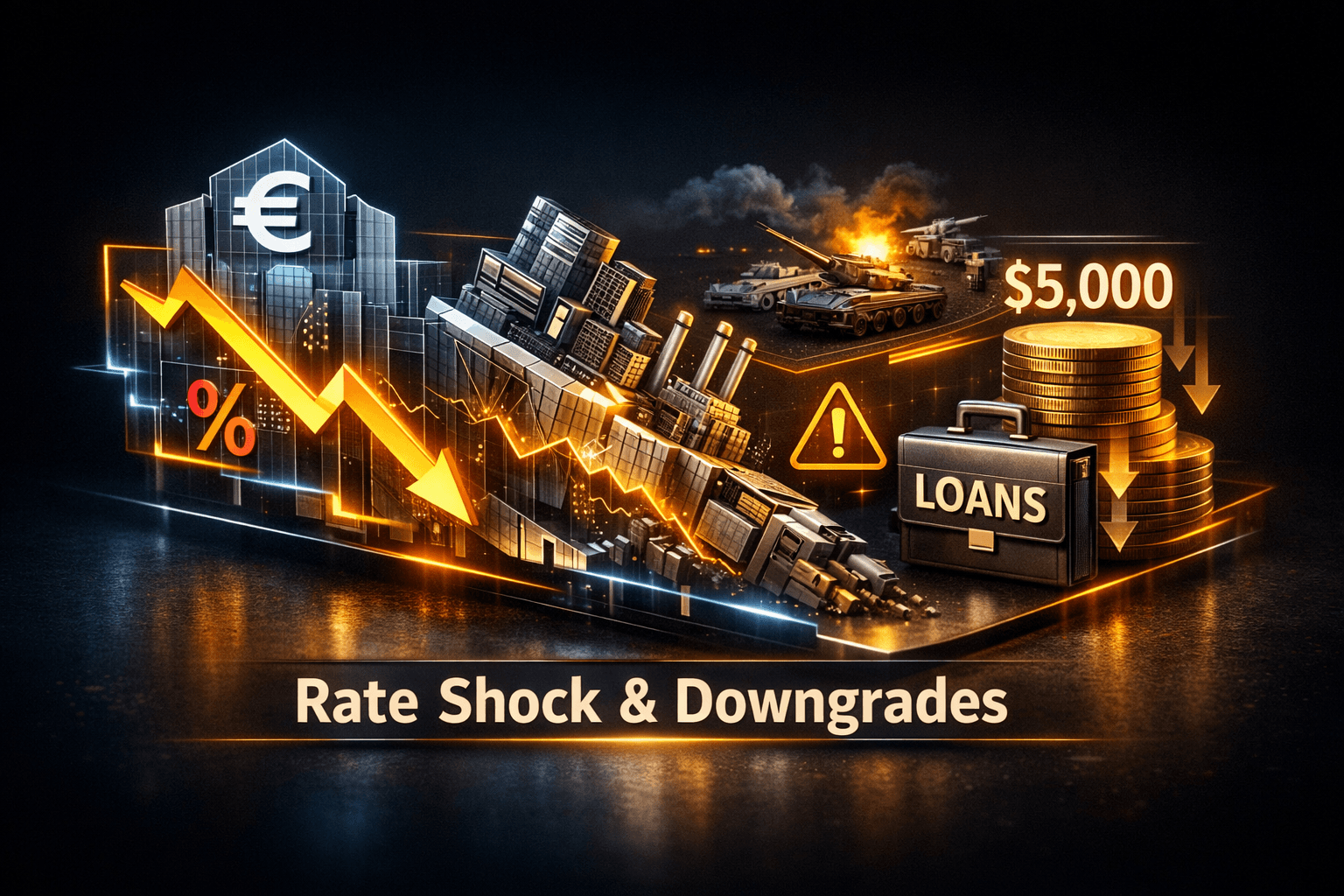
The Big Picture
Global tightening and fresh downgrades put pressure on the Finance & Banking complex as markets open. Traders are bracing for an ECB rate hike today even as Middle East tensions and higher energy prices cloud the inflation outlook.
That macro backdrop is colliding with company-level worries. A rating cut for $PLTR and utilization concerns at $COHU leave investors asking what holds up in a higher-rate, more volatile environment. How should you position your portfolio when policy and geopolitics push volatility higher?
Market Highlights
Quick facts and price-action cues to scan this morning.
- ECB tightening: MarketWatch reports the European Central Bank is virtually certain to raise rates today. Bond markets still disagree on the terminal rate and how energy price moves from the Middle East will feed into inflation.
- Leveraged loans focus: Seeking Alpha flags a combination of strong payrolls, hawkish Fed commentary from former Fed governor Kevin Warsh and Middle East conflict as a "perfect storm" shaping leveraged-loan strategies, including $FLBL's positioning.
- Company notes: $PLTR was hit by a rating downgrade in analysis published this morning. Industrial-chip supplier $COHU draws attention over utilization, with 80% capacity utilization cited as a more immediate concern than its $850 million AI pipeline.
- Policy and politics: MarketWatch runs the numbers on a proposed $5,000 per-adult dividend, highlighting substantial fiscal costs and distributional effects if enacted.
- Personal finance color: MarketWatch profiles Tiffany Haddish building a 17-property real-estate portfolio, a reminder that cash-flow strategies still resonate for many retail investors.
Key Developments
ECB rate decision and global policy tightening
The ECB is widely expected to lift rates today, according to MarketWatch. For banks and lenders, higher European rates can mean wider net interest margins in the near term, but increased default risk and market volatility are also possible if energy-driven inflation proves persistent. You should monitor euro-area bond yields and energy-price moves closely, because they will shape bank earnings estimates and cross-border loan stress.
Downgrade and scrutiny in tech and industrials
Seeking Alpha published a downgrade view of $PLTR, arguing a valuation reset is underway. The note adds to bearish pressure on growth-oriented names that depend on long-term contracts and high valuation multiples. At $COHU, the 80 percent utilization metric was flagged as more critical than pipeline value, underlining the message that execution and capacity matter more than future backlogs when margins are tight.
Leveraged loans and geopolitical risk
A Seeking Alpha piece frames recent payroll strength, hawkish commentary from former Fed official Kevin Warsh, and conflict in Iran as a combined risk set for leveraged-loan strategies like those held by $FLBL. Strong payrolls mean tighter monetary policy and higher financing costs. At the same time, Middle East unrest can lift energy prices and add inflation surprises, compressing credit spreads unexpectedly.
What to Watch
Here are the catalysts and risk points you'll want to track today and near term.
- ECB announcement and press conference, today: Watch the size of the hike and language about terminal rates. Markets will read the forward guidance for implications on U.S. and global financial conditions.
- Energy prices and Middle East developments: Any escalation could push oil higher and complicate inflation trajectories. That matters for bank loan performance and sovereign debt outlooks.
- Company follow-ups: Look for $PLTR and $COHU management commentary, updated guidance, or analyst responses. For $COHU, utilization trends will be a key signal of near-term revenue sustainability.
- Leveraged-loan flows: Monitor secondary market spreads and $FLBL positioning if you have exposure to loan-focused funds. Rising short-term rates can alter refinancing economics quickly.
- Policy headlines on the proposed $5,000 dividend: Any legislative traction or new cost estimates will influence fiscal risk premia and long-term borrowing needs.
What should you prioritize in your own watchlist? Keep an eye on earnings revisions, credit spreads, and liquidity metrics. Are balance sheets stretched after higher rates? That question matters more than ever.
Bottom Line
- Macro first, fundamentals second: ECB tightening and hawkish signals set a challenging environment for banks and credit-sensitive names.
- Downgrades and utilization issues increase idiosyncratic risk, so you should expect more name-specific volatility in tech and industrials.
- Geopolitical events are a wildcard. Energy-driven inflation could force policymakers into a sharper tightening path than markets expect.
- Leveraged loans and credit funds require close monitoring of spreads and refinancing risk, not just headline yield figures.
- Policy proposals and fiscal debates such as a $5,000 dividend add uncertainty for long-term rates and government borrowing costs.
FAQ Section
Q: How will an ECB rate hike affect U.S. banks? A: An ECB hike tightens global funding conditions, which can increase volatility in U.S. markets and influence cross-currency funding costs. It may support higher net interest margins but also raise default risk if tighter policy persists.
Q: Should I be worried about leveraged-loan funds like $FLBL? A: Elevated payrolls and hawkish policy increase refinancing costs and short-term volatility for loan funds. Monitor spreads, fund liquidity, and manager commentary to assess risk.
Q: Does the $5,000 dividend proposal change market fundamentals today? A: The proposal adds fiscal uncertainty. Unless and until legislation advances, the market impact is mainly about shifting expectations for future deficits and potential tax or spending adjustments.