The Big Picture
US markets are closed today; last trading day was Friday, September 4, and markets are heading into a long holiday weekend. The biggest development for the Finance & Banking sector over the last 24 hours is regulatory progress for fintechs, with conditional OCC charters granted to two firms, signaling continued industry momentum even as corporate headlines deliver mixed signals.
Why does this matter to you? Charter approvals change competitive dynamics for fintechs and banks by expanding access to deposits and payments rails. At the same time, product setbacks and valuation debates at large public companies are reminding investors to be selective.
Market Highlights
Here are the quick hits you need to know as you plan for the next trading session on Tuesday, September 8.
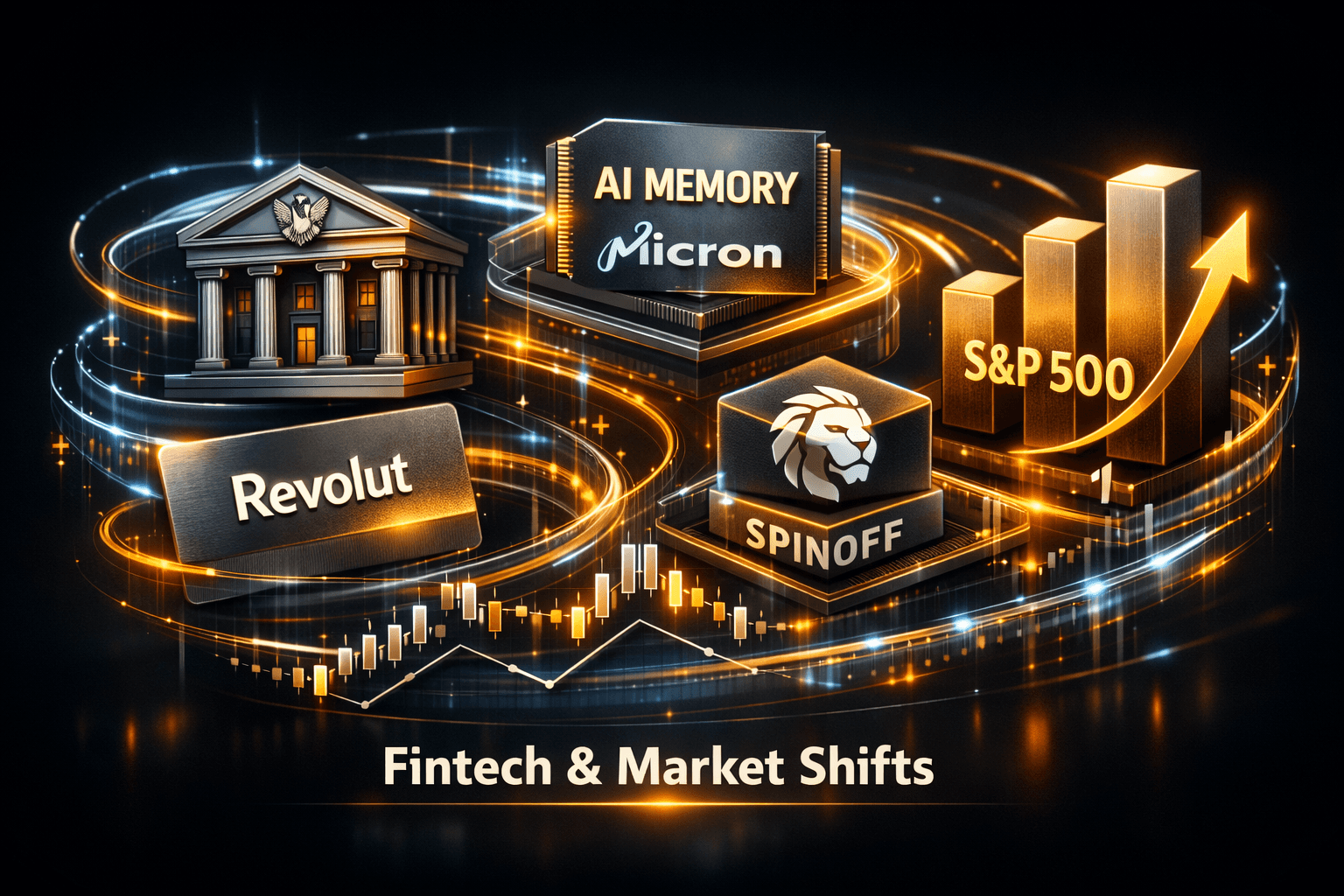
- Fintech charters: Revolut secured a conditional OCC charter and former MoneyLion executives launched OpenReserve, which also received conditional OCC approval, marking a regulatory win for nonbank challengers.
- Index changes: Bloom Energy $BE was named to the S&P 500, while Molson Coors $TAP, Builders FirstSource Builders FirstSource (BLDR), and The Trade Desk The Trade Desk (TTD) are slated for removal from the benchmark.
- Credit/asset management: Nuveen Churchill Direct Lending reported a 27% discount to NAV and an expected 9.5% ROE, figures that stand out for income-oriented investors.
- Corporate product news: Micron Micron Technology (MU) is scaling AI-focused memory capacity, Netflix Netflix (NFLX) faces skepticism that ad revenue alone will boost its multiple, and Tesla Tesla (TSLA) saw its Cybercab rollout disappoint investors.
- Regulatory oversight: The GAO flagged transparency gaps for banks that operate without holding companies, urging improved disclosure rules for investor benefit.
Key Developments
Fintechs win regulatory seat at the table
Revolut's conditional OCC charter and OpenReserve's similar approval are the most consequential events for financial services this weekend. Charter status gives these firms a clearer path to accept deposits and scale U.S. operations, which can reduce reliance on third-party bank partners and lower funding costs.
What does that mean for your exposure to fintech? It increases competitive pressure on regional banks in retail deposits and payments, but it also raises the bar for compliance as federal oversight tightens.
S&P 500 lineup shifts and rebalancing flows
Bloom Energy $BE's addition to the S&P 500 and the removal of $TAP, $BLDR, and $TTD are reminders that index rebalancing drives predictable portfolio flows. Passive funds tracking the index will buy the addition and sell the removals on the effective date, creating short-term liquidity events worth watching.
Should you reposition ahead of the rebalancing? That depends on your time horizon, but keep your eye on volumes and spreads when trading names affected by the move.
Mixed corporate signals: chips, streaming, and EVs
Micron $MU is doubling down on AI memory chip capacity, a strategic bet that aligns with persistent demand for memory in data centers. That could boost revenue mix over time if execution holds.
On the other hand, Seeking Alpha commentary cautioned that Netflix $NFLX may not earn a higher valuation based on advertising alone, while Tesla $TSLA's Cybercab debut failed to meet some investor expectations. These stories show divergence between execution-sensitive hardware or product rollouts and platform businesses wrestling with monetization.
What to Watch
With markets closed today, use the downtime to prepare for catalysts that could move the sector when trading resumes on Tuesday.
- OCC and regulatory updates: Monitor whether the conditional charters become final and how the OCC frames ongoing supervisory expectations, especially around capital and compliance.
- S&P reconstitution timing: Check the effective date for $BE's inclusion and the $TAP, $BLDR, $TTD removals, since rebalancing creates short-term liquidity and price moves.
- Micron execution and AI demand: Watch capacity announcements and inventory commentary from chipmakers to gauge whether AI-driven memory demand continues to support higher margins.
- Bank disclosure rules: Follow GAO and potential follow-up from the SEC or bank regulators on disclosure standards for banks without holding companies, a rule change that could affect investor transparency.
- Income vehicles: For yield-focused investors, note Nuveen Churchill Direct Lending's 27% discount and 9.5% expected ROE, but also monitor underlying portfolio credit quality and liquidity.
Keep in mind that volatility can spike around regulatory rulings and index events. Do you have an alert set for the S&P rebalancing? If not, consider one so you don't miss sudden moves.
Bottom Line
- Neutral overall: fintech charter wins are offset by mixed corporate news, leaving a balanced backdrop for Finance & Banking heading into the next trading session.
- Regulatory developments matter more than ever, since charters and disclosure rules change competitive and transparency dynamics for banks and fintechs.
- Index changes will create short-term flows, so be mindful of liquidity and execution if you trade affected names.
- Product execution remains a differentiator, as seen with $MU's AI-memory push and the mixed receptions for $NFLX and $TSLA product moves.
- This briefing is informational only, analysts note that you should monitor catalysts and risk factors before making any decisions.
FAQ Section
Q: How significant is a conditional OCC charter? A: A conditional OCC charter is a major step toward full national bank status, allowing firms to accept deposits and access payment infrastructure, but final approval and supervisory conditions still matter.
Q: When will S&P 500 index changes affect prices? A: Index inclusions and removals take effect on the S&P's scheduled reconstitution date; passive fund flows around that date often create short-term price pressure for involved stocks.
Q: What should I watch about Nuveen Churchill Direct Lending? A: Focus on discount to NAV, expected ROE, and the underlying credit quality and liquidity in the portfolio, since those drive long-term yield sustainability.