The Big Picture
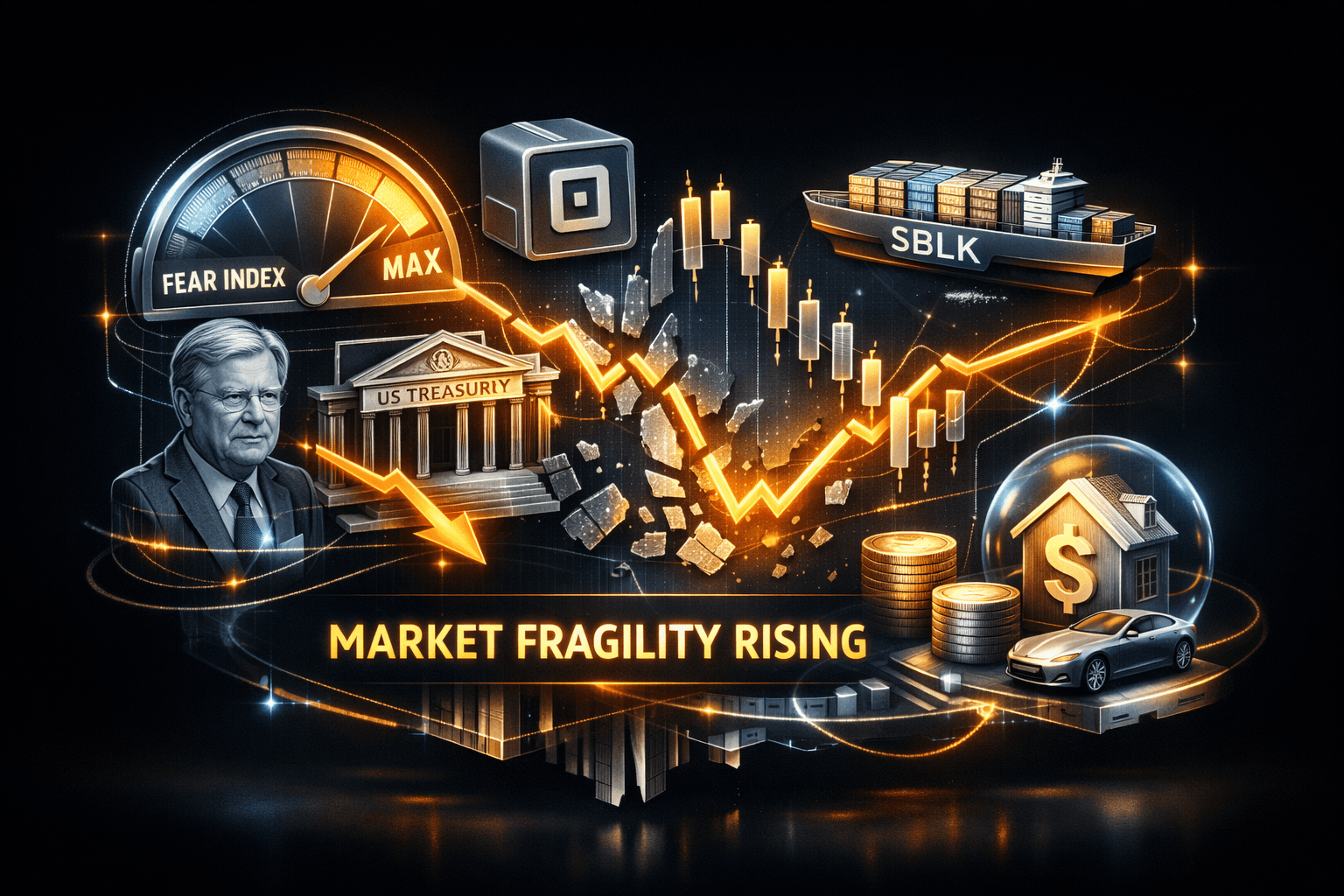
The most consequential development for finance and banking investors this morning is rising market fragility, with a well-known Wall Street turbulence indicator hitting its highest possible level. That reading, which flashed 1 on Aug. 19 for the first time since December 2024, is a clear sign that volatility can accelerate quickly, and you should be aware of the implications for risk assets and fixed income.
At the same time, veteran investor Stanley Druckenmiller publicly criticized Treasury Secretary Scott Bessent's maneuvers in the bond market, adding a political and policy dimension to the volatility story. Together these items suggest headwinds for market stability even as stock-specific value calls appear in the headlines.
Market Highlights
- Market fragility index: The Wall Street turbulence measure hit 1 on Aug. 19, its highest reading and a level linked historically to volatility spikes.
- Policy spotlight: Stanley Druckenmiller criticized Treasury Secretary Scott Bessent, focusing attention on Treasury operations and bond-market signaling.
- Stock ideas: Seeking Alpha pieces flagged deep value in Block, ticker $SQ, and offered a cautious view on Star Bulk Carriers, ticker $SBLK, signaling mixed opportunities within the sector.
- Personal finance note: A MarketWatch reader case shows a 74-year-old with $10,000,000 and no debt asking about charitable and spending options, underscoring planning needs for high-net-worth investors.
- Consumer side: Nonbank headlines include NordVPN pricing and Roborock discounts, reminding you that consumer spending drivers can filter into broader financial demand trends.
Key Developments
Market fragility reading reaches maximum
The turbulence indicator reaching 1 signals elevated market fragility and the potential for rapid volatility expansion. Historically when the gauge has gone to that level, realized volatility and spreads widened, making duration and liquidity risks more acute for banks, asset managers, and lenders.
For you that means volatility-sensitive positions may need closer monitoring, and liquidity conditions around Treasury auctions and corporate issuance deserve particular attention.
Druckenmiller openly criticizes Treasury policy
Stanley Druckenmiller, a widely followed macro investor, publicly criticized Treasury Secretary Scott Bessent for recent bond-market maneuvers. The commentary magnifies scrutiny of fiscal financing strategy and the interaction between Treasury operations and Fed policy, which can affect yields and bank balance sheets.
Investors should note that public disputes at this level can feed headline-driven trading and widen bid-ask spreads in fixed-income markets, especially during times of structural fragility.
Stock-specific narratives: $SQ and $SBLK
Seeking Alpha contributors highlighted deep-value arguments for $SQ tied to the Cash App ecosystem, while another piece suggested caution on Star Bulk Carriers, $SBLK, despite a record quarter. These are examples of divergent firm-level stories within a broader market that is showing stress.
That split matters because selective, idiosyncratic opportunities will coexist with macro-driven risk. You're likely to see dispersion rise between names with strong fundamentals and those exposed to macro or liquidity shocks.
What to Watch
Track Treasury auctions and Fed and Treasury communications closely, because policy signals and issuance calendars will affect yields and liquidity. You should watch auction coverage metrics and any comments from Fed officials for clues on rate and balance-sheet trajectories.
Keep an eye on volatility gauges like the VIX and spread measures for corporates and municipals. Are you prepared for higher realized volatility over the coming weeks? Elevated readings increase the chance of rapid repricing and margin events.
Monitor earnings from major banks and brokerages as results come in, since revenue beat-or-miss patterns and net interest margin trends will shape sector sentiment. Also watch secondary indicators such as loan growth, deposit flows, and credit spreads for early signs of tightening.
Bottom Line
- Systemic risk is elevated: a market fragility gauge recently hit its maximum, and that historically precedes volatility spikes.
- Policy scrutiny is increasing: public criticism of Treasury actions by a high-profile investor adds uncertainty to bond markets and yields.
- Stock-level opportunities exist, but dispersion is likely to rise; $SQ and $SBLK headlines show mixed, idiosyncratic narratives.
- For you, liquidity, duration, and credit spreads are the primary risks to monitor over the next few weeks.
- Personal-finance stories remind high-net-worth households to consider estate, charitable, and spending plans, since cash holdings can be redeployed or donated depending on tax and market outlooks.
FAQ Section
Q: What does a market fragility reading of 1 mean for my portfolio? A: It indicates the market environment is prone to rapid volatility and wider spreads, so you should review liquidity and duration exposure.
Q: How could criticism of Treasury policy affect bond yields? A: Public critique can raise uncertainty around issuance and strategy, which may push yields higher if investors demand larger risk premia.
Q: Should I act on stock-specific ideas like $SQ and $SBLK now? A: Analysts note these are firm-level calls that may offer value or caution, but broader market fragility means you should weigh macro risks before increasing exposure.