The Big Picture
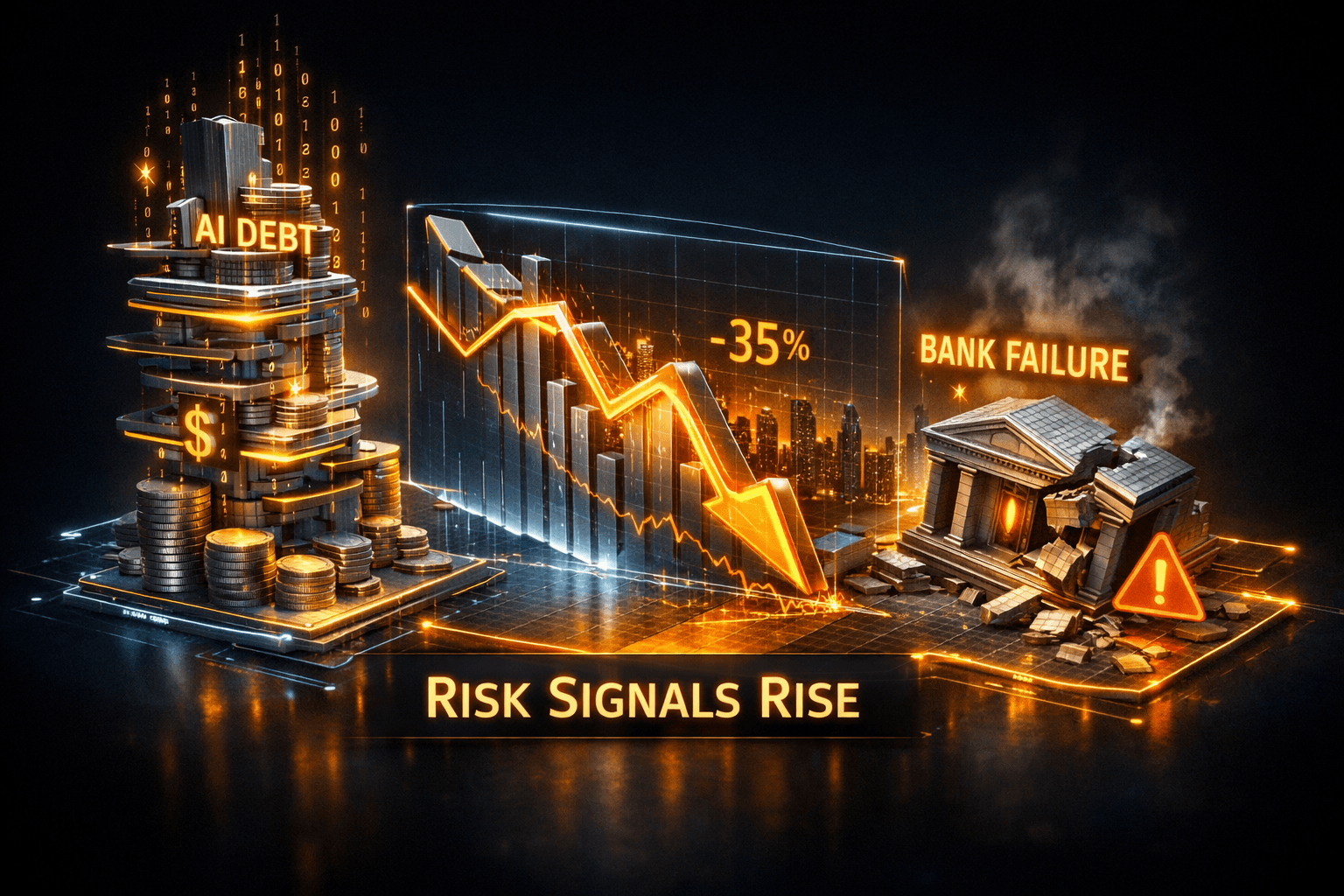
Today’s headlines pushed risk to the front of the Finance & Banking story line, with AI-related debt rising 99% year over year and a mega-cap name losing more than $800 billion in market value in under a month. Those developments, together with a small-bank closure and a geopolitical oil shock, mean investors had to reassess concentration and credit exposure fast.
Why does this matter to you? Credit concentration and sudden market-value swings can ripple into lending, bond holdings, and liquidity for financial institutions, so you’ll want to know where risks are building and what catalysts could move markets tomorrow.
Market Highlights
Quick facts to scan before you dig in.
- AI-related debt, defined by recent coverage as debt tied to hyperscalers and AI projects, jumped 99% over the past year, creating concentration risk across credit portfolios.
- SpaceX has shed more than $800 billion of market value from a $2.67 trillion peak in less than a month, fueling volatility concerns in large-cap tech exposure.
- Global oil topped $83 a barrel, logging intraday gains as high as 5% after a U.S. naval blockade was reimposed on the Strait of Hormuz.
- OCC closed Kentland Federal Savings and Loan Association, with the FDIC appointing Kentland Bank as receiver and moving customers automatically, underscoring continued small-bank fragility.
- $IDT posted its 2026 Q3 results and presented updated metrics, while $FNV (Franco-Nevada) was flagged as stable year to date with potential upside, according to coverage.
- Seeking Alpha highlighted $RIV preferred stock offers yielding over 13%, while preferreds and special income plays drew attention amid market stress.
Key Developments
AI-Related Debt Surge, Credit Concentration Risk
Reports show AI-related corporate borrowing roughly doubled year over year, a 99% jump that analysts call a "shock to the system." The swell in hyperscaler and AI-project debt raises the odds investors and lenders could hit concentration limits tied to one industry or a few large borrowers.
For you that means fixed-income allocations, bank loan books, and fund exposures should be reviewed for single-issuer or sector concentration. Could trouble at one large borrower cascade into broader credit stress? That’s the concern many analysts are flagging.
Market Volatility: Mega-Cap Pressure and Oil Spike
SpaceX’s dramatic market-value decline has put pressure on large-cap growth benchmarks, and while SpaceX isn’t a conventional bank counterparty, the sheer size of the move matters for portfolio risk and derivatives exposures. Investors are asking, should you be worried about spillovers into banks and wealth managers that hold concentrated tech assets?
At the same time, oil’s jump above $83 a barrel on renewed Strait of Hormuz tensions pushes inflation and interest-rate sensitivity back into the foreground. Energy names and commodity-focused royalties like $FNV gained attention from commentators as beneficiaries, but higher fuel costs can strain consumers and corporate margins.
Regulation and Small-Bank Stress
The OCC’s closure of Kentland Federal Savings and Loan Association highlights how smaller institutions remain vulnerable, even in a generally stable macro picture. The FDIC’s quick receiver appointment is standard procedure, but it renews questions about deposit flows and local credit availability.
On the regulatory front, a judge-approved deal gives CFPB nominee Brian Johnson 60 days to review a workforce reduction plan if confirmed. That pause could shift enforcement or staffing timelines, and it’s another variable banks and consumer finance firms will be watching closely.
What to Watch
Eyes on catalysts that could amplify or ease today's moves.
- Geopolitics: Any escalation around the Strait of Hormuz will keep oil volatile and may pressure inflation readings, which affects bank margins through rate expectations.
- Credit signals: Watch loan-loss provisions, bank stress tests, and earnings commentary for signs that AI-related debt concentration is translating into credit deterioration.
- CFPB and regulatory timeline: The Senate confirmation and the 60-day review window for the CFPB nominee could shape consumer enforcement and staffing for weeks, so monitor votes and statements.
- Earnings and presentations: $IDT’s Q3 materials and follow-up calls from regional banks will offer direct insight into loan quality and deposit dynamics in this environment.
- Income alternatives: With yields and preferreds getting attention, track spreads and coverage for $RIV preferreds and other high-yield instruments, but note elevated yield often signals higher risk.
What should you prioritize in the short term? Start with concentration checks. Where are you exposed to a handful of large issuers, single sectors, or rate-sensitive balance sheets?
Bottom Line
- Systemic risk cues rose today because of concentrated AI-related borrowing and a massive market-value swing in a mega-cap, so caution is warranted when assessing credit and concentration exposure.
- Oil’s spike to above $83 a barrel increases inflation and rate uncertainty, which can compress bank net interest margin dynamics and stress corporate borrowers.
- Small-bank closures persist as a localized risk, underscoring the importance of deposit and liquidity monitoring for community lenders.
- Regulatory shifts at the CFPB and evolving staffing timelines could change enforcement cadence, so watch confirmations and official notices closely.
- Income plays like preferreds are attracting interest with yields north of 13% in some cases, but high yield often reflects higher default or liquidity risk, so analysts note careful due diligence is needed.
FAQ Section
Q: What is "AI-related debt" and why does it matter? A: AI-related debt refers to borrowing tied to hyperscalers and large AI projects. It matters because rapid growth in that borrowing can concentrate credit risk and hit portfolio limits if a few borrowers falter.
Q: Should I be worried about the small-bank closure today? A: The OCC closure of Kentland Federal Savings and Loan is concerning locally, but FDIC receivership protocols aim to protect depositors. You should monitor wider regional deposit trends and bank earning calls for contagion signs.
Q: How does the oil spike affect banks and finance stocks? A: Higher oil can push inflation and influence rate expectations, which alters bank margins and loan performance. Energy producers may benefit while consumer lenders face tighter credit conditions if fuel-driven costs squeeze households.