The Big Picture
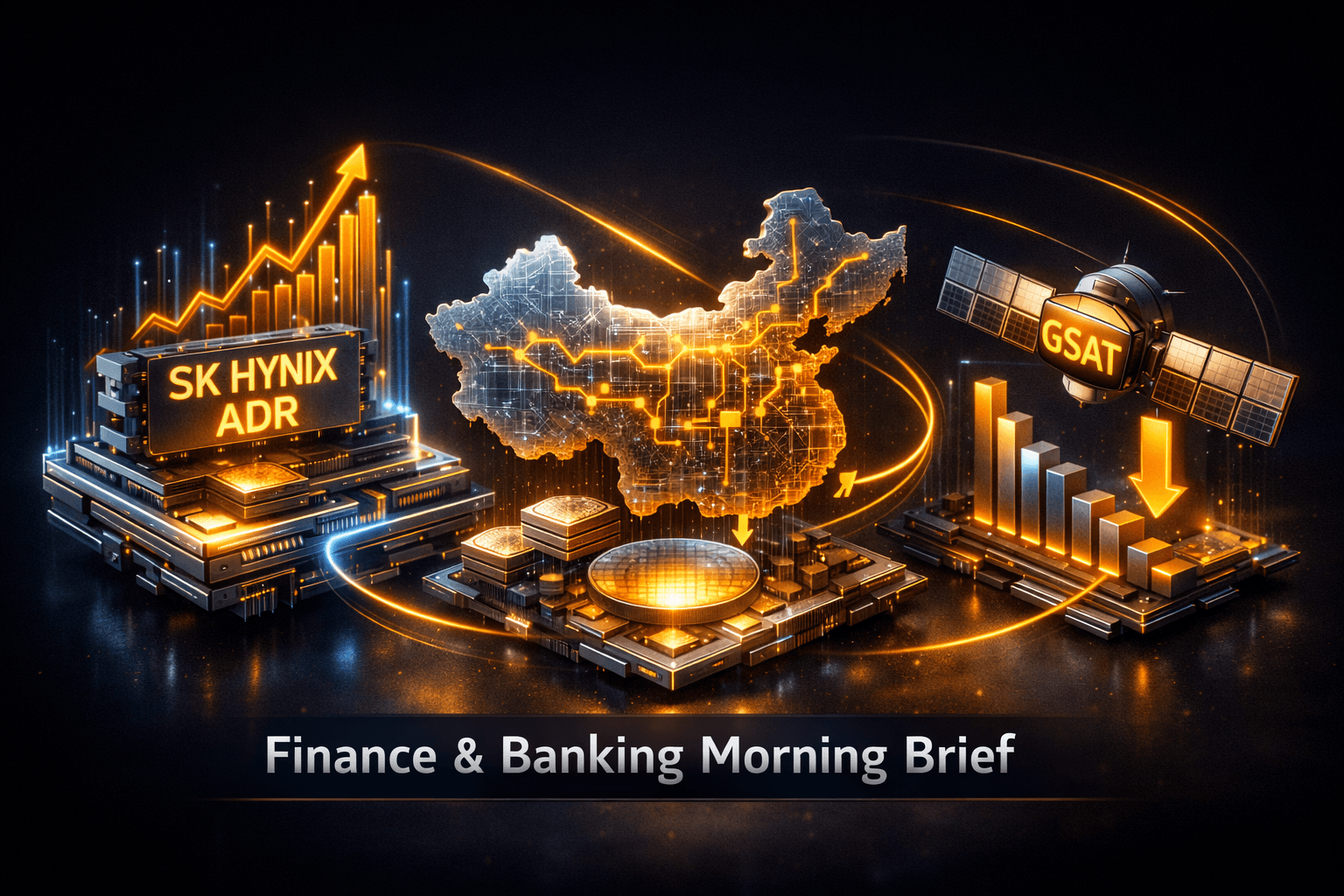
SK Hynix's move to issue American depository receipts and list on the Nasdaq is the standout development this morning, offering U.S. investors a simpler route into one of the memory-chip leaders. That step, together with renewed focus on Chinese semiconductor investment and selective mining recoveries, sets a broad theme: access and reallocation across tech and resource plays.
At the same time you should note cautionary signals. An analyst view that the Amazon-related deal reduces upside for $GSAT, and a high‑stakes personal finance dispute reported in MarketWatch, remind you that company headlines and legal risks can move market sentiment fast. What should you watch and why does it matter for your allocation decisions today?
Market Highlights
Quick facts and price moves to scan this morning.
- SK Hynix, moving to list American depository receipts on the Nasdaq, aims to widen U.S. investor access, tapping huge AI-driven demand for memory chips, no share-price move cited in the story.
- Semiconductor ecosystem interest in China is rising, with $SMHC spotlighted for investing in a parallel local supply chain, signaling continued sector capital flows into chip manufacturing themes.
- Satellite services name $GSAT is under coverage with a take that the Amazon deal caps upside, leading an analyst to stay on hold rather than buy, suggesting limited near-term rerating potential.
- Precious metals and mining play $MUX is getting attention for a potential self-funding turnaround and hidden copper exposure, offering commodity-linked recovery stories to watch.
- MarketWatch also ran consumer-focused items, from a contested home-gift legal case to a $63 million celebrity estate feature, underscoring that household balance-sheet and luxury real estate stories can influence retail sentiment.
Key Developments
SK Hynix Lists ADRs, Easing U.S. Access
MarketWatch reports SK Hynix will issue American depository receipts and seek a Nasdaq listing, a move that should make it easier for U.S. investors to participate in one of the three major memory-chip suppliers. Given surging demand for AI-optimized memory, the ADR route could boost liquidity and broaden the investor base, though it doesn't guarantee immediate price appreciation.
For you, this means easier exposure to memory markets without cross‑listing frictions. Watch for filing details and the ADR ticker, since those will determine inclusion in U.S.-focused ETFs and broker platforms.
China Semiconductor Play and Local Ecosystems
Seeking Alpha highlights $SMHC in the context of investing in China’s parallel semiconductor ecosystem, reflecting policymakers' push for local supply chains. That theme matters because it could attract capital to domestically oriented chip firms and spur partnerships or subsidies that change competitive dynamics.
Investors should consider how exposure to China-centric semiconductor names fits your risk profile, since policy shifts can be decisive. Do you have the geographic or regulatory diversification you need?
Satellite Services and Mining Notes: $GSAT and $MUX
An analyst piece on $GSAT argues the Amazon deal caps potential upside, prompting a hold recommendation. Practically, that suggests near-term investor returns may be limited even if the deal reduces execution risk. Price momentum may be muted until new revenue levers appear.
On the resource side, $MUX surfaces as a potential self-funding turnaround with a copper option, according to Seeking Alpha. That combination could offer a play on both operational recovery and commodity exposure, but it brings volatility tied to copper prices and execution of mining plans.
What to Watch
Several near-term catalysts could shape sector moves and your own decisions.
- SK Hynix ADR filings and Nasdaq ticker announcement, which will affect accessibility and potential ETF inclusion.
- Chinese policy updates and subsidy signals for domestic semiconductor projects, which could change investment flows to names like $SMHC.
- Updates on the Amazon-related work with $GSAT or any revised guidance, since analysts say upside looks limited for now.
- Copper price trends and company-level operational updates from $MUX, which will determine whether the turnaround can self-fund.
- For retail investors, legal and estate stories like the MarketWatch home-gift dispute are a reminder to document property transfers and understand forced sale risk where co-ownership exists.
Be ready to act if filings, guidance, or policy statements create clear information changes. How will you position for potential volatility, and do you have stop-losses or size limits in place?
Bottom Line
- SK Hynix’s planned Nasdaq ADR is the primary headline, improving U.S. access to a major memory-chip supplier and likely increasing liquidity.
- China-focused semiconductor investment stories suggest continued policy-driven capital flows, but regulatory risk remains a key consideration.
- $GSAT faces a constrained upside view from at least one analyst, indicating patience may be warranted until new growth signals appear.
- $MUX offers a commodity-linked recovery angle, but execution risk and copper price exposure could mean higher volatility.
- Personal finance and property disputes are a reminder that legal and household balance-sheet risks can have real market implications for retail investors.
FAQ Section
Q: What does an ADR listing mean for U.S. investors? A: An ADR lets U.S. investors buy shares in a foreign company in dollars through U.S. exchanges, improving liquidity and simplifying custody and trading.
Q: How should I interpret an analyst saying a deal "caps upside" for a stock? A: That view means the deal may limit future price gains because it reduces speculative potential, even if it lowers certain execution risks, so the stock might not rerate higher quickly.
Q: Are mining turnaround stories like $MUX less risky if they claim to be self-funding? A: Self-funding reduces the need for dilutive financing, but operational execution and commodity price swings still create notable risk, so monitor cash flow and production targets closely.