The Big Picture
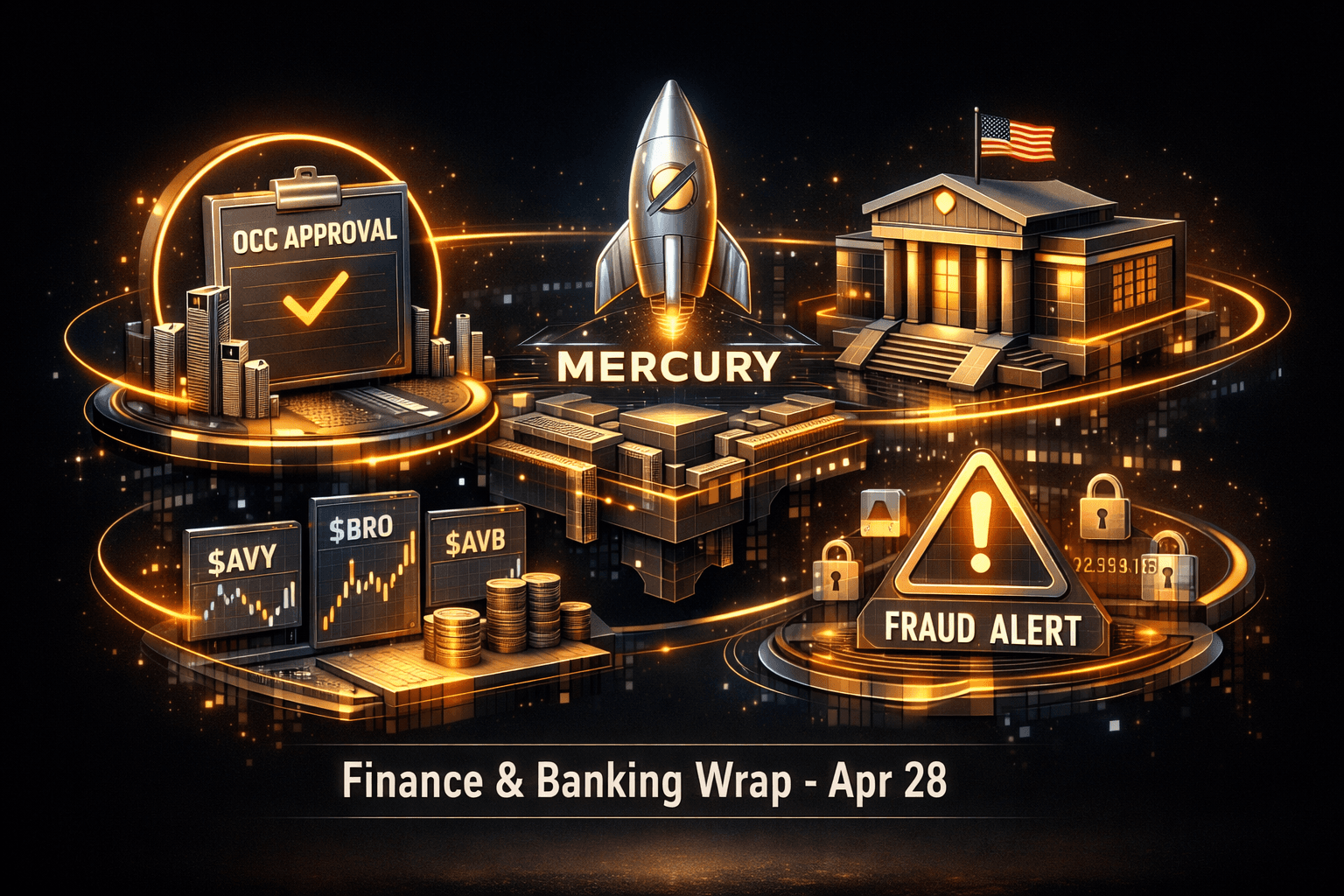
Today's biggest development for the Finance & Banking sector was regulatory progress for fintech, as Mercury received a conditional OCC national bank charter, a move that could reshape competition in digital banking. At the same time, traditional banks are investing in brand and marketing to capture higher-margin customers while investors parse a batch of Q1 earnings call transcripts from insurance, REIT and manufacturing names.
Why does this matter to you? Regulatory approvals and repositioned bank brands affect competitive dynamics and distribution of financial services, while consumer-facing stories on fraud and retirement planning highlight ongoing risks for savers and depositors.
Market Highlights
Quick facts and market reactions you should know from today's headlines.
- Mercury nabs conditional OCC charter, moving it closer to operating as a national bank, a material step for the fintech's competitive trajectory.
- U.S. Bank launches a brand refresh, signaling a push to win affluent customers and scale wealth initiatives, according to Banking Dive reporting.
- Earnings call transcripts posted for Avery Dennison $AVY, Brown & Brown $BRO and AvalonBay Communities $AVB, offering fresh management commentary on Q1 performance and trends.
- Consumer alert, MarketWatch reports a bounced class-action settlement check affecting a retiree, underscoring fraud and payment risk for personal accounts.
- Crypto price-prediction pieces highlighted long-term forecasts, including $MYRO projected to $0.050 by 2030 and $TON projected to $26.17 by 2030, reflecting ongoing retail interest in speculative tokens.
Key Developments
Mercury wins conditional OCC charter
Banking Dive reports Mercury secured conditional approval from the Office of the Comptroller of the Currency a few months after applying and appointing Jon Auxier as CEO of the proposed Mercury Bank. That clearance is an important regulatory milestone and it could give Mercury broader lending and deposit powers if final approval follows.
For you, that means more fintech competition at the national level and a potential shift in how digital banks attract deposits and commercial clients. Will established banks respond with faster product rollouts or tighter pricing? That's a key question for tomorrow's trading and strategy conversations.
U.S. Bank brand refresh aims at wealth customers
$USB's marketing chief told Banking Dive the refresh uses jewel tones and a shield motif to convey sophistication and arrival in wealth management. The repositioning is meant to support higher-fee businesses and improve customer perception amid stiff competition.
This is a reminder that banks are not just competing on rates and tech, they're competing for client perception and fee pools. If you follow regional and super-regional banks, watch how brand and marketing spend link to customer acquisition metrics over the next quarters.
Earnings transcripts provide management color
Transcripts for Avery Dennison $AVY, Brown & Brown $BRO and AvalonBay $AVB were posted on Seeking Alpha. The materials are mostly management discussion and Q&A, useful for gauging margin commentary, pricing power and portfolio trends even when headline numbers have already been released.
Investors and analysts often mine transcripts for guidance tone and language shifts. You can use these to refine expectations for upcoming quarterly reports or earnings revisions, but note transcripts don't replace formal guidance or audited results.
Consumer risks and retail-focused content
MarketWatch highlighted a case where a class-action settlement check bounced and funds were debited from an elderly recipient’s account, raising fraud and process-risk issues. Separately, personal finance columns addressed retirement asset mix and early retirement planning for a 56-year-old with $3.5 million in savings.
Practical takeaway: keep an eye on settlement processing safeguards, monitor account notices, and consider plan-level tax and withdrawal sequencing when you review retirement arrangements.
What to Watch
Here are the catalysts and risks that could move Finance & Banking names in the short term.
- Regulatory follow-through for Mercury: final OCC conditions and timing for conversion to a full banking charter. Could Mercury become a more direct competitor to regional banks?
- Bank earnings season, as banks begin reporting Q2 results and update guidance. Management tone on margins, deposit costs and loan growth will matter to you.
- Consumer protection headlines and fraud incidents, which may influence deposit flows and bank reputational risk, especially among older customers.
- Macro and policy: Fed commentary and inflation readings continue to influence net interest margins and valuation multiples for financials.
- Retail crypto appetite and speculative tokens like $MYRO and $TON, which remain volatile and can affect fintech user acquisition trends and payment volumes.
What should you monitor in your watchlist? Check regulatory calendars, analyst notes on fintech charters, and quarterly calls for management language shifts.
Bottom Line
- Neutral day overall: regulatory wins for fintech and marketing moves by incumbents offset consumer fraud concerns and non-material earnings transcripts.
- Mercury's conditional OCC charter is a near-term structural story for fintech competition, but final outcomes and timing matter.
- U.S. Bank's brand refresh signals strategic focus on wealth and fees, a trend you may see across regional peers.
- Transcripts from $AVY, $BRO and $AVB provide useful managerial color, but don't substitute for formal releases and numbers.
- Watch consumer-protection headlines closely, they can change sentiment quickly and affect deposit behavior.
FAQ Section
Q: What does a conditional OCC charter mean for a fintech? A: It means regulators have approved moving toward a national bank structure subject to conditions, enabling broader banking activities if final approval is granted.
Q: Are the earnings call transcripts replacements for earnings reports? A: No, transcripts provide management commentary and investor Q&A but you should rely on official earnings releases and filings for financials.
Q: How should I treat crypto price-prediction pieces? A: Treat them as speculative analysis, not forecasts anchored in fundamentals, and weigh them against volatility and regulatory risk.