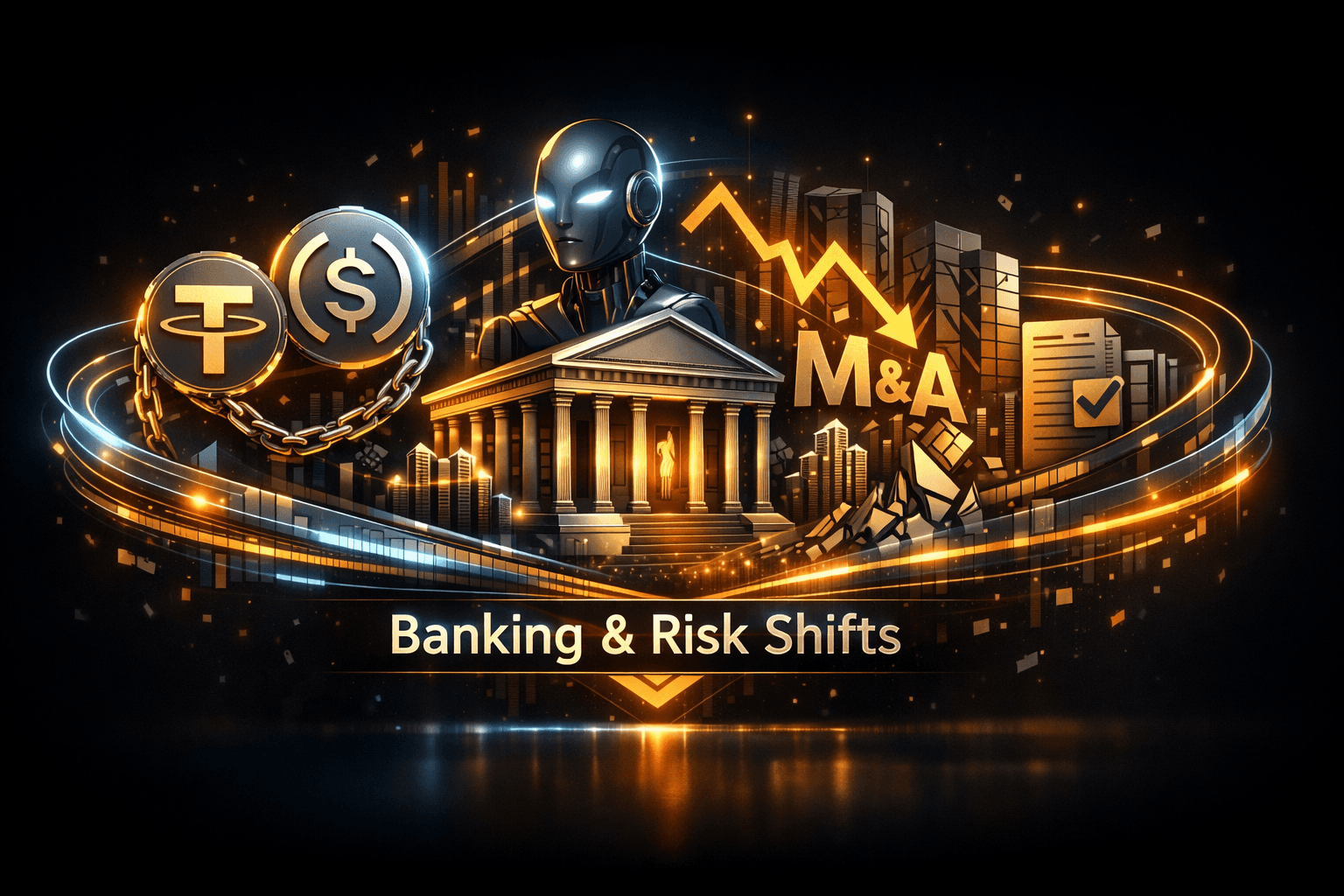
The Big Picture
Today’s Finance & Banking storylines aren’t driven by a single shock, but by a shifting backdrop of technology adoption, hidden exposures, and regulatory friction. Stablecoin exposure is expanding quietly through vendors and payment rails, while banks race to deploy AI agents with stronger governance in focus.
These structural shifts matter because they change banks’ liquidity, counterparty and operational risk profiles even as corporate headlines from tech and industrials keep market volatility alive. What you own and how your providers are wired now matters more than ever.
Market Highlights
Quick facts to start your trading day and position monitoring.
- Stablecoin exposure rising: Banking Dive reports hidden stablecoin links in vendor and payments chains, suggesting growing operational and liquidity channels into the banking system.
- $META deal blocked: China halted Meta Platforms’ roughly $2 billion acquisition of an autonomous AI products firm, a regulatory setback for cross-border AI M&A.
- Corporate previews: Seeking Alpha published pieces on $MXL being re-rated, $GM’s structural transformation and $MU’s memory cycle evolution ahead of Q1 reads and analyst review.
- Household finances and wealth: MarketWatch highlights a retirement case with $3.5 million in savings and $2.5 million held in retirement accounts, underlining tax strategy issues for affluent retail investors.
- Macro risk note: Benzinga flags rising oil prices and tools to explore hedged portfolios quickly, which ties into bank asset sensitivity and client hedging demand.
Key Developments
Quiet expansion of stablecoin exposure and what it means for banks
Banking Dive details how stablecoin links are proliferating through vendors, payments firms and treasury platforms. Those exposures are often embedded and not always visible on bank balance sheets.
For you that means liquidity and counterparty risk could shift faster than traditional metrics indicate. Regulators and risk teams are likely to raise scrutiny, so watch bank disclosures for vendor concentration and off-balance-sheet payment flows.
AI agents in banking, governance moving front and center
Banking Dive sponsored content argues success won’t be measured by how many AI agents get deployed, but by how well they’re governed. Institutions are focusing on model validation, escalation paths and compliance guardrails.
That’s a potential positive for operational efficiency and client experience, but it also implies near-term implementation costs and oversight headaches. Are banks ready to manage the second-order risks of scaled agents?
Corporate and market signals: re-ratings, cyclical shifts and regulatory headwinds
Seeking Alpha’s pieces paint a mixed micro picture. $MXL was characterized as having been re-rated too far, too fast, implying valuation pressure for fast-rising components names. $MU analysis suggests the memory cycle is evolving rather than collapsing, which supports selective semiconductor exposure.
Meanwhile $GM is getting a positive structural narrative ahead of Q1. On the regulatory front, $META saw a roughly $2 billion acquisition blocked by China, underscoring geopolitical limits on cross-border tech deals and M&A execution risk.
What to Watch
Here are the catalysts and risk signals to monitor through the trading day and coming weeks.
- Earnings and previews: Watch Q1 commentary from cyclical firms, including auto and semiconductors, for demand signals that could ripple into bank loan books and capital markets activity.
- Regulatory moves on stablecoins: Any guidance or enforcement actions from domestic regulators will materially affect bank vendor risk and liquidity planning. Track agency statements and bank disclosures.
- AI governance updates: Look for conference presentations, vendor agreements and bank board minutes addressing agent oversight. Those will reveal how implementation costs and risk controls are being allocated.
- Oil price momentum and hedging flows: Rising crude can lift inflation expectations and affect trading desks, corporate cash flow, and demand for hedges. Keep an eye on energy-driven volatility as a market risk amplifier.
- M&A and cross-border friction: The $META-China decision is a reminder that geopolitics can kill deals quickly. Follow any guidance from multinationals and their M&A pipelines for implications to capital markets fees and advisory revenues.
Bottom Line
- Hidden stablecoin links are changing bank risk profiles, so check vendor exposures and disclosures for liquidity signaling.
- AI agents offer efficiency gains but require stronger governance, which may raise near-term costs and operational oversight needs.
- Corporate re-ratings and cycle commentary from $MXL, $MU and $GM are sending mixed signals about valuation and demand, suggesting selectivity matters.
- Geopolitical and regulatory actions like China blocking $META’s deal show M&A execution risk is elevated for cross-border tech targets.
- Rising oil prices are an immediate market risk; consider how increased volatility could affect bank trading revenues and client hedging demand.
FAQ Section
Q: How can stablecoin exposure affect bank liquidity? A: Stablecoins can create new payment and settlement channels that flow through vendors and treasury platforms, possibly introducing rapid liquidity drains that aren’t visible on traditional balance sheet metrics.
Q: Should I worry about AI agents in my bank’s services? A: You should ask your provider about governance, escalation procedures and model validation, because strong controls influence both service quality and operational risk.
Q: What does the $META deal block mean for investors? A: It highlights geopolitical and regulatory limits on cross-border tech M&A, which can affect deal pipelines, advisory fees and strategic growth plans for technology companies.