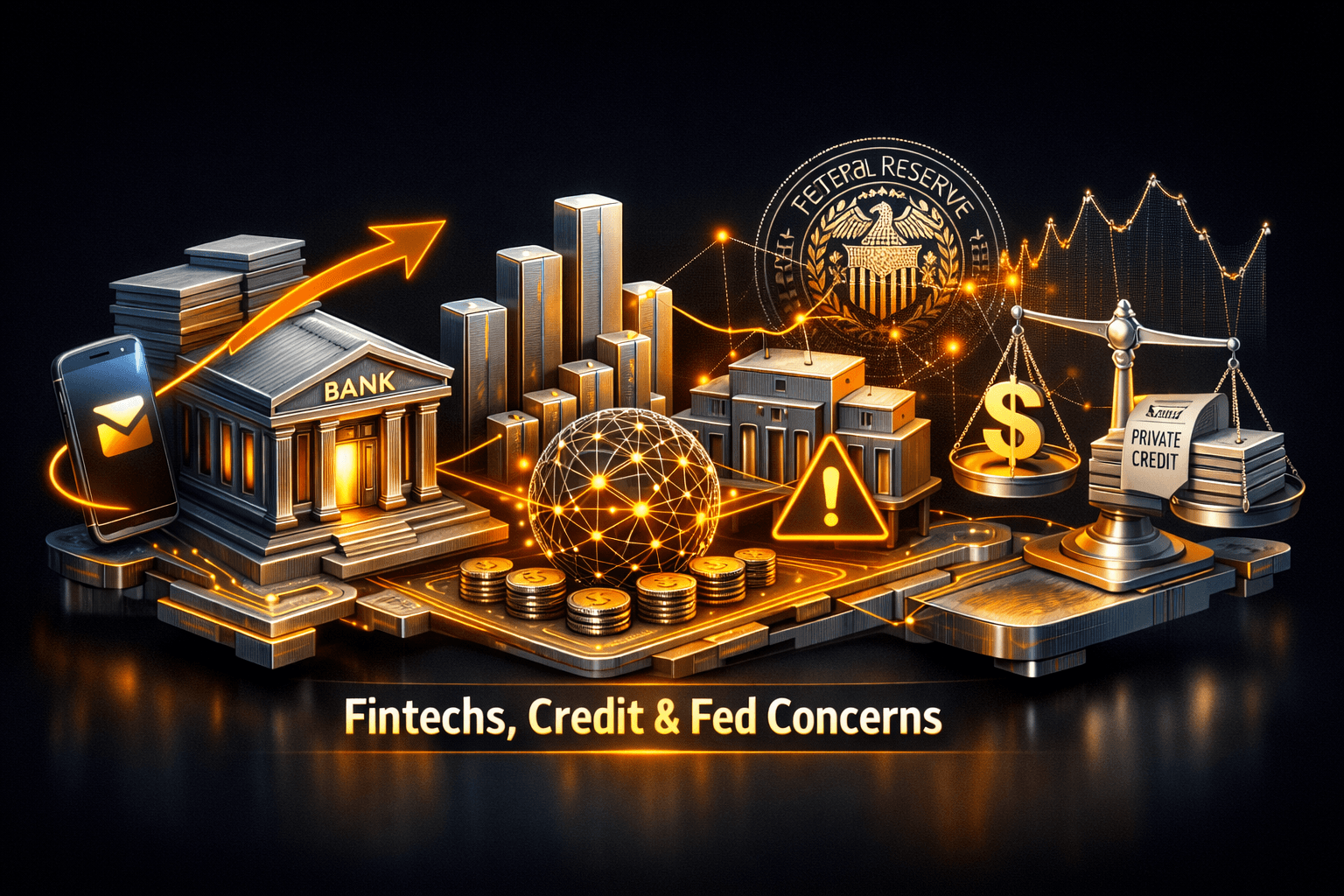
The Big Picture
Fintech expansion and corporate repositioning featured heavily today, even as questions about credit risk and central-bank governance kept a lid on broad enthusiasm. You saw Mission Lane file for a bank charter, and LendingClub move to rebrand as Happen Bank, signals that digital lenders are pursuing stability and regulatory advantages.
At the same time, commentary narrowing the definition of Federal Reserve independence and a bearish take on a private-credit name heightened investor caution. What does all this mean for your allocations and risk exposure tomorrow? It means mixed signals, so selectivity will matter.
Market Highlights
Trading reflected the split narrative, with sector-specific winners and pockets of weakness.
- Mission Lane filed a bank charter application, the first credit card charter filing in roughly 20 years, a development that may reshape digital-card competition.
- LendingClub, $LC, announced a rebrand to Happen Bank, citing alignment of brand with product mix and digital strategy.
- Tilray, $TLRY, and other cannabis names rallied after reports the administration may reclassify cannabis, potentially easing research and banking access for growers.
- FS KKR Capital, $FSK, drew a critical note calling it one of the weaker links in private credit, underlining investor concern about asset-quality and liquidity in that market segment.
- Crypto coverage drove interest in Toncoin, $TON, with some price predictions pointing to $26.17 by 2030, adding to speculative flows into digital assets.
- Consumer finance stories hit home for retail readers: a MarketWatch piece on a 20-year-old leaving a job raised 401(k) rollover questions and another highlighted a 3% advisory fee on a $1.5 million estate, prompting fee scrutiny.
Key Developments
Mission Lane Seeks Bank Charter
Mission Lane applied for a national-style bank charter, the first credit-card focused charter filing in about 20 years. The charter would allow the company to apply its home-state interest rates nationwide and could reduce funding and regulatory frictions for its credit-card business.
For you, that means fintechs are still pushing for structural advantages to lower costs and scale lending, and regulators will be a key gatekeeper to watch.
LendingClub Rebrands; Incumbents Shift
LendingClub said it will rebrand as Happen Bank and emphasized its evolution from a loan marketplace to a digital bank. CEO Scott Sanborn called the change a natural step to match the brand with the business model.
Rebrands can help signal strategy shifts to customers and partners, but they also invite scrutiny of execution. Will the market reward clearer positioning or wait for results?
Fed Independence Debate and Private Credit Concerns
Former Fed official Kevin Warsh published arguments narrowing the definition of Fed independence, advocating for regime changes that could increase political pressure on monetary policy. Those views add uncertainty around future policy moves and how markets interpret Fed signals.
Meanwhile, a critical piece on FS KKR Capital described it as a weak link in private credit, a reminder that yield-seeking investors face credit and liquidity trade-offs. Together, these stories keep rate-risk and credit-risk front and center.
What to Watch
Tomorrow and in the coming days, several catalysts could move finance and banking names and broader risk appetite.
- Regulatory timeline for Mission Lane's charter application, and any OCC or FDIC commentary that could clarify prospects for new card banks.
- Official moves on cannabis reclassification and any subsequent banking guidance that would expand access to services for cannabis businesses.
- Fed speakers and economic data that will shape rate expectations after debate over Fed independence; market pricing could shift quickly on rhetoric.
- Private-credit and bank earnings, plus any stress signals in quarterly reports from non-bank lenders, that may confirm or refute the concerns raised about names like $FSK.
- Crypto price action and regulation, with Toncoin and broader digital-asset flows reacting to investor forecasts and macro liquidity.
Keep an eye on fees and asset-allocation questions raised by retail stories today. Are you paying excessive advisory fees for low alpha? That can erode long-term outcomes regardless of market direction.
Bottom Line
- Fintechs continue to pursue structural options, with Mission Lane's charter filing and $LC's rebrand signaling a push for banking-style stability and scale.
- Credit and governance risks are underlined by criticism of private-credit firms and debate over Fed independence, so risk pricing may stay elevated for some names.
- Cannabis reclassification headlines and crypto forecasts are supporting speculative interest, but regulatory clarity will determine lasting flows.
- Retail-focused stories about 401(k) rollovers and advisory fees remind you to question costs and alignment between your goals and any adviser or product.
- Overall, the tape is mixed, so a selective approach and attention to upcoming regulatory and earnings catalysts make sense.
FAQ
Q: What does Mission Lane's bank charter filing mean for digital lenders? A: A successful charter would let Mission Lane apply its home-state rates broadly and reduce reliance on third-party bank partners, a model other fintechs may try to emulate.
Q: Should you be worried about reports criticizing private-credit names like FS KKR Capital? A: The report flags credit and liquidity risk in parts of private credit; you should monitor disclosures, leverage, and valuation gaps, and consider how much exposure you have to opaque credit vehicles.
Q: How might cannabis reclassification affect banking services? A: Reclassification could ease regulatory barriers, potentially allowing more banks to offer accounts and lending to cannabis businesses, but implementation will depend on guidance from regulators and risk controls.