The Big Picture
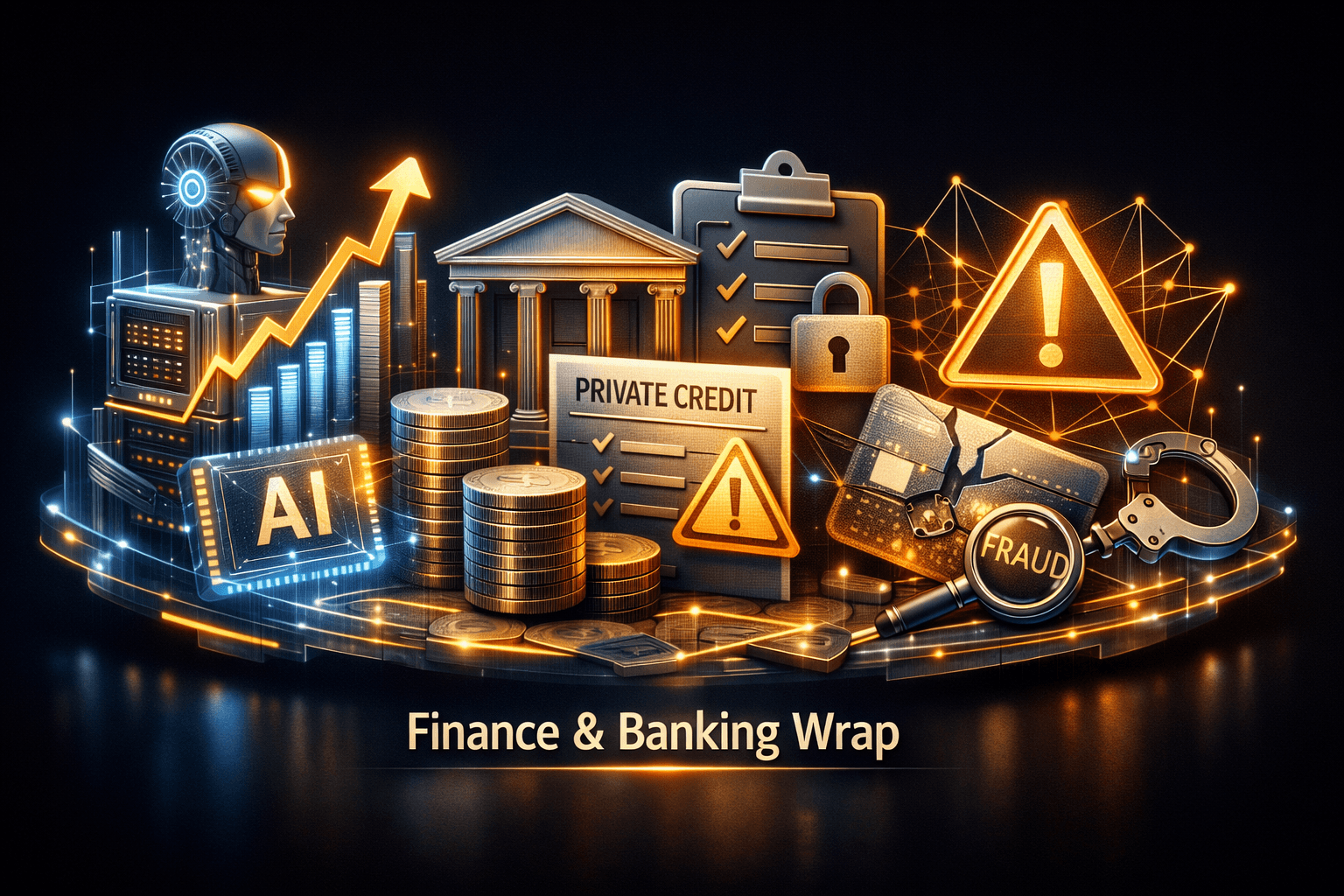
Today’s Finance & Banking headlines sent mixed signals, with AI-driven strength in software and server makers counterbalanced by regulatory friction in banking and fresh warnings about private credit and fraud. You saw momentum in infrastructure-related stocks, but you also saw reminders that capital, oversight, and security remain front and center.
Why this matters is simple: technology demand can lift banks and fintechs indirectly through higher enterprise spending, yet regulatory delays and tightening charter conditions can slow industry growth. What you own or follow will determine how these cross-currents matter to your portfolio.
Market Highlights
Key moves and facts from today's headlines and filings.
- Server and infrastructure names drew attention after MarketWatch coverage highlighted strong moves in $SMCI, $DELL, and $HPE due to easing memory pressures and renewed CPU demand.
- VALT Bank received a conditional OCC charter requiring it to raise $25 million before opening and to maintain a 9% tier 1 leverage ratio for its first three years.
- B2 Bank tapped executives from Climate First Bank for CEO, president and credit chief roles as it pursues a national digital banking strategy.
- The Fed's Office of Inspector General flagged gaps that have slowed bank merger and application processing, prompting the Fed to start implementing fixes.
- Private credit drew scrutiny in a Seeking Alpha piece likening the sector to the Hotel California, where capital can arrive but may be hard to exit.
- Meme and small-cap coverage included a Benzinga price projection for $MYRO targeting $0.050 by 2030, underscoring continued retail interest in microcap names.
Key Developments
AI, software and the server rebound
Coverage from Seeking Alpha and MarketWatch showed software firms and server makers getting renewed investor interest. The Seeking Alpha piece argues some software firms can still thrive amid AI adoption, while $SMCI, $DELL, and $HPE have been cited as beneficiaries of easing component constraints.
That combination suggests enterprise spending on compute and software may remain a tailwind, but you should note demand is uneven across segments. Are you positioned to track which vendors win long term?
New and conditional bank charters reshape competition
VALT Bank’s conditional OCC charter is notable for its concrete capital and leverage conditions, specifically a $25 million fundraising target and a 9% tier 1 leverage ratio requirement for the first three years. Those terms show regulators are focused on capital resilience for new entrants.
Separately, B2 Bank’s hiring of Climate First alums signals a push toward national digital expansion. For you that means more competition in the digital banking space, but also that entrants must clear higher regulatory and capital hurdles.
Regulatory drag, private credit caution and fraud risks
The Federal Reserve OIG report pointing to slow M&A and application processing highlights a structural drag on deal activity. The Fed has started to act on recommendations, but processing backlogs could persist and affect sector consolidation timelines.
Private credit’s characterization as a Hotel California raises a red flag about liquidity and exit risk in direct lending pools. Add to that high-profile consumer fraud stories tied to payment platforms and you see a trio of risks to monitor: regulatory timelines, liquidity in private credit, and payments security.
What to Watch
Look for the following near-term catalysts and risks that could move financial sector sentiment tomorrow and beyond.
- Regulatory updates and OCC actions, including any progress on VALT Bank’s capital raise. Analysts note charter terms often set the tone for new fintech entrants.
- Fed communications and any follow-up on OIG recommendations, since changes to application rules could speed M&A or alter deal structures.
- Server and semiconductor supply signals, including inventory commentary from $SMCI, $DELL and $HPE. CPU and memory trends will affect infrastructure spend and software vendor revenues.
- Private credit fundraising and liquidity reports, as well as performance updates from credit funds. Will capital stay committed or start to seek exits?
- Payments security incidents and fraud disclosures, especially involving major platforms such as $PYPL. You should monitor breach reports and consumer protection guidance closely.
Keep an eye on macro cross-currents too, including oil markets and geopolitical developments that drive financial exposures. There may be light at the end of the tunnel in some markets, but it could be uneven.
Bottom Line
- Tech and infrastructure momentum is a clear positive for enterprise spend, but it does not erase banking and credit risks flagged by regulators and analysts.
- VALT’s conditional charter and B2 Bank’s hires show innovation continues, yet capital and compliance remain nonnegotiable hurdles.
- Private credit liquidity concerns and the Fed OIG’s findings suggest you should watch process and exit dynamics more closely than headline yields alone.
- Payments fraud stories are a reminder that platform risk and consumer protections can create headline volatility for fintech names.
- Analysts note the sector is sending mixed signals, so a selective approach and attention to regulatory milestones will likely matter to your positioning.
FAQ Section
Q: What does a conditional OCC charter mean for a new bank? A: It means the bank can proceed but must meet explicit requirements, such as VALT’s $25 million raise and a 9% tier 1 leverage ratio, before it opens and during its early years.
Q: Is private credit safe given the Hotel California analogy? A: The phrase signals liquidity and exit concerns, not universal failure. Data suggests private credit offers yield but can have limited short-term liquidity, so you should track fund terms and redemption mechanics.
Q: How will server and AI demand affect banks and fintechs? A: Increased enterprise spending on compute and software can boost revenues for tech vendors and their suppliers, which can indirectly benefit banks with exposure to those clients, but effects will be uneven across companies and regions.