The Big Picture
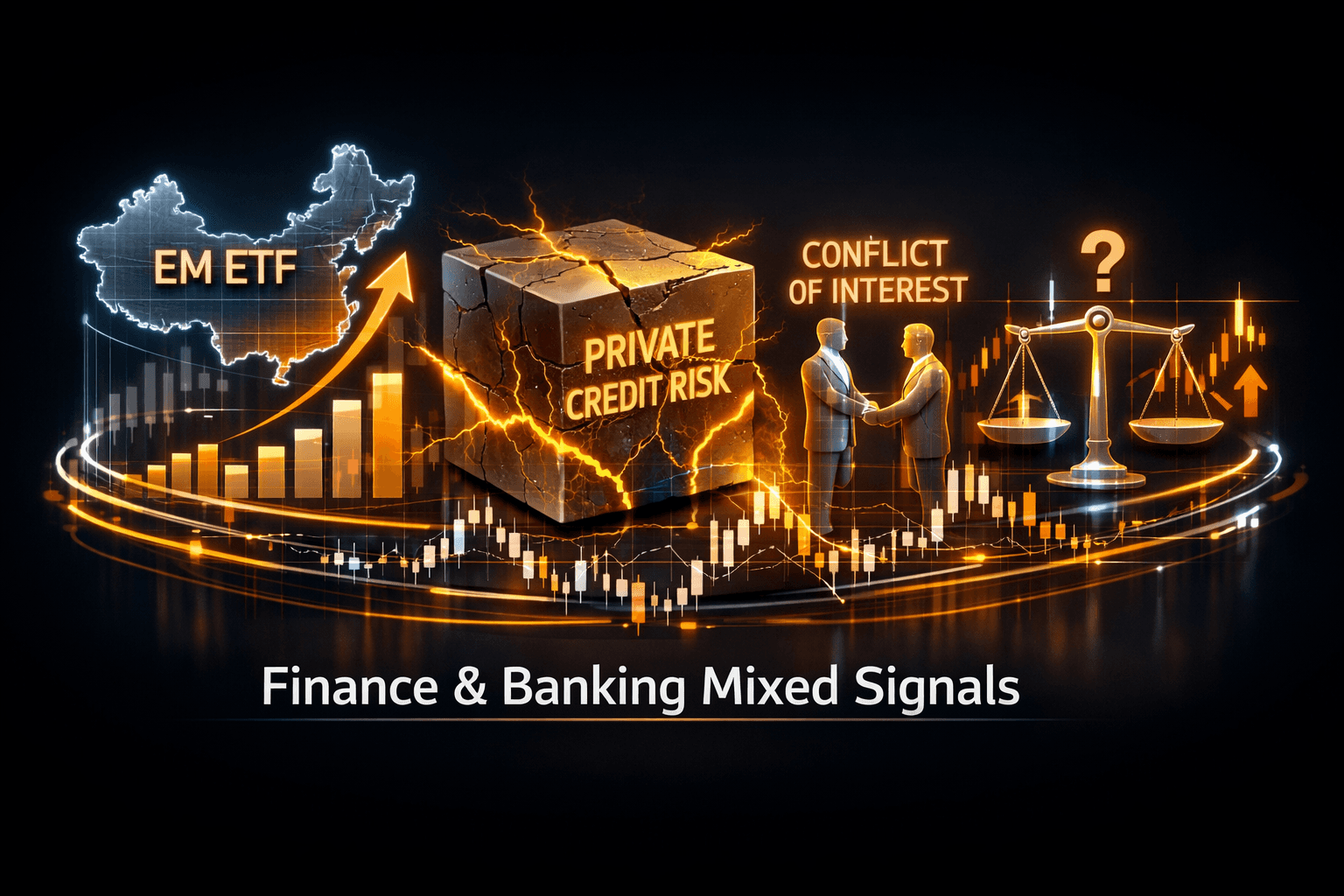
Markets woke to a patchwork of Finance & Banking headlines on Mar 24, leaving no single theme to drive the sector. You’ll see both opportunity-focused stories, like an emerging-markets ETF flagged for value and China exposure, and cautionary pieces, including private-credit stress scenarios and adviser conflict concerns.
Why does this matter to you? Because the mix means selectivity will likely matter more than broad themes today. Are you positioned for country- or sector-specific moves, or for macro risk that could ripple through credit and consumer names?
Market Highlights
Quick facts and market moves to scan this morning.
- $PXH, an emerging-markets ETF, gets attention for value and a heavier China position, prompting interest from yield and EM-tilt investors.
- $KHC draws fresh skepticism in a retail piece urging caution on the consumer staple, while $EL reports a potential suitor yet its stock shows little follow-through.
- Macro risk: a MarketWatch analysis says a rise in private-credit defaults to crisis-like levels would trim GDP by roughly 0.2% to 0.5% in the near term, not a full-scale repeat of 2008.
- Analyst projection snippets: $WMT is forecast to reach about $107 by 2030, while $RUM and $IONQ have long-term price targets cited at roughly $6.46 and $43 respectively in separate pieces.
Key Developments
Emerging-Markets ETF Spotlight: $PXH
Seeking Alpha highlights $PXH as offering solid value and an overweight to China. That suggests investors looking for EM exposure may get more China beta and value characteristics from this fund than from broad EM ETFs.
For you, that means if you want EM exposure but are wary of idiosyncratic China moves, you should check the fund’s country weights and sector breakouts before adding exposure.
Private Credit Stress Test, But Limited GDP Hit
MarketWatch runs a scenario where private-credit defaults spike to levels like the 2008 financial crisis. Their calculations show GDP may fall between 0.2 and 0.5 percentage points, not the multi-point contraction of the last systemic crisis.
This is a reminder that private credit is a growing slice of corporate finance and that credit stress can transmit to growth without necessarily triggering a banking panic. Keep an eye on liquidity and mark-to-market pressure in credit funds.
Corporate and Consumer Signals: $KHC, $EL, $WMT
$KHC attracts a skeptical take in Seeking Alpha, arguing the consumer staple may be better in your pantry than your portfolio. That commentary focuses on brand and margin worries rather than macro credit risk.
$EL revealed a possible suitor in luxury group Puig, yet the stock hasn’t responded strongly, showing how deal chatter does not always translate to immediate market gains. Meanwhile, long-term forecasts for $WMT point to modest upside by 2030, underscoring a divergent view across consumer names.
What to Watch
Here are the catalysts and risks that could move Finance & Banking names today and near term.
- Earnings and results flow: check for any additional Q4/Q1 reports that may update revenue and margin expectations for banks, consumer staples, and telecoms such as $CHA.
- Credit signals: watch private-credit fund NAVs, redemption notices, and weekly distress indicators. How quickly stress feeds into asset managers could shape risk appetite.
- ETF flows: monitor daily flows into $PXH and other EM ETFs to see whether real money is buying China-heavy allocations or rotating elsewhere.
- Adviser conflicts and regulation: consumer stories on undisclosed revenue sharing may put compliance and trust under the spotlight, prompting regulatory focus or state investigations in extreme cases.
- Deal developments: any formal offers or filings related to $EL-Puig or other M&A chatter could re-rate specific consumer or luxury names, but will you see a fast move or a slow grind higher?
Bottom Line
- News is mixed across Finance & Banking today, so a selective approach is warranted rather than broad sector bets.
- $PXH’s China tilt highlights differentiated EM exposures; check holdings before you add ETF allocation.
- Private-credit stress could shave 0.2% to 0.5% off GDP in a severe scenario, so follow credit-market liquidity closely.
- Corporate stories vary: some names face skepticism while others carry long-term analyst targets, making stock selection key.
- Watch flows, earnings, and adviser-disclosure headlines for signals that could quickly change sentiment.
FAQ Section
Q: How should I interpret an ETF being overweight in China? A: Overweight means the ETF holds a larger share of China than the benchmark, so you get more China exposure and more concentration risk compared with a broad EM fund.
Q: Could private-credit defaults trigger a banking crisis like 2008? A: The analysis cited today suggests a severe private-credit stress would dent GDP by 0.2% to 0.5%, but it would not necessarily recreate the systemic banking collapse of 2008.
Q: What should I do if my advisor has undisclosed revenue sharing? A: You should ask direct questions about compensation and conflicts, and consider getting a second opinion if disclosures feel incomplete or unclear.