The Big Picture
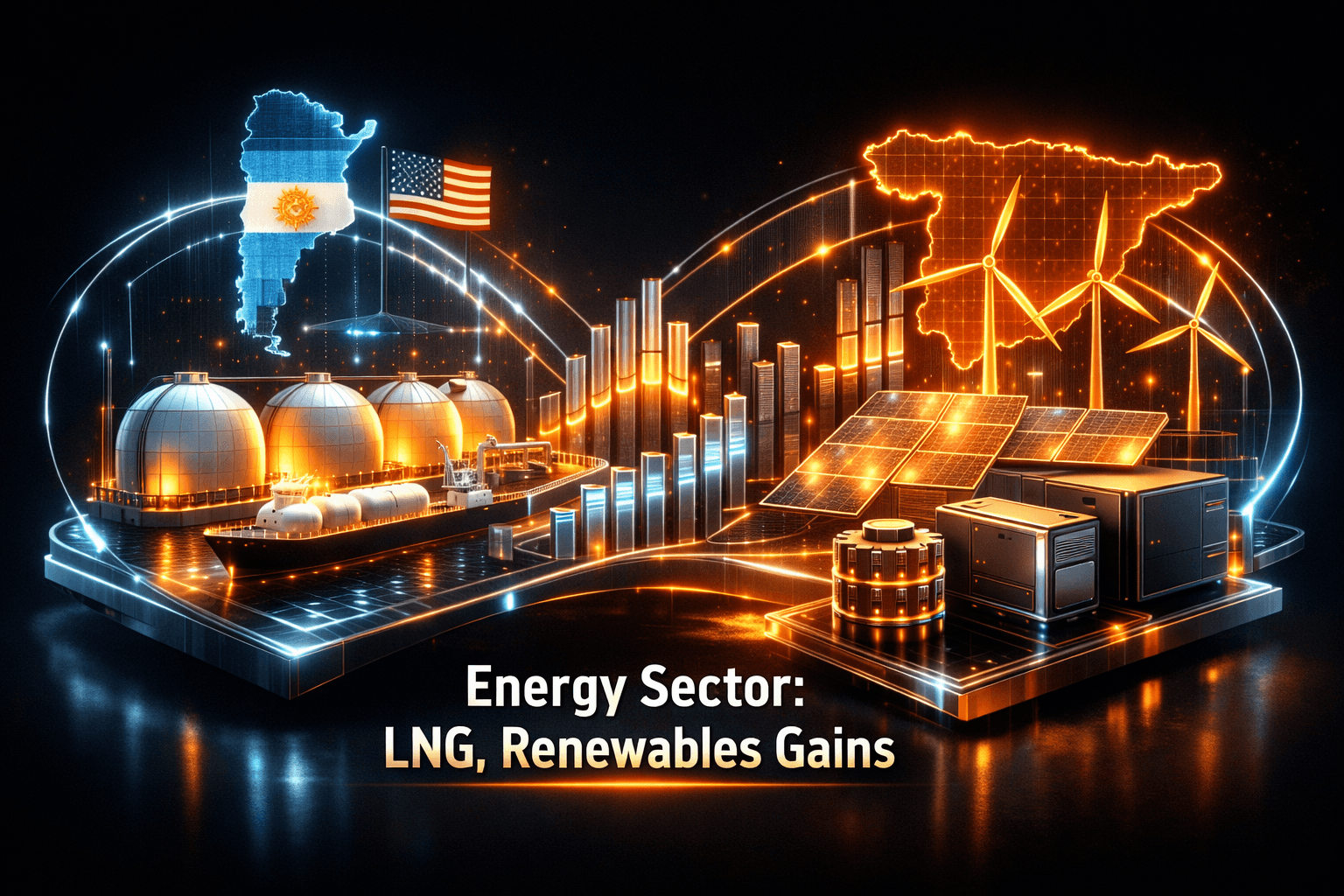
The headline this morning is the U.S. commitment to back Argentina’s first LNG export project with up to a $6 billion loan, a move that shifts supply dynamics and signals U.S. support for new global LNG corridors. That financing, part of a broader Andes-Atlantic Corridor initiative, could unlock South American LNG exports and draw multinational partners into new upstream and midstream investment.
At the same time you’re seeing decisive progress on the clean side, with Spain allocating up to 11 GW of grid capacity for renewables and storage, and technology gains from Longi and Pylontech that improve the economics of solar plus storage. Together these stories suggest capital is flowing across the energy transition spectrum, even as regional supply disruptions through the Strait of Hormuz and refinery constraints add short-term volatility.
Market Highlights
Key numbers and moves to note from overnight and early reports, so you can quickly see where attention is focused today.
- U.S. support for Argentina LNG, loan capacity up to $6 billion, led by Argentina’s $YPF and partners including Eni, signaling new export capacity.
- Spain plans to allocate up to 11 GW of grid capacity to renewables and storage, with tenders for Guardo and Velilla drawing pumped-hydro interest.
- Pylontech starts mass production of large-format LFP cells in 588 Ah and 601 Ah sizes, a step toward utility-scale storage deployment.
- Longi sets a world record for single-junction silicon solar cell efficiency at 28.29 percent, confirmed by ISFH, improving module-level potential.
- Morgan Stanley warns a possible U.S. diesel export ban could push U.S. gasoline prices higher, highlighting refinery utilization risk. The note was reported by Bloomberg and referenced by OilPrice.
- Qatar has ramped LNG shipping through the Strait of Hormuz to the highest levels in more than two months, while Indian refiners have lifted LPG output nearly 20 percent in September as imports were disrupted.
Key Developments
U.S. backs Argentina LNG, creating a new export corridor
The U.S. Department of State said financing agencies can play a role alongside private capital to support the Andes-Atlantic Corridor, with the Argentina LNG project led by $YPF and partners including Eni. For investors this matters because it signals government-level de-risking of large liquefaction projects, which can accelerate capital commitments and long-term supply growth from a new basin.
Renewables and storage capacity leaps, tech improvements lower costs
Spain’s 11 GW allocation, and Pylontech’s mass production of 588 Ah and 601 Ah LFP cells, together point to faster buildout of grid-scale storage and solar-plus-storage projects. Longi’s 28.29 percent single-junction record, confirmed by ISFH, suggests module efficiency gains will keep lowering levelized costs, a tailwind for developers and equipment suppliers you may hold exposure to.
Hormuz shipping uptick and refinery reactions tighten near-term fuel markets
Qatar increasing LNG tanker traffic through Hormuz, combined with Indian refiners boosting LPG output by about 20 percent, highlights how regional chokepoints are forcing producers and refiners to retool supply chains. Morgan Stanley’s analysis that a diesel export ban could push U.S. gasoline prices higher is a reminder that policy moves can have counterintuitive effects on domestic fuel costs.
What to Watch
Here are the catalysts and risks that could move the sector in the coming days, and what you should track if you follow energy stocks or funds.
- Argentina LNG milestones, permits, and off-take agreements, monitor official timelines from $YPF and partner disclosures for commercialization cues.
- Spanish tender results for Guardo and Velilla, watch which pumped-hydro or battery-storage developers win capacity and the awarded tariffs.
- Commercial ramp and shipment schedules from Pylontech, and Longi’s path to integrating the efficiency gains into mass-produced modules, these will affect component suppliers and project margins.
- U.S. policy on diesel exports, follow statements from the administration and any legislative action since this could influence refinery runs and gasoline price trajectories.
- Shipping patterns through Hormuz and Indian LPG inventory levels, track freight and regional import data, they’ll signal near-term tightness in fuels and LNG flows.
How should you position your watchlist in this environment, and where might opportunities appear? Consider monitoring both traditional energy names tied to LNG and refining, and clean energy suppliers who stand to benefit from improved battery and cell economics.
Bottom Line
- U.S. financing for Argentina’s LNG project is a major catalyst that could expand global LNG supply and attract private capital to South America.
- Spain’s 11 GW grid allocation and technology advances from Longi and Pylontech reinforce momentum in renewables and utility storage.
- Regional supply disruptions via the Strait of Hormuz and refinery constraints create near-term price volatility, especially for refined products.
- Policy moves on diesel exports could have unintended consequences for U.S. gasoline prices, according to Morgan Stanley, so monitor regulatory developments closely.
- Keep a selective approach, track project timelines and tender outcomes, and watch how technology gains translate into order books and cost improvements.
FAQ Section
Q: What does U.S. backing of Argentina LNG mean for global supply? A: It signals government support that can lower financing risk, helping a new export basin come online and adding long-term LNG supply diversity.
Q: Will Longi’s efficiency record and Pylontech’s cells change project economics soon? A: Efficiency and larger LFP cells improve system-level yields and storage economics, but commercial impact depends on manufacturing scale and supply chain adoption.
Q: How could a diesel export ban affect U.S. fuel prices? A: Analysts say refiners may cut runs if exports are restricted, which could tighten gasoline supplies and push prices higher, so policy shifts are a key risk factor.