The Big Picture
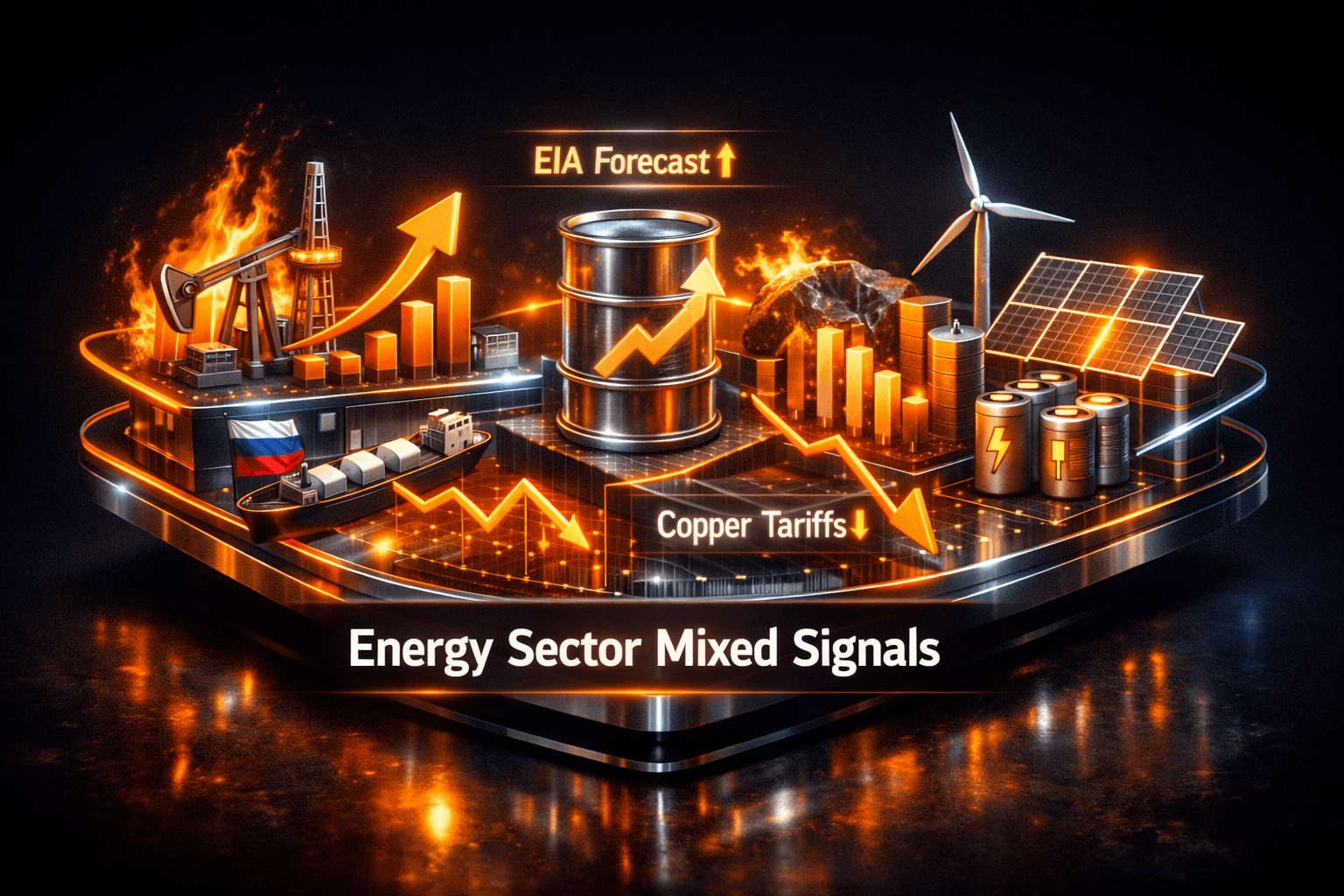
Oil prices led market action on Sep 10 as geopolitical risk around the Strait of Hormuz pushed Brent above $107, creating immediate upside in producers and midstream names. At the same time, supply-side data and policy uncertainty created offsets that leave the sector with mixed signals for investors.
Why should you care? Because today's developments affect different parts of the energy complex in opposite ways, so you may need to be selective about exposure and watch near-term catalysts closely.
Market Highlights
Quick facts and moves to know from today's session.
- Brent crude surged more than 6 percent to $107.63 a barrel after escalations raised supply risk in the Strait of Hormuz.
- Russia reported lower crude output in August, a near-term supply tightening that likely supported the oil rally.
- The EIA raised its 2027 U.S. oil production forecast to 14.3 million barrels per day, up from 14.2 million bpd in August, signaling higher longer-term domestic supply.
- Copper-related stocks fell after reports the White House tariff plan for refined copper stalled, putting pressure on miners such as $FCX and $SCCO.
- Enbridge agreed to buy Tallgrass Pipelines for $2.55 billion, a consolidation move for midstream assets tied to Rockies flows, relevant for $ENB shareholders and pipeline capacity markets.
- EV and storage news: Kia launched the affordable EV3 with a $29,890 base and a $349 monthly lease option, while $TSLA activated Cybertruck Powershare to pair with Powerwall 3, adding more than three days of backup power according to the company.
Key Developments
Oil spikes on Hormuz risk and Russian output dip
Brent's jump to $107.63, a rise of more than 6 percent, was the dominant market mover today as tensions around the Strait of Hormuz rattled traders. Russia's drop in crude output for August added to the supply tightness narrative, supporting higher spot prices and immediate gains in crude producers.
For you that means near-term upside pressure on oil-linked equities and on firms exposed to transportation and drilling activity. But keep an eye on how sustained this move is, given offsetting supply forecasts.
EIA raises U.S. production outlook even as oil trades up
The U.S. Energy Information Administration lifted its 2027 crude forecast to 14.3 million bpd, up from earlier estimates, while leaving 2026 steady at 13.8 million bpd. That upward revision highlights the strong domestic supply base led by the Permian and other U.S. plays.
Higher long-range supply forecasts could cap the oil rally if geopolitical risks ease, so today's price gains may be volatile. Which names will weather the swings depends on balance-sheet strength and hedge positions, not just production exposure.
Copper tariff uncertainty dents miners, while renewables and storage advance
Reuters reporting that a refined copper tariff plan has stalled in the White House sent copper-linked stocks lower, with miners such as $FCX and $SCCO seeing notable selling. That matters because copper is a key input for EVs, batteries, and grid expansion, so tariff moves affect the clean-energy supply chain as much as metal markets.
On the technology side, Tesla updated Powershare to work with Powerwall 3 and Cybertruck, adding over three days of backup capacity, and Kia rolled out an inexpensive EV3 lease option. Solar manufacturing news also moved the renewables narrative, as Midsummer signed a partnership for CIGS thin-film production in Indonesia, showing supply-chain diversification for solar modules.
What to Watch
Here are the catalysts and risks that could shape the sector tomorrow and next week.
- Geopolitics: Any further escalation around the Strait of Hormuz will likely keep oil prices elevated. You should monitor official statements and shipping disruptions closely.
- Supply data: Watch weekly U.S. inventory reports and any additional production updates from Russia or OPEC+. The EIA's higher 2027 forecast is a reminder that structural U.S. supply can blunt rallies.
- Copper policy and tariffs: Trade announcements or renewed tariff talk will move copper miners and could feed through to EV and renewable project costs.
- M&A and midstream integration: The $2.55 billion Enbridge purchase of Tallgrass assets changes Rockies to Cushing flows. Track regulatory approvals and pipeline utilization data for signs of margin pressure or relief.
- EV and storage rollouts: Product launches and integration features, like Tesla's Powershare update, matter for downstream demand for batteries and grid services. Will broader EV adoption keep rising demand for metals and electricity?
Bottom Line
- Energy headlines are giving mixed signals today, with stronger near-term oil pricing offset by higher projected U.S. production and metal-market uncertainty.
- Geopolitical risk is the proximate cause of today's oil gains, but the EIA outlook and inventory flows will determine how durable the rally is.
- Copper tariff uncertainty is a new wildcard for the energy transition, potentially raising costs for EVs and renewables even as demand trends remain firm.
- Midstream consolidation, such as $ENB's Tallgrass deal, is a reminder that infrastructure repositioning can create pockets of opportunity and risk in pipeline cash flows.
- Watch near-term data releases, policy announcements, and corporate updates to decide how you want to position your exposure to oil, gas, metals, and clean-energy technology.
FAQ Section
Q: How will Brent trading above $107 affect consumers? A: Higher Brent raises gasoline and diesel price risk, which can filter into consumer fuel costs over weeks, but regional refining and inventories will influence the magnitude.
Q: Does the EIA’s higher 2027 U.S. oil forecast mean the oil rally is over? A: Not necessarily, because near-term moves are driven by supply interruptions and geopolitics, while the EIA outlook speaks to longer-term supply capacity that can limit sustained price gains.
Q: Should I worry about copper tariff news for EV and solar investments? A: Tariff uncertainty can increase input cost risk and project timelines, so it's a factor to monitor if you have exposure to miners, EV makers, or module manufacturers.