The Big Picture
Today’s most impactful theme in Energy was capital coming off the sidelines and into projects. You saw fresh private money for U.S. solar manufacturing, a major international gas investment directed to Texas, and incremental progress on advanced nuclear and refining that together suggest growing momentum in supply-side energy investment.
That matters because capacity builds and new projects tend to shape multi-year supply dynamics, which can affect commodity prices, corporate cash flows, and job trends. So ask yourself, what does this wave of investment mean for the companies and technologies you follow?
Market Highlights
Trading headlines today were anchored by greenfield project moves and geopolitical-energy developments rather than a single earnings beat or shock. Below are the quick facts to track ahead of tomorrow’s session.
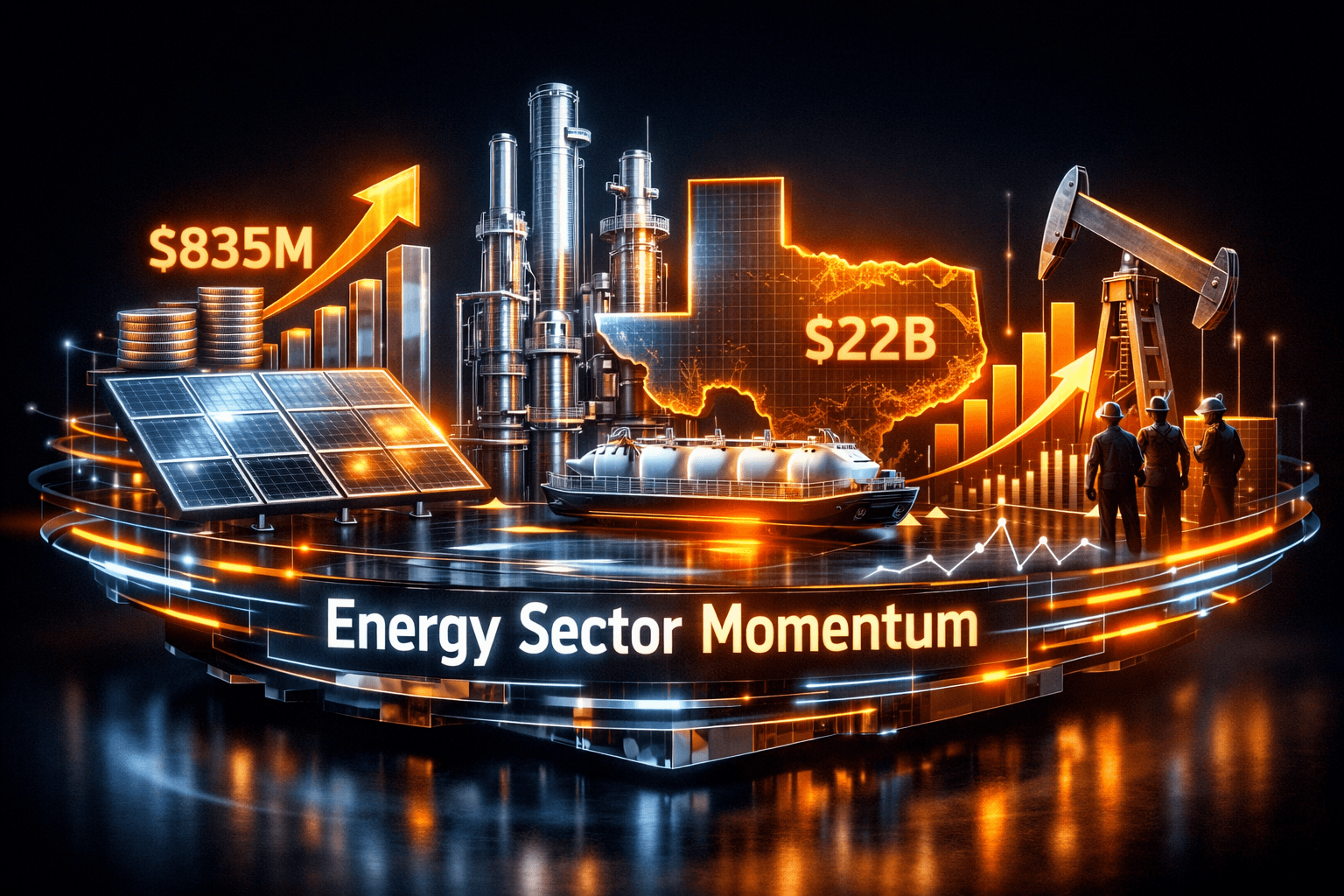
- Suniva raised $835 million to add about 4.5 GW of solar cell capacity, planning a $600 million facility in Laurens County, South Carolina, and targeting late 2027 for production.
- South Korea identified a gas-fired power project in Texas as the first U.S. investment under last year’s trade deal, a prospective $22 billion scope that signals large-scale LNG and gas infrastructure engagement.
- U.S. Bureau of Labor Statistics data reported a month-on-month rise in oil and gas extraction employment, bucking recent downward trends in the sector and pointing to incremental hiring.
- Belarusian refineries posted decade-high profits as they ramped exports of gasoline and diesel, a development tied to disruptions in Russian refining that drove eastward flows.
- Energy policy and geopolitical items grabbed headlines, including U.S. Administration moves on Venezuela’s oil and mineral assets, and a contentious UK report arguing household savings from scrapping net zero that fuels political debate.
Key Developments
Suniva’s $835M Raise Accelerates U.S. Solar Manufacturing
Suniva secured $835 million to build a 4.5 GW solar cell capacity expansion, including a $600 million plant in South Carolina expected to open in late 2027 and create roughly 564 manufacturing jobs. For investors, this reinforces policy-era momentum toward domestic supply chains and suggests more durable U.S. solar module feedstock availability, which could help margins for U.S.-based PV integrators and installers over time.
Korea Picks a $22B Texas Gas Project Under Trade Deal
Seoul has identified a Texas gas-fired power project as the first U.S. investment under the bilateral trade pact, a designation that could unlock tens of billions in project finance and equipment orders. You should watch supplier pipelines and midstream partners, because large foreign-sponsored projects often mean multiyear equipment, construction, and service contracts for U.S. vendors.
U.S. Interest in Venezuela’s Oil and Critical Minerals
The U.S. Administration, after claiming majority control of Venezuelan oil reserves, is exploring U.S. company participation in Venezuela’s gold and critical minerals. Analysts note this could reshape supply access for strategic minerals used in batteries and renewable technologies, but the story remains politically complex and will involve months of negotiation and legal work.
Refining, Nuclear and Workforce Signals
Belarusian refineries posted their highest profitability in a decade as Russian refining disruptions boosted cross-border sales, showing how regional logistics shifts can create winners. ONE Nuclear said it’s made substantive pre-development progress on a proposed 1 GW small modular reactor in Louisiana, underscoring private capital interest in advanced nuclear. Meanwhile U.S. oil and gas extraction employment rose month-on-month, a signal that hiring may be stabilizing.
What to Watch
Tomorrow and the coming weeks will be about follow-through. Watch the policy timelines, project permitting, and financing milestones because those will determine how fast capacity actually comes online.
- Suniva permitting and construction updates, plus any offtake or supply agreements, will be critical to gauge timing to production.
- Look for formal announcements or memoranda of understanding on the Korea-Texas project that detail partners, timelines, and financing sources.
- Monitor U.S. Administration moves on Venezuela for legal steps and binding agreements that could enable U.S. participation in mining and oil operations.
- Keep an eye on hiring trends and payrolls in upcoming BLS reports to confirm whether the oil and gas workforce recovery is sustained.
- Policy risk is still real, especially in Europe and the UK where debates over net zero could influence renewables subsidies and demand trajectories. How will political pressure reshape future support for clean energy?
Risk factors to watch include geopolitical volatility, project permitting delays, supply-chain bottlenecks, and potential changes in subsidy or trade policy that can alter project economics. Are you prepared for a scenario where timelines stretch by a year or two?
Bottom Line
- Capital is flowing, with Suniva’s $835M raise and a Korea-backed Texas gas project signaling renewed investment in supply-side capacity.
- Employment and refinery profitability trends point to pockets of strength across fossil and low-carbon segments even amid policy debate.
- U.S. moves on Venezuela’s resources add a geopolitical layer that could influence global supply chains for oil and critical minerals.
- Policy and permitting remain the gating items; watch regulatory milestones and project offtake announcements closely.
- Data suggests momentum building, but you should monitor execution risk and political developments that could slow or reshape these plans.
FAQ Section
Q: How will Suniva’s new facility affect U.S. solar supply? A: The plant is expected to add about 4.5 GW of cell capacity and should strengthen domestic upstream supply chains, potentially easing module input constraints over the next 18 to 24 months.
Q: Does the Korea-Texas gas project mean more U.S. natural gas demand? A: Large foreign-sponsored gas projects can support local construction and operations demand, and they often boost midstream and equipment spending, but project timelines and final contracts will determine the scale of demand.
Q: Should I expect immediate market volatility from U.S. actions on Venezuela’s resources? A: Actions are likely to be incremental and legally complex, so any market impact will depend on deal specifics and implementation timing rather than a single overnight shock.