The Big Picture
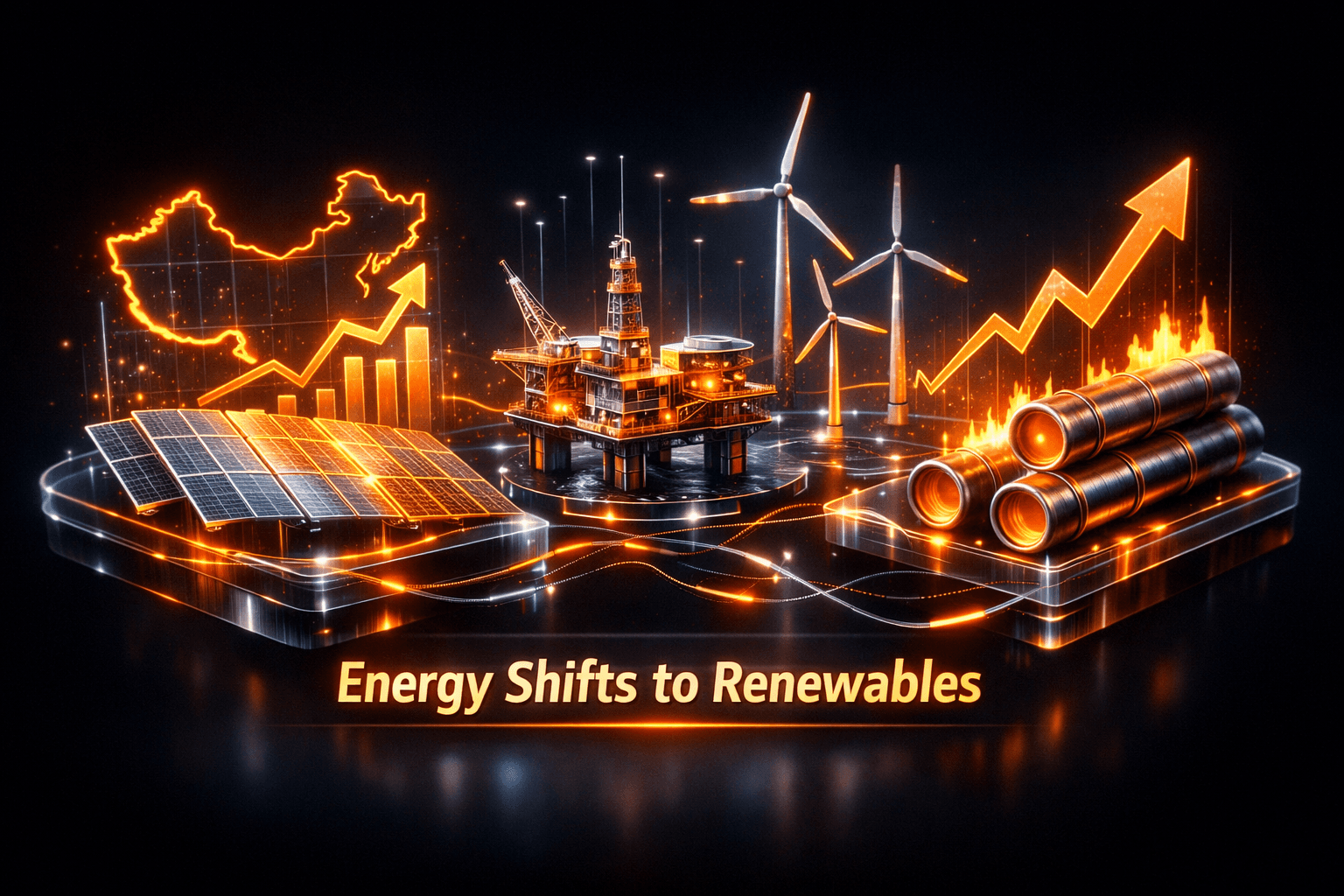
Today the energy narrative moved from theory to scale, as large renewable projects and capacity additions made headlines alongside commodity and geopolitical developments that keep markets on their toes. You saw breakthroughs in hybrid solar, offshore floating wind, and accelerated solar rollouts in Europe, while U.S. natural gas forecasts moved higher, showing demand and price support.
Why does this matter to you? These stories show the transition is increasingly about concrete infrastructure and near-term economics, not future promises. That shift can change where returns and risks show up across energy supply chains, from power equipment makers to utilities and midstream commodity players.
Market Highlights
Quick facts and takeaways from today’s top stories.
- China connected what reports call the world’s largest hybrid solar plant to the grid, a landmark for large-scale solar plus storage deployment.
- China National Offshore Oil Corporation, $CNOOC, launched a 16-megawatt tension-leg platform floating wind turbine destined to power offshore oil rigs, blending renewables with upstream operations.
- Germany installed about 1.28 GW of new PV in June, bringing H1 additions to roughly 7.4 GW and cumulative PV to about 125.2 GW.
- U.S. EIA raised its Henry Hub natural gas price forecast for 2026 and 2027, indicating tighter supply or stronger demand than previously expected.
- At least 11 million barrels of U.S. crude were sold to Asian refiners in a single late trade, underscoring cross‑Pacific flows amid global oil volatility.
- Auto sector signals were mixed: Lamborghini pushed its first full EV past 2030, while Hyundai cut IONIQ 5 N prices by $6,300 for 2026 models, reflecting differing product and demand dynamics.
- Consumer-level clean energy deals continued, with deep discounts on portable power stations and home energy gear, highlighting growing retail demand and price competition.
Key Developments
China’s hybrid solar plant and the shifting energy security story
Reports that China has connected the world’s biggest hybrid solar plant reinforce how storage is making renewables more dependable at scale. As oil market shocks raise questions about traditional fuel security, battery-backed and hybrid systems are changing risk calculations for grid operators and large consumers. For you, that means more utilities and sovereign-backed projects may prioritize integrated renewables with storage when they sign long-term procurement contracts.
Floating wind powering oil operations, a practical crossroad
$CNOOC’s 16 MW tension-leg platform turbine headed to the Lufeng fields shows pragmatic cross-pollination, where wind helps lower operating emissions and fuel use on offshore platforms. This is an example of companies merging legacy operations with low-carbon tech. Could that improve project economics and extend asset lives? It’s a development worth watching if you follow offshore services and equipment suppliers.
Europe and Central Asia: solar and nuclear capacity gains
Germany’s 7.4 GW of PV additions in the first half of 2026 and China’s deepening nuclear partnerships with Central Asian partners illustrate two parallel tracks to scale clean baseload and variable power. Kazakhstan officials touring Chinese nuclear projects signals more cross-border nuclear builds and fuel deals, which could shift long-term demand for uranium and engineering services.
What to Watch
Here are actionable catalysts and risk points that could shape trading and investment narratives tomorrow and beyond.
- Natural gas pricing: follow EIA updates and Henry Hub moves, because higher gas forecasts support producers and affect power generator economics, which in turn influences renewables dispatch and merchant power prices.
- Project financing and offtake announcements: large hybrid and floating wind projects need long-term contracts to pencil. Watch for power purchase agreements and state-backed guarantees, because they determine who wins from scale.
- Geopolitics and crude flows: U.S. threats of sanctions related to Russian oil, and large U.S. crude sales to Asia, can change regional price spreads and refinery margins quickly. Keep an eye on shipping flows and sanction headlines.
- Automotive electrification dynamics: Lamborghini’s delay on full EVs is a reminder that product mix matters. Hyundai’s $6,300 IONIQ 5 N cut shows margin and pricing pressure in mass-market EV segments. How will that affect commodity demand for battery metals and longer-term oil demand?
- Policy and permitting: any near-term approvals for large renewables or nuclear projects will amplify the momentum you saw today. Watch agency statements and bilateral agreements closely.
Bottom Line
- Renewables are moving from pilot projects to grid-scale deployments, with storage closing the reliability gap and prompting new procurement strategies.
- Innovations like floating wind used for oil rigs show a pragmatic path to emissions reduction inside legacy sectors, creating cross-sector opportunities.
- Higher EIA Henry Hub forecasts point to firmer natural gas markets, supporting midstream and producer cash flows in the near term.
- Geopolitical risks and crude flow changes mean volatility can return quickly, so you should monitor headline risk and supply routes.
- Automaker moves show the EV transition is uneven, which will influence demand curves for oil, power, and battery raw materials for years to come.
FAQ Section
Q: How will larger hybrid solar plants affect grid reliability? A: Hybrid plants that pair storage with solar reduce hourly and seasonal variability, making intermittent resources more dispatchable and improving short-term reliability metrics for grids.
Q: Should I expect natural gas prices to keep rising after the EIA update? A: The EIA’s upward revision signals tighter balances or stronger demand, but future price direction will depend on weather, LNG flows, and supply responses from producers.
Q: Does Lamborghini delaying full EVs change the broader EV outlook? A: It highlights segmentation in the auto market. Luxury and performance brands may opt for hybrid pathways longer, while mass-market EV adoption and pricing competition continue to evolve separately.