The Big Picture
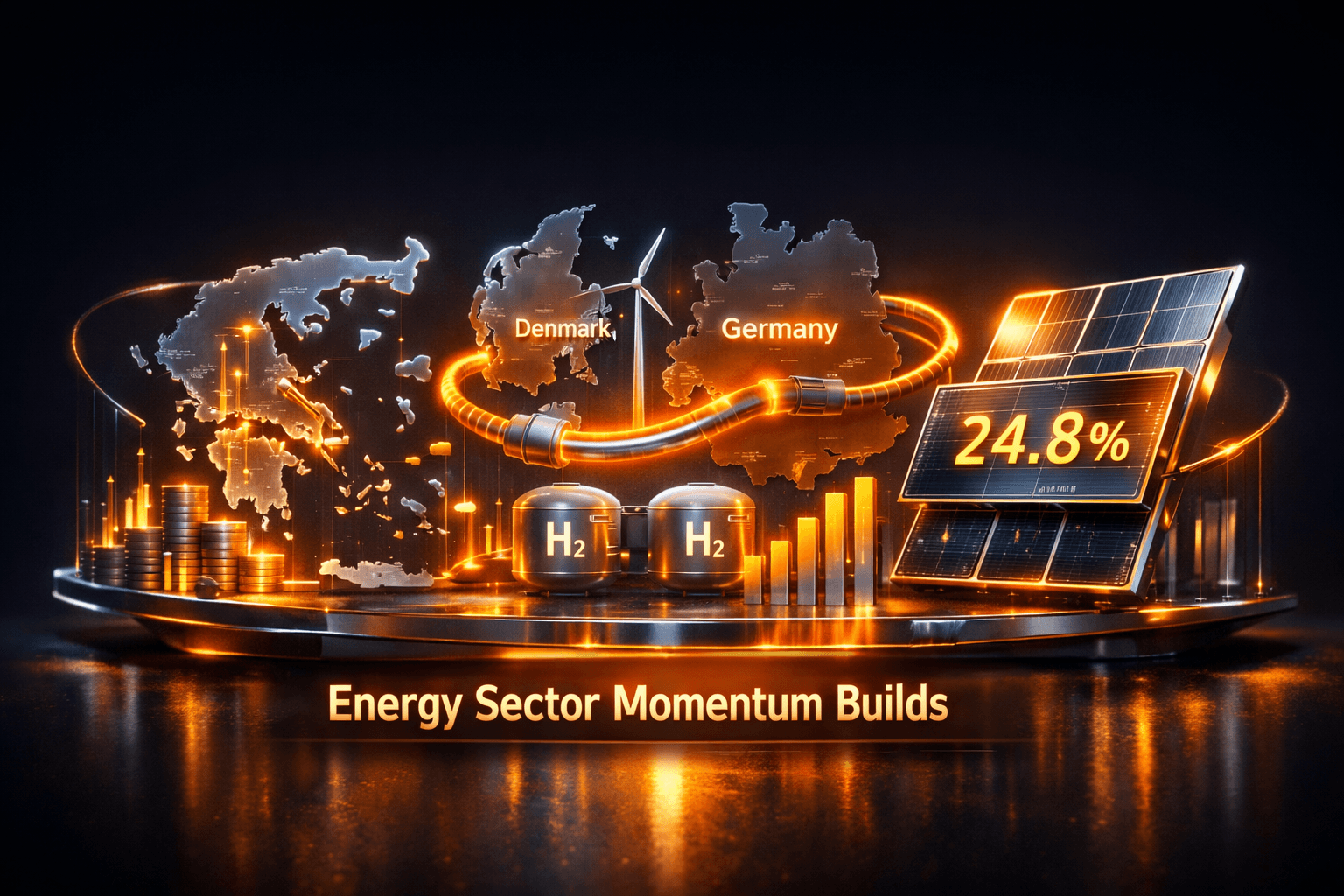
Today’s top theme was momentum, not uncertainty. Large-scale investment, new clean-energy infrastructure and tech improvements dominated the headlines, signaling accelerating capital deployment into the energy transition.
That matters for you because policy, project finance and module efficiency translate into project economics and industry cash flows over the next several years. With governments and private funds moving from strategy to execution, the pace of real projects is picking up.
Market Highlights
Quick facts and numbers that mattered today.
- Greece attracted about $26 billion in energy investments over the past month as Europe races to replace Russian gas ahead of a planned 2027 phaseout.
- Denmark and Germany launched Europe’s first hydrogen superhighway, a cross-border infrastructure step intended to connect production and demand centers.
- Canadian Solar $CSIQ introduced a TOPCon module with 24.8% efficiency and up to 670 W output, saying it delivers a roughly 1.4% LCOE reduction for utility scale projects.
- Libya reached 1.4 million barrels per day of oil production, the highest since 2013, while the US Treasury issued a 60 day license allowing some Iranian energy exports through August 21.
- JERA signed time charters for four ammonia carriers to support an ammonia project in Louisiana, reflecting growing logistics needs for low carbon fuels.
- Consumer and retail signals included Hyundai $HYMTF offering notable EV discounts and early Prime Day deals on battery power stations from EcoFlow and Anker, underscoring demand channels for electrification hardware.
Key Developments
Europe’s Hydrogen Superhighway Goes Live
Denmark and Germany formally launched the bloc’s first hydrogen corridor today. The project is a tangible shift from policy statements to operating infrastructure and could help link northern production to industrial demand in Germany.
Why it matters, and why you should care: hydrogen transport capacity reduces a key bottleneck for heavy industry and shipping fuel offtake. It’s a step in the right direction for scaling demand, and it raises questions about where electrolyzer and pipeline investment will flow next.
$26B Floods into Greek Energy as Europe Seeks Alternatives
Investors ploughed roughly €23 billion, about $26.3 billion, into Greece’s energy sector in the last month as the EU prepares to end Russian gas imports by 2027. Names reported involved major global funds and sovereign players.
The implication is clear, you’ll see accelerated build out of LNG, pipeline interconnectors, and green hydrogen import and export capacity in southeastern Europe. That will shift regional trade and could create new winners among midstream operators and utilities over time.
Solar Tech Push: Canadian Solar’s 24.8% TOPCon Module
$CSIQ’s new module claims 24.8% cell efficiency and up to 670 W output with 90 percent bifaciality, cutting levelized cost of energy by about 1.4 percent for large projects. That’s material for developers who buy modules by the megawatt.
For you as an investor, better module efficiency nudges project margins higher and reduces land and BOS pressure for utility projects. It also tightens competitive pressure on lower tier suppliers.
Oil Supply Moves: Libya, Iran and Mixed Signals
Libya’s recovery to 1.4 MMbpd and a temporary US license for some Iranian exports through August 21 add near term supply that could temper oil prices. Those developments introduce a check on commodity upside even as energy transition flows accelerate.
So how will markets balance this? Price-sensitive oil projects may face headwinds even while transition projects get cheaper and more bankable.
What to Watch
Here’s what could move prices and company fortunes in the coming days and weeks.
- EU gas policy and the 2027 Russian gas phaseout timetable, which will drive more investment into LNG terminals, interconnectors, and storage projects.
- Execution risk on large Greek projects and financing terms from major funds like $BLK, which will determine how much capital actually gets spent versus pledged.
- Solar module pricing and shipment data after $CSIQ’s announcement, since efficiency gains often lead to faster procurement cycles for utility buyers.
- Hydrogen project tender schedules and electrolyzer supply constraints, because scaling hubs requires both pipelines and equipment.
- Oil market reaction to Libya and Iran supply flows, and any OPEC or producer responses. Will inventory builds mute price rallies, or will demand resilience absorb extra barrels?
- Near term consumer demand indicators for EVs, including how discounts from Hyundai $HYMTF affect leasing and resale values.
Bottom Line
- Capital is shifting from strategy to execution across clean energy, with Greece and the Denmark Germany hydrogen corridor the clearest examples today.
- Technology gains, like $CSIQ’s 24.8 percent TOPCon module, will squeeze LCOE and favor efficient, scale players and project developers.
- Near term oil supply upticks from Libya and a temporary Iran license could cap commodity upside, so expect choppy price behavior even as transition investment rises.
- Watch EU policy timelines and project financing terms closely, because those will determine where the next waves of infrastructure build out happen and who benefits.
- Stay selective, and follow execution and financing milestones rather than headlines alone, because project delivery will drive returns over the next several years.
FAQ Section
Q: How will Greek energy investment affect European gas markets? A: The influx of roughly $26 billion should accelerate new import and transit capacity, reducing reliance on a single supplier and improving regional security of supply over the next 18 to 36 months.
Q: Does Canadian Solar’s 24.8 percent module mean solar costs will fall immediately? A: Not instantly, but higher efficiency modules lower LCOE for new projects and can improve developer margins as procurement and BOS costs are optimized over multiple procurement cycles.
Q: Should you expect oil prices to climb after Libya and Iran news? A: Those supply increases introduce downward pressure on prices in the near term, but prices will also respond to demand data and producer decisions, so volatility is likely.