The Big Picture
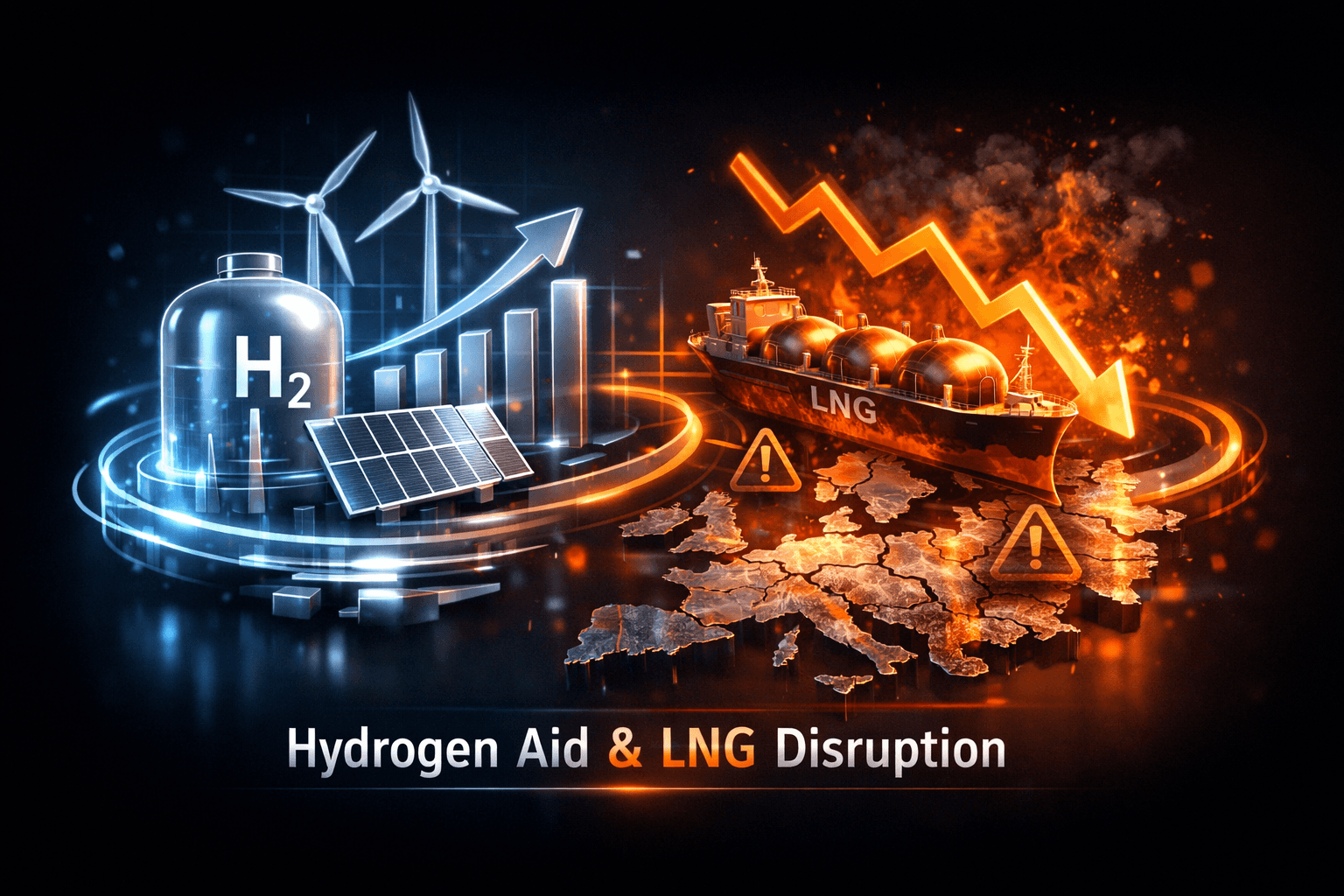
Europe's green push picked up meaningful backing overnight while global gas markets remain strained, leaving you with a mixed set of signals to parse this morning. Germany won European Commission approval for a sizable green hydrogen aid package, and researchers reported promising advances in solar cells and grid-scale storage.
At the same time, QatarEnergy extended an LNG force majeure into August and Norway's gas output slipped again, keeping supply risk elevated. What does this mean for your energy exposure today and near term? It means selectivity will matter as policy, technology and geopolitics steer different parts of the sector in different directions.
Market Highlights
Key facts to scan quickly before you trade. These are the concrete numbers and company items you'll want top of mind.
- Germany green hydrogen aid: European Commission cleared a support scheme worth about $1.5 billion, backing up to 1,000 MW of electrolyzer capacity and production of up to 10 million tonnes of renewable hydrogen.
- QatarEnergy LNG: Force majeure on LNG exports extended into mid-August after damage from earlier strikes, creating continued supply uncertainty for buyers worldwide.
- Santos ($STO): Australia’s Santos said it will prioritize oil and LNG expansion across Australia, Alaska and Papua New Guinea, signaling a renewed focus on upstream growth.
- Norway gas output: Preliminary data show roughly 12 billion cubic feet per day of natural gas produced in April, marking the fourth consecutive monthly decline.
- Renewables policy and tech: Serbia pushed connection studies for variable renewables out to 2029, while German researchers flagged POLO back-junction solar cells as lower cost than PERC under certain scenarios.
Key Developments
Germany's $1.5B Hydrogen Backing
The European Commission approved Germany's support scheme that could fund up to 1,000 megawatts of electrolyzers and enable production of as much as 10 million tonnes of renewable hydrogen. For you, that means more fiscal tailwinds for hydrogen supply chains, from electrolyzer makers to project developers, and potential offtake that could anchor new demand.
LNG Supply Disruption Persists
QatarEnergy said it will extend a force majeure on LNG exports until mid-August after damage to facilities from earlier strikes. With Norway's output down to about 12 billion cubic feet a day in April, global gas tightness may persist into the northern summer, keeping price volatility on the table for utilities and traders.
Renewables Tech Advances and Local Policy Divergence
Researchers in Germany see POLO back-junction solar cells delivering lower production costs and reduced silver use versus PERC, improving prospects for European PV manufacturing competitiveness. Separately, a Chinese team proposed storing renewables in urban heating pipelines using compressed-air energy storage, which could repurpose existing infrastructure and help integrate variable generation.
Contrast those technological gains with Serbia's decision to delay connection studies for variable renewables until 2029, while adding battery rules and aggregation options for buildings. The split shows how innovation is racing ahead even as local grid policy can slow deployments.
What to Watch
Keep an eye on the following catalysts and risks that could move energy names and commodity prices this week.
- QatarEnergy notices and buyer updates, plus how tight LNG markets translate to European and Asian spot prices. Watch shipping and charter markets too, since rerouting increases costs.
- German hydrogen tender timelines and project awards, which will clarify which manufacturers and developers stand to benefit from the $1.5 billion scheme.
- Technology adoption signals: any pilot-scale POLO BJ cell production steps, and validation of the compressed-air heating pipeline concept. Will these technologies scale to affect module costs and storage economics?
- Santos ($STO) project updates and capital allocation details, including final investment decisions for Alaska and PNG assets. You'll want clarity on timelines and expected production profiles.
- Regional regulatory shifts, such as Serbia's renewables delay. Could other markets tighten grid connection rules, or will they move to accelerate integration instead?
Bottom Line
- Policy and technology are providing fresh tailwinds for green hydrogen, solar cell cost reduction, and novel storage approaches, which could lower long run costs for clean energy supply.
- However, LNG supply disruptions and declining Norwegian gas output keep near-term market risk and price volatility elevated for natural gas markets.
- Company-level moves matter: fossil fuel producers like Santos are signaling fresh upstream investment while Europe backs green infrastructure, so different subsectors will move on different drivers.
- Local grid and regulatory choices still matter, as Serbia's postponement shows. That means deployment timelines for renewables can vary widely by market.
- Stay selective and watch the upcoming tenders, force majeure updates, and production announcements to see which trends gain momentum and which fade.
FAQ Section
Q: How will Germany's hydrogen aid affect project timelines? A: The approval should accelerate financing and offtake talks for projects that secure awards, but individual project timelines will still depend on permitting and supply chain availability.
Q: Does QatarEnergy's force majeure mean LNG prices will spike immediately? A: Extended force majeure keeps upside pressure on spot LNG, but actual price moves will depend on demand, storage levels and how quickly buyers replace volumes.
Q: Should you expect immediate cost drops from POLO back-junction cells and pipeline CAES? A: These technologies show promise, but commercial scale-up takes time. Data suggests potential cost and efficiency gains, yet large scale adoption will depend on manufacturing and pilot outcomes.