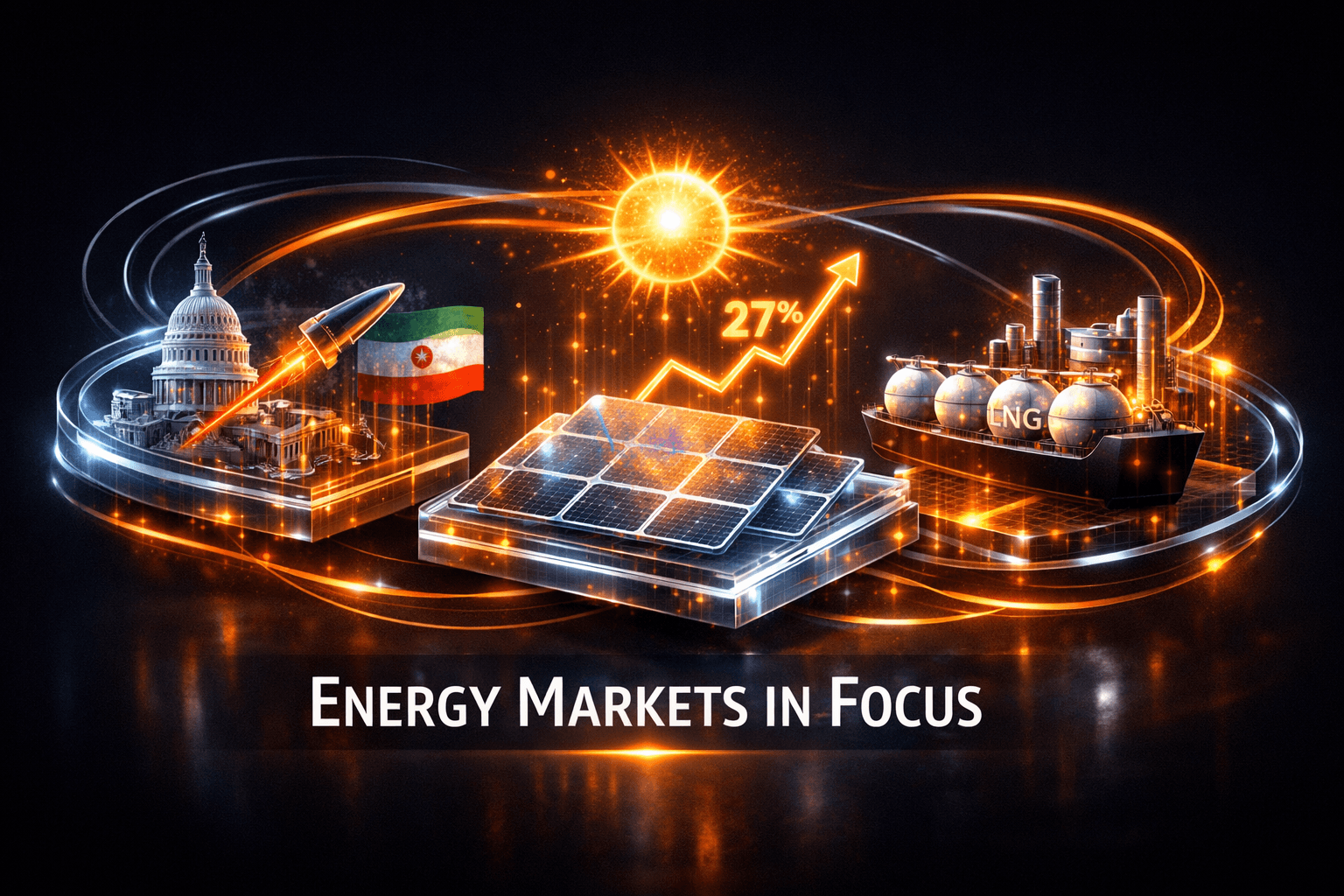
The Big Picture
Overnight energy headlines delivered a mixed bag for investors, with geopolitics and supply shocks pushing prices one way and technology and commercial deals pulling the other. You should note that U.S. markets were closed for Memorial Day, so price moves reported from Asian and European sessions reflect offshore trading rather than U.S. intraday action.
Brent slipped below the $100 per barrel mark in Asian trade after U.S. Secretary of State Marco Rubio downplayed an imminent U.S.-Iran deal, yet regional disruptions and local fuel hikes kept a risk premium in place. At the same time, advances in solar cell efficiency and new LNG offtake agreements show structural momentum in low-carbon and gas markets.
Market Highlights
Quick facts and numbers to scan before you dig into the details.
- Brent Crude fell under $100 per barrel in Asian trade on Monday, with losses contained at roughly 3-4% in European hours after weekend diplomacy headlines.
- India raised pump prices for the fourth time this month, taking diesel up about 8.6% and gasoline up 7.8% cumulatively since early May, driven by Strait of Hormuz disruptions.
- China coking coal prices jumped about 8% after a deadly mine blast, with the leading Dalian contract near $186.76 per ton.
- $ENI secured LNG offtake deals totalling about 2 million metric tons per year for Indonesian projects, adding commercial momentum for its LNG strategy.
- $LVWR is beginning to show pre-production prototypes of its small electric bikes, highlighting consumer EV product development in the mobility segment.
- Researchers at UNSW and DAS Solar reported tunnel back-contact cells exceeding 27% efficiency while cutting silver use by 3 to 4 mg per watt.
Key Developments
Geopolitics and Oil: U.S.-Iran Signals Create Volatility
Oil markets reacted to mixed diplomatic signals over a possible U.S.-Iran framework. Secretary of State Marco Rubio said the U.S. would "deal with Iran another way" if talks don't produce a good outcome, which pressured futures in Asian trade. You may see lingering volatility given those comments alongside ongoing supply concerns, such as the Strait of Hormuz disruptions that have already pushed fuel prices higher in Asia.
Thermal and Coal: China Mine Blast Tightens Near-Term Supply
A major mine gas explosion in Shanxi province prompted safety checks and an immediate 8% jump in the Dalian coking coal contract. That supply shock is likely to support prices for metallurgical coal in the near term, and you're likely to see further volatility as regulators assess production capacity and safety closures.
Gas and LNG: New Production and Commercial Commitments
Russia's Gazprom has started production at the Chona fields, expected to feed up to 2 million tons a year into the Eastern Siberia-Pacific Ocean pipeline system. Meanwhile $ENI clinched about 2 million metric tons a year in LNG offtake tied to Indonesian projects. Together these items point to incremental supply additions and commercial momentum in the gas-to-LNG chain, but geopolitical and shipping risks will remain relevant.
Power and Utilities: Dividends Return at Uniper
German utility $UN01.DE reported shareholders approved a EUR 0.72 per share dividend for 2025, the first payout since the government bailout in late 2022. That signals improving financial stability in parts of the European power sector, and it may shift investor focus back toward cash returns for utilities with normalized balance sheets.
Renewables and Tech: Higher Efficiency, Lower Silver Use
UNSW and DAS Solar's tunnel back-contact silicon cell achieved over 27% efficiency in mass-produced cells while reducing silver content by about 3 to 4 mg per watt. This technical step could lower module manufacturing cost and help competitiveness for silicon PV, although research also shows aerosols from coal plants reduced global solar output by roughly 5.8% in 2023, an environmental headwind for generation.
What to Watch
Looking ahead, several catalysts could move sector sentiment once U.S. trading resumes on Tuesday, May 26. Will the diplomatic rhetoric around Iran ease or escalate? That will be a key driver for oil volatility and risk premiums in crude and refined markets.
Also watch for company-level news and regional supply updates. For example, any confirmation of extended production curbs in China after the Shanxi accident could further lift coal-linked names. On the renewables side, commercial rollouts that adopt the new tunnel back-contact approach will be important to follow if you track module suppliers or equipment manufacturers.
Finally, keep an eye on LNG contract announcements and shipping news. New offtake deals like $ENI's can change the forward balance for regional gas markets, yet shipping bottlenecks or geopolitical limits could offset new supply.
Bottom Line
- Geopolitics remains the immediate market mover, with U.S.-Iran commentary and Strait of Hormuz disruptions keeping oil volatility elevated.
- Supply shocks in coal and new production from Gazprom add offsetting pressure across thermal and gas markets.
- Solar technology gains, including 27% tunnel back-contact cells, signal structural progress for PV cost and efficiency, even as pollution reduces realized output in some regions.
- Commercial wins, like $ENI's LNG offtake and Uniper's resumed dividend, show pockets of stability and monetization across the sector.
- With U.S. markets closed for Memorial Day, use the long weekend to review exposures and be ready for potentially choppy trade when U.S. markets reopen on Tuesday, May 26.
FAQ Section
Q: How should I interpret Brent falling below $100 as of Asian trade? A: That move reflects overnight reactions to diplomatic statements and offshore trading. It doesn't imply U.S. exchanges moved on Monday, because U.S. markets were closed for Memorial Day.
Q: Will the new 27% tunnel back-contact solar cells immediately lower module prices? A: Data suggests the approach cuts silver use and improves efficiency, but broad cost impact depends on adoption at scale and manufacturing changes, which take time.
Q: Are coal and LNG now safer bets after recent supply events? A: Recent price support from coal supply disruption and new LNG offtakes point to demand for those commodities, but geopolitical, safety and regulatory risks mean outcomes can change quickly.